The Real Estate Plot Twist Nobody Saw Coming
Let’s start with a truth bomb: India’s homes are getting hotter every year — and your AC bill is proof.
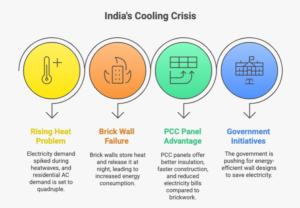
2024 was one of the hottest years ever recorded. Heatwaves pushed national electricity demand up by 9%, the highest summer spike in a decade. According to the International Energy Agency, every 1°C rise above 24°C triggers a 2% jump in electricity consumption, mostly because millions of us switch on (and never switch off) our ACs.
But here’s the twist nobody talks about:
That’s right. Indian homes have been built with the same heat-absorbing brick walls for nearly 40 years, even though summers are now hotter, cities are denser, and cooling demand is exploding.
Brick walls were great for your grandparents.
They’re not great for you.
Enter the building material that’s rewriting the rulebook:
PCC panels — and the rise of PCC panels sustainable developers India who are changing how modern India builds, lives, and saves energy.
Think of PCC panels as the “iPhone moment” for home construction:
And the most important part?
They finally align with India’s new energy codes and sustainability laws.
The Government of India literally issued an energy code (Eco-Niwas Samhita 2018) telling developers:
“Hey, stop cooking people inside their homes. Fix your walls.”
The Bureau of Energy Efficiency also warns that India’s buildings already consume 30% of national electricity, and this number will explode if our homes keep overheating.
So the question is no longer: “Should we upgrade our construction systems?”
The real question is:
“Why didn’t we do this earlier?”
Today’s blog explains why PCC panels sustainable developers India are winning 2025 — and why your next home should absolutely NOT be built with old-school, heat-trapping brick walls.
Let’s break the matrix.
We love blaming weather.
But India’s cooling crisis isn’t just about rising temperatures — it’s about bad construction choices.
FACT 1: India’s residential buildings LOSE the cooling battle before the AC even turns on.
The building envelope (walls + roof + windows) determines indoor comfort.
And according to Eco-Niwas Samhita (ENS), walls are the No. 1 source of heat gain in Indian homes.
Brick walls absorb heat all day, store it like a thermal battery, and release it inside at night when you’re trying to sleep.
That’s why:
FACT 2: India’s AC explosion is a time bomb.
IEA says cooling appliances in India will quadruple by 2037 if we don’t redesign our buildings.
More ACs = more emissions = more heatwaves = more ACs
It’s a vicious loop.
But here’s the twist:
Your AC bill is not rising because you’re using more AC.
Your AC is rising because your walls are outdated.**
FACT 3: 90% of India’s homes were not designed for today’s climate.
Why?
Because we still use the same brickwork logic from a time when:
But 2025 India is a different beast:
Brick walls simply can’t cope with this new climate.
Which is why PCC panels sustainable developers India are stepping in with a building system engineered for extreme heat, high insulation, and energy efficiency.
In 2018, the Government of India made a historic announcement that barely made the news:
Eco-Niwas Samhita (ENS) — India’s first-ever energy code for homes.
This code tells developers:
“Your building envelope MUST limit heat gain.
Your walls MUST reduce cooling demand.
Your homes MUST be energy efficient.”
ENS was not a suggestion.
It was a wake-up call.
According to the ENS impact assessment:
India can save 125 billion units of electricity by 2030
JUST by improving walls and roofs.
The Bureau of Energy Efficiency (BEE) further highlights:
So let’s decode why PCC panels fit perfectly into India’s new policy environment.
WHY PCC PANELS WIN THE POLICY GAME:
✔ High insulation → ENS compliant
✔ Reduced heat gain → BEE objectives achieved
✔ Lower energy use → Green certification points (IGBC, GRIHA)
✔ Factory precision → Reduced construction waste
✔ Faster builds → Perfect for PMAY, smart cities & private projects
This is exactly why PCC panels sustainable developers India are becoming the preferred partners for government-aligned, regulation-ready green housing.
Let’s go inside the material that’s disrupting Indian construction.
What exactly are PCC panels?
PCC = Precast Concrete Composite or Precast Cement Concrete
These are factory-made wall panels designed like a sandwich:
Concrete skin + insulated core + concrete skin
This “sandwich” is the real MVP.
BENEFIT 1: Thermal insulation up to 30% better than brick.
How?
Because:
Your home stays cooler longer.
Your AC works less.
Your bills shrink.
BENEFIT 2: Sound insulation — you finally get peace.
Brick walls = hollow noise tunnels
PCC panels = dense, layered silence barriers
Perfect for:
BENEFIT 3: Thinner walls = more space.
PCC walls can be 40–50% thinner than brick while being stronger.
Meaning:
BENEFIT 4: Earthquake-resistant precision.
Factory production = perfect alignment + consistent strength
No on-site mixing errors
No inconsistent curing
BENEFIT 5: Perfect for green certification.
Which is exactly why PCC panels sustainable developers India are rapidly becoming the backbone of India’s green-home revolution.
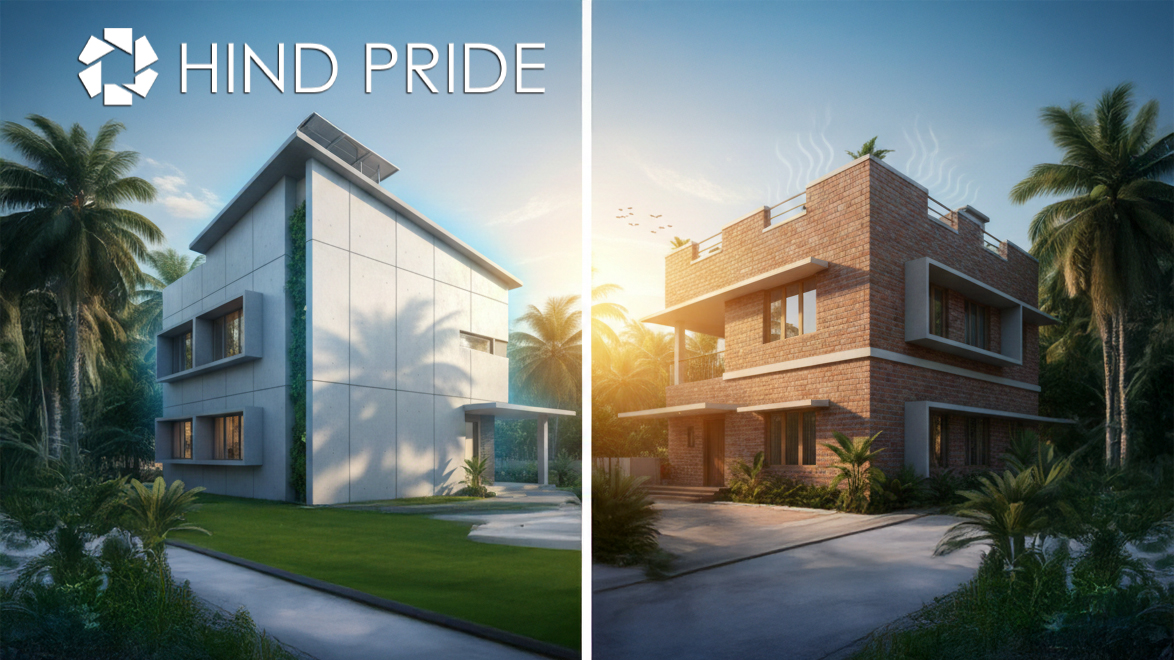
Let’s compare brickwork and PCC panels like a UFC fight card.
ROUND 1: THERMAL INSULATION
Brickwork:
PCC Panels:
✔ Winner: PCC Panels
ROUND 2: ENERGY SAVINGS
Studies show PCC panel homes reduce energy use by:
20–30% annually
Why?
Because your AC runs less, cools faster, and shuts off sooner.
✔ Winner: PCC Panels
ROUND 3: EMBODIED CARBON
Brick:
PCC panels:
✔ Winner: PCC Panels
ROUND 4: SPEED OF CONSTRUCTION
Brick walls = slow, labor-heavy, weather-dependent.
PCC = plug-and-play.
PCC cuts wall construction time by 40–50%.
Even Govt of India mandates precast components in highway projects > ₹300 crore to boost speed & quality.
✔ Winner: PCC Panels
ROUND 5: LIFESPAN
Brickwork = cracks, seepage, long-term maintenance
PCC = uniform, dense, durable, moisture-resistant
✔ Winner: PCC Panels
ROUND 6: COST OVER LIFECYCLE
Brick appears cheaper initially.
But maintenance + energy + repairs → costs explode later.
PCC reduces:
Long-term savings = massive.
✔ Winner: PCC Panels
Here’s what nobody told you:
Green-certified homes get cheaper loans.
Banks reward:
Lower electricity bills = higher creditworthiness
Developers using PCC panels can show:
Buyers get:
And this is exactly why PCC panels sustainable developers India are attracting NRIs, premium buyers, and smart investors.
The shift is MASSIVE.
PCC panels reduce:
Perfect for fast-paced urban development.
Trend 2: Sustainable luxury buyers WANT energy-efficient envelopes
Especially:
Buyers aged 28–50 now ask:
“How cool does the house stay without AC?”
And PCC panel developers can answer confidently.
Trend 3: Environmental regulations are tightening
From ENS to IGBC, India is moving toward:
Trend 4: Developers want faster ROI
PCC = 40–50% faster wall completion = faster project delivery = better cash flow.
Which is why PCC panels sustainable developers India are becoming the most future-ready category of builders in the ecosystem.
At Hindpride, the philosophy is simple:
“A home must protect you — not punish you.”
Over the last decade, traditional construction has FAILED Indian homeowners:
So Hindpride redefined its building strategy around:
✔ ENS-compliant envelopes
✔ High thermal comfort
✔ Reduced heat gain
✔ Optimised wall performance
✔ Lower lifetime cost
✔ Faster, cleaner construction
Which means:
Hindpride builds projects the way 2025 demands — not the way 1980 did.
This is why we proudly stand among the leading PCC panels sustainable developers India, delivering homes that are engineered, not improvised.
Smarter Walls = Smarter Living.
India’s climate is changing fast.
But your home doesn’t have to suffer.
Brick walls belonged to a different era.
PCC panels belong to the future.
They offer:
As India enters a new era of heatwaves, energy demand, and climate-conscious buying, the smartest investment you can make is simple:
And if you want a home where:
✔ Summers feel lighter
✔ Nights feel cooler
✔ Energy bills feel smaller
✔ Every room feels future-ready
Then the next step is easy
Q 1. What are PCC panels and why are they becoming popular in India?
PCC (Precast Concrete Composite) panels are factory-made wall systems designed as a “sandwich”—two concrete layers enclosing an insulated core. This structure dramatically improves thermal comfort, reduces heat gain, and speeds up construction timelines. India’s climate is getting hotter, and traditional brickwork simply cannot meet modern thermal performance requirements.
The popularity of PCC panels surged after the Government of India introduced Eco-Niwas Samhita (ENS 2018), which mandates that residential buildings must limit heat gain and reduce cooling loads. PCC panel systems naturally meet these energy-efficiency goals because they reduce air leakage, lower heat transfer, and offer better insulation compared to masonry.
As a result, PCC panels sustainable developers India are using this technology to build smarter, greener, and more efficient homes that are aligned with national energy codes.
Q 2. How do PCC panels help reduce electricity bills in Indian homes?
Electricity bills in India spike mainly due to cooling demand. Studies from the International Energy Agency (IEA) show that every 1°C rise above 24°C increases national electricity consumption by 2%, largely from air-conditioning loads.
PCC panels significantly reduce indoor heat gain because their insulated core prevents external heat from entering the home. Unlike brick walls, which store and radiate heat into bedrooms at night, PCC panels stabilize indoor temperatures throughout the day.
This directly reduces the need for AC usage. Homes built by PCC panels sustainable developers India have been shown to reduce energy consumption by 20–30%, delivering lower monthly AC bills and more comfortable indoor living.
Q 3. Are PCC panels compliant with India’s building energy codes?
Absolutely. PCC panels are one of the easiest ways to comply with Eco-Niwas Samhita (ENS) 2018, India’s official energy code for residential buildings. ENS emphasizes designing building envelopes—especially walls and roofs—that minimize heat gain and optimize natural ventilation.
Since PCC panels provide inherent insulation and airtightness, they match ENS requirements more efficiently than brick or block construction. Their performance aligns with the Bureau of Energy Efficiency (BEE) national targets that aim to reduce electricity consumption through improved building design.
This compliance makes PCC panels sustainable developers India especially attractive to buyers who want energy-efficient homes that comply with government-mandated climate improvements.
Q 4. Are PCC panels environmentally friendly?
Yes — PCC panels are far more sustainable than traditional brick construction. Bricks require energy-intensive kiln firing and contribute to soil degradation. PCC panels, on the other hand, are factory-cast with optimized material use, which reduces waste and embodied carbon.
Global LCA (Life Cycle Assessment) studies show that precast concrete systems often produce significantly lower emissions due to controlled manufacturing and efficient material distribution.
Additionally, PCC panels support green-building frameworks like IGBC and GRIHA, which award points for materials with low thermal transmittance, reduced waste, and improved energy performance.
This sustainability advantage is a major reason buyers increasingly prefer projects built by PCC panels sustainable developers India, especially those seeking long-term eco-friendly homes.
Q 5. Are PCC panel homes stronger and more durable than brick homes?
PCC panels are engineered under factory-controlled conditions, which ensures uniform strength, precise curing, and consistent density. Unlike brick walls that vary in quality based on local material and labor, PCC systems offer predictable, high-performance durability.
These panels are:
Because of their controlled manufacturing environment, PCC systems eliminate many of the site issues that cause seepage and cracks in brick structures.
This is why PCC panels sustainable developers India use this technology to ensure lower maintenance costs and longer-lasting structural performance.
Q 6. Do PCC panels help builders complete projects faster?
Yes — PCC panels can cut wall construction time by 40–50% compared to brickwork. Since walls are pre-manufactured in factories, installation becomes a plug-and-play process, unaffected by weather, labor fluctuations, or curing delays.
In fact, the Ministry of Road Transport & Highways (MoRTH) has mandated the use of precast components for large infrastructure projects due to their speed, quality, and efficiency advantages.
This speed advantage directly benefits homebuyers because it reduces project delays, improves possession timelines, and enhances developer cash flow. Many modern developers now position themselves as PCC panels sustainable developers India to accelerate delivery and meet customer expectations for timely handover.
Q 7. Are PCC panels suitable for luxury homes and farmhouses?
PCC panels are ideal for luxury villas, farmhouses, premium second homes, and wellness estates. Their superior thermal insulation ensures cool daytime temperatures and pleasant indoor conditions, which is essential for regions with high heat exposure.
They also offer excellent acoustic performance — perfect for quiet retreats, wellness homes, or senior-living communities.
Luxury developers choose PCC because:
This aligns perfectly with the design expectations of premium buyers, making PCC panels sustainable developers India the preferred choice in elite residential segments.
Q 8. How do PCC panels affect resale value?
Homes built with PCC panels tend to have higher resale value for several reasons:
As India rapidly transitions toward green building norms and ENS compliance becomes more mainstream, buyers increasingly prefer homes built by PCC panels sustainable developers India, boosting resale potential.
Q 9. Can PCC panels help homeowners earn green-building incentives?
Yes. PCC panels make it easier to earn:
These incentives reduce financing costs and increase long-term property value. This is why buyers increasingly look for PCC panels sustainable developers India who build ENS-ready and IGBC-compatible homes.
Q 10. Are PCC panels cost-effective for homebuyers in the long run?
Absolutely. While PCC panel construction may have a slightly higher initial cost in some regions, the lifecycle savings are significantly higher compared to brick-built homes.
Savings include:
When you factor in energy efficiency, reduced upkeep, and green loan incentives, PCC homes end up far more economical over 10–20 years.
This long-term value is a key reason why smart investment-focused buyers prefer homes built by PCC panels sustainable developers India.
You’ve just seen the numbers, the science, the government policies, and the real-life benefits. The truth is clear: India is entering a new era of heatwaves, energy demand, sustainability rules, and smarter construction technology.
And in this future, homes built with PCC panels aren’t just an upgrade — they’re the new standard.
Imagine stepping into a home where:
This is the difference PCC panels sustainable developers India are bringing to the next generation of smart homebuyers — homes that are engineered for comfort, built for efficiency, and designed for India’s changing climate.
Now imagine owning one.
Whether you’re building your dream farmhouse, upgrading to a premium villa, or investing in a long-term future asset — the smartest decision you can make today is to choose a home built with PCC panel technology.
Because this isn’t just a construction upgrade.
It’s a life upgrade.
It’s cooler summers.
It’s smaller bills.
It’s cleaner comfort.
It’s smarter value.
It’s your home evolving — finally — into what it should have always been.
Step into a Hindpride home and feel the PCC difference.
Let our team walk you through:
See firsthand why Hindpride is one of the leading PCC panels sustainable developers India, building homes that are faster, cooler, greener, and future-ready.
Your dream home should not wait.
Your comfort should not wait.
And your energy savings should definitely not wait.
📞 Contact Hindpride Now — and experience the future of smart, sustainable, climate-ready living.