For decades, India’s construction story has been written in concrete, steel, and scale. Skylines rose. Infrastructure expanded. Towns turned into cities and cities into megacities. But beneath this visible progress lay a quieter, ignored by-product—construction and demolition waste.
Broken bricks dumped on city outskirts. Excavated soil filling wetlands. Crushed concrete lining riverbanks. Debris quietly pushed into landfills that were never designed to handle such volumes.
For years, construction waste remained out of sight, out of regulation, and out of responsibility.
That era ends in 2026.
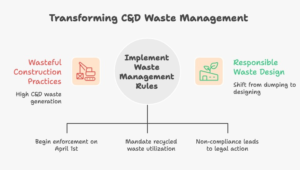
From 1 April 2026, the construction and demolition waste management rules 2026 come into force, marking one of the most significant regulatory shifts the Indian construction industry has seen in decades. These rules do not merely suggest better practices. They mandate accountability, enforce measurable recycling targets, and integrate construction into India’s broader circular economy framework.
This is not just a compliance update.
It is a fundamental change in how construction projects are planned, approved, executed, and evaluated.
This article explains—fact by fact, clause by clause—what the construction and demolition waste management rules 2026 actually mean, why they were introduced, who must comply, and how they will reshape sustainable construction, eco-friendly PCC, and material planning across India.
The construction and demolition waste management rules 2026 stem from the Environment (Construction and Demolition) Waste Management Rules, 2025, notified by the Ministry of Environment, Forest and Climate Change (MoEF&CC).
While India introduced C&D waste rules earlier in 2016, enforcement remained fragmented. Many cities lacked processing facilities. Monitoring mechanisms were weak. Compliance was often treated as a paperwork exercise.
The 2025 notification changes that completely.
Effective date
The construction and demolition waste management rules 2026 become legally enforceable from 1 April 2026 across India.
This gives builders, developers, and contractors a limited transition window to prepare systems, partnerships, and site-level processes.
Under the construction and demolition waste management rules 2026, C&D waste includes waste generated from:
Typical C&D waste materials:
The rules make one thing clear: construction waste is no longer “inert” or harmless. It is a regulated waste stream with environmental consequences.
According to studies by CPCB and MoHUA, construction and demolition waste accounts for nearly 25–30% of India’s total solid waste generation in urban areas.
Unlike municipal waste, C&D waste:
The construction and demolition waste management rules 2026 were introduced because India can no longer afford linear construction practices—extract, build, dump—in a resource-constrained future.
This is where the construction and demolition waste management rules 2026 fundamentally transform the industry.
1. Mandatory Construction and Demolition Waste Management Plans
Projects falling under defined thresholds must prepare a C&D Waste Management Plan at the planning stage.
This plan must detail:
Without this plan, projects may face:
2. Introduction of Extended Producer Responsibility (EPR)
One of the most significant changes under the construction and demolition waste management rules 2026 is the introduction of Extended Producer Responsibility (EPR) in construction.
EPR means:
This aligns construction with regulated sectors like plastic waste and e-waste.
3. Mandatory Utilisation Targets for Processed C&D Waste
For the first time, the construction and demolition waste management rules 2026 introduce mandatory utilisation targets.
Year | Minimum Use of Processed C&D Waste |
2026–27 | 5% |
2027–28 | 10% |
2028–29 | 15% |
2029–30 | 20% |
2030–31 onwards | 25% |
This processed waste can be used in:
The construction and demolition waste management rules 2026 apply to:
Even smaller projects must follow basic segregation and authorised disposal norms.
There are no blanket exemptions.
The construction and demolition waste management rules 2026 are designed around circular construction, where waste is reintegrated into the material lifecycle.
Typical waste flow:
India already has operational C&D waste recycling plants in:
One of the biggest material impacts of the construction and demolition waste management rules 2026 is on Plain Cement Concrete (PCC).
Key implications:
Research by IITs and CPCB shows that processed recycled aggregates, when used within limits, are suitable for:
Eco-friendly PCC is no longer optional—it becomes a compliance-aligned strategy.
The construction and demolition waste management rules 2026 also support India’s climate commitments by:
This aligns with:
Builders preparing early for the construction and demolition waste management rules 2026 are already:
Early adoption leads to:
Non-compliance with the construction and demolition waste management rules 2026 can lead to:
Enforcement authorities:
The construction and demolition waste management rules 2026 are not the end goal. They are the foundation.
Future regulations may include:
Construction will no longer be judged only by what is built, but by how responsibly it is built.
1. What are the construction and demolition waste management rules 2026?
The construction and demolition waste management rules 2026 are India’s updated regulatory framework governing how construction and demolition waste must be handled, processed, reused, or disposed of. These rules are notified by the Ministry of Environment, Forest and Climate Change (MoEF&CC) and become mandatory from 1 April 2026.
They replace the earlier 2016 framework with stricter compliance, clear utilisation targets for recycled waste, and accountability mechanisms such as Extended Producer Responsibility (EPR). The rules apply to residential, commercial, and infrastructure projects and aim to reduce landfill dependency while promoting circular construction practices.
2. When do the construction and demolition waste management rules 2026 come into effect?
The construction and demolition waste management rules 2026 officially come into force on 1 April 2026 across India. From this date, compliance is no longer optional, and projects that fall under the defined thresholds must adhere to the rules.
This includes preparing waste management plans, ensuring segregation at site, using authorised recycling facilities, and meeting mandatory utilisation targets for processed construction waste. Projects approved or executed after this date may face penalties, approval delays, or legal consequences if they fail to comply.
Builders are encouraged to begin preparation well before April 2026 to avoid disruption.
3. Who must comply with the construction and demolition waste management rules 2026?
The construction and demolition waste management rules 2026 apply to a wide range of stakeholders, including:
Even smaller construction or renovation projects are expected to follow basic waste segregation and authorised disposal practices. There are no blanket exemptions, and responsibility lies primarily with the waste generator.
Enforcement is carried out by State Pollution Control Boards and Urban Local Bodies.
4. What is a Construction and Demolition Waste Management Plan?
A Construction and Demolition Waste Management Plan is a mandatory document under the construction and demolition waste management rules 2026. It outlines how waste generated at a construction or demolition site will be handled responsibly.
The plan typically includes:
This plan must be submitted during project approvals and may be reviewed during inspections. Without it, projects may face approval delays or penalties.
5. What are the recycled waste utilisation targets under the 2026 rules?
One of the most important provisions of the construction and demolition waste management rules 2026 is the introduction of mandatory utilisation targets for processed C&D waste.
The minimum usage requirements are:
Processed C&D waste can be used in applications such as PCC, road sub-base layers, kerbstones, and paving blocks. These targets aim to reduce dependence on virgin materials and promote circular construction.
6. How does Extended Producer Responsibility (EPR) apply to construction waste?
The construction and demolition waste management rules 2026 introduce Extended Producer Responsibility (EPR) to the construction sector. Under EPR, builders and developers remain responsible for the waste they generate—even after it leaves the construction site.
This means:
EPR ensures that waste management is not shifted entirely to municipalities and that generators actively participate in recycling and reuse.
7. Can recycled construction waste be used in PCC and concrete?
Yes. Under the construction and demolition waste management rules 2026, processed and quality-tested recycled aggregates can be used in Plain Cement Concrete (PCC) and other non-structural concrete applications.
Studies by CPCB, IITs, and BIS confirm that recycled aggregates—when processed correctly—are suitable for:
However, usage must comply with applicable BIS standards and quality guidelines.
8. What are the penalties for non-compliance with the 2026 rules?
Failure to comply with the construction and demolition waste management rules 2026 can result in:
State Pollution Control Boards and Urban Local Bodies are authorised to enforce penalties and conduct inspections.
9. How do the construction and demolition waste management rules 2026 support sustainability?
The construction and demolition waste management rules 2026 are designed to support India’s sustainability and climate goals by:
These rules align with national policies such as India’s Circular Economy Strategy and climate commitments.
10. How should builders prepare for the construction and demolition waste management rules 2026?
Builders should start preparing for the construction and demolition waste management rules 2026 well before April 2026 by:
Early preparation reduces compliance risks, avoids delays, and positions builders as responsible and future-ready.
2026 marks a turning point for Indian construction.
The construction and demolition waste management rules 2026 ask the industry to pause and reflect:
Compliance is mandatory.
Conscious construction is a choice.
Builders who embrace this shift early will define the next decade—stronger, cleaner, and future-ready.
The construction and demolition waste management rules 2026 are not just another regulatory hurdle. They are a clear signal of where Indian construction is headed.
A future where:
For builders and project owners, the question is no longer whether to comply—but how responsibly and intelligently it is done.
At Hindpride, we believe construction must move beyond checklists and penalties. We work with a future-first approach—integrating C&D waste planning, eco-friendly PCC, recycled material strategies, and low-impact construction practices directly into project design and execution.
Whether you are:
the right time to act is now.
Talk to our sustainability-led construction team to:
Build responsibly. Build transparently. Build for tomorrow.
👉 Start a conversation with Hindpride today.