In 2026, the way families evaluate homes in NCR is evolving. Location still matters. Connectivity still matters. Design still matters. But increasingly, buyers are asking a deeper question:
How does this home perform in peak summer?
This shift is one of the main reasons searches for eco-friendly construction builders in Noida have steadily increased. The modern buyer is not looking for trends. They are looking for comfort, lower operating costs, healthier interiors, and long-term resilience.
Noida continues to grow as a strong residential and infrastructure-driven region. With this growth comes greater awareness. Buyers are comparing not just floor plans, but thermal performance, ventilation logic, material quality, and energy efficiency.
An eco-friendly construction builder in Noida is therefore being evaluated not on marketing language, but on measurable building science principles.
This article explores why 2026 buyers prefer homes that are 20–30% more energy-efficient, what that percentage really means, which national standards support this shift, and how to evaluate construction quality intelligently.
Rising Cooling Demand Is a Practical Reality
Delhi-NCR has seen increasing heat intensity and longer high-temperature periods. Research has connected rising summer heat and humidity with increased cooling demand and electricity consumption (Centre for Science and Environment – CSE).
Globally, buildings already account for a significant share of electricity use, and cooling demand is projected to grow further without efficiency improvements (International Energy Agency – IEA).
For homeowners, this translates into a simple experience:
An eco-friendly construction builder in Noida responds to this climate context by designing homes that reduce heat gain before cooling systems are even switched on.
What “30% More Energy-Efficient” Actually Means
The 20–30% efficiency improvement often referenced in green building conversations is not a marketing exaggeration. Green building frameworks in India indicate that well-designed green buildings can achieve approximately 20–30% energy savings compared to conventional baselines.
However, this improvement does not come from a single product. It comes from a system:
A credible eco-friendly construction builder in Noida integrates these elements cohesively rather than adding isolated features.
India’s residential energy conservation code, Eco Niwas Samhita (ENS), developed under the Bureau of Energy Efficiency (BEE), focuses specifically on reducing heat gain and improving building envelope performance.
ENS emphasizes:
This is important because in hot climates, envelope performance determines how much energy is needed for cooling.
An eco-friendly construction builder in Noida who aligns with ENS principles demonstrates awareness of national efficiency frameworks and climate-responsive construction.
For broader building energy standards, ECBC 2017 also reflects India’s push toward energy performance regulation.
These codes do not criticize traditional construction—they simply provide measurable benchmarks to improve performance.
In NCR’s climate, roofs receive direct solar radiation for extended periods. Heat absorbed at the roof level significantly affects indoor temperature.
Cool roof strategies are recognized for reducing heat absorption and lowering indoor temperature gains (Natural Resources Defense Council – NRDC).
An eco-friendly construction builder in Noida may incorporate:
These measures reduce AC dependence and improve indoor comfort.
Material selection plays a major role in thermal stability.
AAC Blocks
Autoclaved Aerated Concrete (AAC) blocks are covered under BIS documentation (IS 2185 Part 3), ensuring product standardization.
AAC blocks can offer:
Fly Ash Bricks
India has emphasized increased fly ash utilization for sustainable purposes.
CPWD circulars have also reinforced fly ash brick usage in appropriate contexts.
An eco-friendly construction builder in Noida, selecting standardized materials contributes to both thermal performance and responsible resource use.
This approach does not criticize conventional materials; it enhances performance where possible.
Glass can be both beneficial and problematic. While it enhances daylight and aesthetics, excessive or poorly oriented glazing can increase heat gain.
An eco-friendly construction builder in Noida evaluates:
This reduces overheating while preserving daylight quality.
Cross ventilation improves comfort and can reduce dependence on mechanical cooling in moderate weather conditions.
A well-planned, eco-friendly construction builder in Noida incorporates:
Passive cooling is not a substitute for AC in peak summer—it is a complementary efficiency strategy.
Eco-friendly construction is not only about energy—it is also about health.
The World Health Organization provides indoor air quality guidelines covering pollutants that can affect health.
The U.S. Environmental Protection Agency (EPA) explains that VOC concentrations can be higher indoors and may originate from paints, adhesives, and finishes.
An eco-friendly construction builder in Noida often prioritizes:
This approach supports occupant well-being without compromising aesthetics.
Energy-efficient lighting systems, especially LED integration and smart electrical layouts, reduce baseline electricity consumption.
An eco-friendly construction builder in Noida may plan:
While individually small, these improvements accumulate over years.
Even if rooftop solar is not installed immediately, future readiness increases property value and long-term flexibility.
UPERC has published consultation papers regarding net metering frameworks in Uttar Pradesh.
UPNEDA serves as the official renewable energy portal in the state.
An eco-friendly construction builder in Noida that understands these frameworks can design homes ready for future renewable integration.
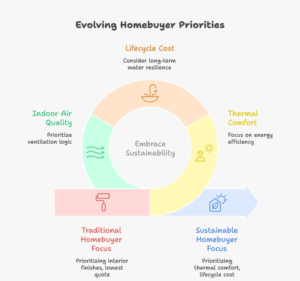
The appeal of an eco-friendly construction builder in Noida often lies in lifecycle economics.
Operational costs include:
If envelope efficiency reduces cooling load by even 20–30%, the cumulative savings across 10–20 years can be meaningful.
This is not a critique of conventional construction—it is an enhancement based on climate and efficiency data.
“Eco-friendly means expensive.”
Upfront cost differences depend on design choices. However, lifecycle cost comparisons often show operational savings over time when cooling load is reduced (IGBC reference above).
“Eco-friendly is only about solar panels.”
Solar is one element. Envelope performance, insulation, and ventilation are foundational.
“Sustainable materials compromise durability.”
Materials such as AAC blocks follow BIS documentation. Fly ash utilization is supported by national policy directions. Performance depends on execution quality.
“Ventilation is not useful in NCR.”
While peak summer requires mechanical cooling, ventilation improves comfort in transitional seasons and nights.
An eco-friendly construction builder in Noida integrates these strategies without compromising structural integrity or compliance.
When reviewing options, consider asking:
A transparent, eco-friendly construction builder in Noida will provide clear technical reasoning.
Noida remains one of NCR’s most dynamic urban centers. Infrastructure growth, policy clarity, and residential expansion continue to strengthen its appeal.
The rise of the eco-friendly construction builder in Noida reflects maturity in buyer awareness, not dissatisfaction with the region. It signals:
This progression supports sustainable urban growth.
1) What does an eco-friendly construction builder in Noida actually do differently?
An eco-friendly construction builder in Noida focuses on reducing a building’s environmental impact while improving indoor comfort and long-term efficiency. This typically includes optimizing the building envelope (roof, walls, and windows) to reduce heat gain, improving ventilation planning, selecting standardized and durable materials, and incorporating energy-efficient systems.
Instead of relying only on air conditioning to maintain comfort, such builders emphasize passive design principles supported by national frameworks like Eco Niwas Samhita (ENS) developed by the Bureau of Energy Efficiency (BEE).
Green building frameworks in India also indicate that well-designed green buildings can achieve meaningful energy savings compared to conventional construction (IGBC).
2) How can energy-efficient homes reduce electricity bills in Noida’s climate?
In hot climates like NCR, cooling demand significantly affects electricity bills. Research from the Centre for Science and Environment (CSE) has linked rising summer heat and humidity with increased cooling demand and electricity consumption in Delhi-NCR.
Globally, the International Energy Agency (IEA) reports that space cooling already accounts for a substantial share of building electricity demand and is expected to grow.
An eco-friendly construction builder in Noida reduces electricity usage by lowering heat gain through roof insulation, wall systems, and shading strategies—thereby decreasing AC runtime and peak load consumption.
3) What is Eco Niwas Samhita (ENS) and why should homeowners care?
Eco Niwas Samhita (ENS) is India’s residential energy conservation code developed under the Bureau of Energy Efficiency. It focuses on reducing heat gain through improved building envelope performance, including roof, wall, and window design.
For homeowners, ENS provides a reference framework to evaluate how well a home is designed for thermal comfort. An eco-friendly construction builder in Noida familiar with ENS principles is more likely to incorporate climate-responsive construction strategies rather than relying solely on mechanical cooling.
4) Are AAC blocks suitable for residential construction in Noida?
Autoclaved Aerated Concrete (AAC) blocks are widely used in modern construction and are covered under BIS documentation (IS 2185 Part 3), ensuring standardized product quality.
AAC blocks offer benefits such as lighter weight and improved thermal insulation compared to conventional bricks when properly installed. An eco-friendly construction builder in Noida may choose AAC blocks to enhance thermal performance and reduce structural load, provided detailing and execution are done correctly.
5) Why are fly ash bricks considered sustainable?
Fly ash utilization is supported at the national policy level in India. The Ministry of Environment, Forest, and Climate Change has emphasized greater ash utilization in construction (PIB).
Additionally, CPWD circulars have reinforced the use of fly ash bricks in appropriate contexts.
An eco-friendly construction builder in Noida may use fly ash bricks as part of resource-efficient construction while ensuring compliance with structural and durability standards.
6) What are cool roofs, and how do they help in NCR?
Cool roofs are designed to reflect more sunlight and absorb less heat compared to conventional roofs. This can reduce indoor temperature gain and lower cooling demand. The Natural Resources Defense Council (NRDC) explains how cool roofs contribute to energy efficiency and urban heat mitigation.
In a climate like Noida’s, an eco-friendly construction builder in Noida may incorporate reflective coatings or insulation strategies to improve roof performance and indoor comfort.
7) Do low-VOC paints and finishes really make a difference?
Volatile Organic Compounds (VOCs) can originate from paints, adhesives, and finishes, and indoor concentrations may sometimes be higher than outdoor levels. The U.S. Environmental Protection Agency (EPA) provides an overview of VOC impacts on indoor air quality.
The World Health Organization (WHO) has also published indoor air quality guidelines covering pollutants that affect health.
An eco-friendly construction builder in Noida often prioritizes low-VOC materials to support healthier indoor environments, particularly for families with children or elderly members.
8) Is rooftop solar practical in Uttar Pradesh?
Rooftop solar adoption in Uttar Pradesh is supported by regulatory discussions and net metering frameworks. The Uttar Pradesh Electricity Regulatory Commission (UPERC) has published consultation documents regarding net metering.
UPNEDA serves as the official renewable energy development agency in the state.
An eco-friendly construction builder in Noida may design solar-ready homes, allowing homeowners to integrate rooftop solar systems in the future if desired.
9) Does green construction improve resale value?
Energy-efficient homes often appeal to buyers seeking lower operational costs and improved comfort. The Indian Green Building Council (IGBC) highlights potential energy savings in green buildings.
As cooling demand rises globally (IEA).
Homes designed by an eco-friendly construction builder in Noida may offer stronger long-term appeal due to their efficiency and climate responsiveness.
10) How can buyers verify if a builder is genuinely eco-friendly?
To evaluate an eco-friendly construction builder in Noida, buyers can:
Verification through documentation, standards alignment, and technical explanations is more reliable than marketing claims. Trusted references such as BEE can provide useful context when assessing claims.
Building responsibly in 2026 is no longer a theoretical discussion about sustainability—it is a practical approach to long-term livability. In growing urban regions like Noida, responsible construction means designing homes that perform efficiently under real climate conditions, support occupant health, and remain structurally durable for decades.
As temperatures rise and cooling demand increases, the performance of a building’s envelope—its roof, walls, windows, and ventilation systems—directly affects comfort and electricity consumption. Research from the International Energy Agency highlights how cooling demand in buildings continues to grow globally, making efficiency a structural necessity rather than an optional feature. In this context, choosing an eco-friendly construction builder in Noida is increasingly about performance, not perception.
Responsible construction begins with climate-responsive design. This includes reflective roofing strategies, thermally stable wall systems, optimized window placement, and passive airflow planning. Frameworks like Eco Niwas Samhita (ENS), developed under the Bureau of Energy Efficiency, emphasize the importance of reducing heat gain in residential buildings. These guidelines reinforce that energy efficiency is not achieved through one feature—it is achieved through integrated planning.
Beyond energy use, responsible construction also addresses indoor environmental quality. The World Health Organization has documented the health impact of indoor pollutants, underscoring the importance of material selection. Similarly, the U.S. Environmental Protection Agency explains how volatile organic compounds (VOCs) from certain paints and finishes can affect indoor air quality. An eco-friendly construction builder in Noida who prioritizes low-VOC finishes and ventilation planning contributes to healthier living environments without compromising structural quality or aesthetics.
Responsible building also considers resource efficiency. National policies encouraging fly ash utilization and standardized construction materials under BIS documentation demonstrate India’s broader commitment to improving construction practices. When builders align with these directions, they are participating in a larger movement toward sustainable urban development.
Importantly, building responsibly does not mean rejecting traditional methods or criticizing existing development. It means improving what already works by incorporating measurable efficiency strategies. Noida’s infrastructure growth and residential expansion provide an opportunity to integrate better-performing construction into a rapidly developing urban landscape.
From a financial perspective, responsible construction also protects long-term value. Homes designed to reduce cooling load, manage heat gain effectively, and maintain indoor air quality may experience lower operational stress over time. As buyer awareness grows, performance-driven homes are likely to remain relevant and competitive in the resale market.
Choosing an eco-friendly construction builder in Noida is therefore not just an environmental choice—it is a strategic one. It reflects a forward-looking mindset that values durability, comfort, regulatory awareness, and lifecycle efficiency.
As urban centers continue to evolve, responsible construction becomes a shared responsibility between developers, policymakers, and homeowners. When homes are designed with performance, health, and efficiency in mind, they contribute not only to individual well-being but also to broader urban sustainability.
Ultimately, building responsibly for the future means constructing homes that are prepared for tomorrow’s climate realities, aligned with national efficiency frameworks, and designed to support comfortable living for generations.