If you’ve ever searched for an eco-friendly construction company in Delhi NCR, you’ve probably seen the same promises repeated everywhere: “green homes,” “sustainable materials,” “energy-efficient design,” “earth-friendly practices.” The words look right. The intent sounds right. But when you ask for proof—actual standards, measurable performance, documented design choices—many claims collapse into aesthetics: a few plants, a rooftop solar panel, and marketing copy that feels greener than the building itself.
In Delhi NCR, sustainability isn’t a luxury label anymore. It’s a survival-grade decision. Heat waves are harsher, electricity loads climb every summer, water stress is real, and air quality concerns make indoor living a health issue—not a lifestyle preference. That’s why choosing an eco-friendly construction company in Delhi NCR must be based on evidence, not brochures.
This guide breaks down 7 proof-based factors that help you identify whether an eco-friendly construction company in Delhi NCR is truly sustainable—or simply using “eco” as a design theme. You’ll also get practical checklists, homeowner questions, and a clear evaluation framework.
Throughout this blog, we’ll reference credible, standard-setting sources like the World Green Building Council, India’s Bureau of Energy Efficiency (ECBC), GRIHA, and TERI.
The term “eco-friendly” has become so popular that it has also become dangerously vague. A builder might call themselves an eco-friendly construction company in Delhi NCR because they used “AAC blocks,” added a rainwater pit, or installed a few solar lights. Those features aren’t bad. But they don’t automatically create a sustainable building system.
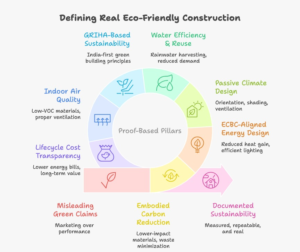
A truly eco-friendly construction company in Delhi NCR is defined by a complete approach—one that considers:
In other words, an eco-friendly construction company in Delhi NCR should be able to show you how the building performs across its entire life: from material sourcing and construction practices, to energy behavior, water efficiency, and indoor comfort for the people living inside it.
If “eco” is only visible in the décor, it’s not sustainability. If an eco-friendly construction company in Delhi NCR can explain performance with clarity and proof, you’re in the right conversation.
One of the most reliable ways to assess an eco-friendly construction company in Delhi NCR is to ask a simple question:
“What are you doing about embodied carbon?”
Embodied carbon is the climate cost of a building before it is even occupied. It includes emissions from extracting raw materials, manufacturing cement and steel, transporting products, and running construction activities. The World Green Building Council highlights embodied carbon as a major component of total building impact, and it’s a global focus area for real sustainability conversations.
An eco-friendly construction company in Delhi NCR should understand that a home is not only about how it runs—it’s also about what it is made of.
What embodied carbon looks like in real construction
A serious eco-friendly construction company in Delhi NCR will think about:
The proof you should ask for
If you want to verify an eco-friendly construction company in Delhi NCR, ask for:
An eco-friendly construction company in Delhi NCR that cannot explain embodied carbon is often operating in the shallow end of sustainability.
If there’s one sign that an eco-friendly construction company in Delhi NCR is serious, it’s familiarity with ECBC—India’s Energy Conservation Building Code.
Even if a residential project is not formally certified under ECBC, an eco-friendly construction company in Delhi NCR should design with ECBC logic: energy performance is planned, not guessed.
What ECBC-style thinking changes in a home
A capable, eco-friendly construction company in Delhi NCR applies ECBC principles in:
Why ECBC matters specifically in Delhi NCR
Delhi NCR faces high cooling demand and intense summers. An eco-friendly construction company in Delhi NCR that designs without envelope intelligence often creates homes that feel hot, then “fixes” the problem with larger AC systems. That’s not sustainable—it’s expensive, energy-heavy, and uncomfortable.
Quick homeowner check: 5 questions
When evaluating an eco-friendly construction company in Delhi NCR, ask:
The more confidently an eco-friendly construction company in Delhi NCR answers these, the stronger the foundation.
A truly eco-friendly construction company in Delhi NCR doesn’t rely only on gadgets. It relies on design intelligence—especially passive design.
Passive design means the building works with climate, orientation, sun path, wind, shading, and material behavior to keep indoor spaces comfortable with less mechanical effort.
TERI’s work on green buildings in India emphasizes the importance of designing buildings that are energy-efficient and climate-appropriate.
What passive design looks like in practical terms
A thoughtful, eco-friendly construction company in Delhi NCR considers:
Why passive design is a trust signal
Because passive design requires planning, not spending. It’s harder to market but more effective long-term. If an eco-friendly construction company in Delhi NCR explains how the building stays cooler by design, that’s sustainability you can feel—every day.
In Delhi NCR, water planning isn’t a “green add-on.” It’s core infrastructure thinking. Any eco-friendly construction company in Delhi NCR must treat water like a limited resource that needs circular management.
A sustainable home reduces freshwater demand and uses water systems intelligently throughout the year.
What water-smart construction should include
A reliable eco-friendly construction company in Delhi NCR integrates:
The proof angle: avoid token systems
Many projects add a rainwater pit as a formality. A real eco-friendly construction company in Delhi NCR can explain:
When a water strategy is detailed, the eco-friendly construction company in Delhi NCR is probably designing sustainability rather than decorating it.
Global green buzzwords can confuse homeowners. That’s why it’s valuable when an eco-friendly construction company in Delhi NCR understands and aligns with GRIHA, India’s national green rating framework.
GRIHA (Green Rating for Integrated Habitat Assessment) evaluates sustainability across energy, water, materials, waste, occupant health, and site planning.
Why GRIHA alignment matters
A mature eco-friendly construction company in Delhi NCR doesn’t just chase “green aesthetics.” It thinks in categories:
Even when a home isn’t formally GRIHA-certified, a builder who uses GRIHA principles is more likely to deliver real outcomes.
How you can use GRIHA thinking as a homeowner
Ask the eco-friendly construction company in Delhi NCR to walk you through:
If answers are structured and consistent, the sustainability approach is likely real.
In Delhi NCR, indoor air quality is not a premium feature. It’s a health safeguard. A true eco-friendly construction company in Delhi NCR understands that building design affects the air you breathe inside your home.
Indoor pollution can come from:
What to look for in a health-first build
A responsible, eco-friendly construction company in Delhi NCR should have:
The “proof” questions to ask
To validate an eco-friendly construction company in Delhi NCR, ask:
If the builder answers with specifics rather than slogans, you’re dealing with a stronger eco-friendly construction company in Delhi NCR.
Sustainability becomes meaningful when it’s measurable not only in carbon or water, but also in long-term comfort and cost.
A truly eco-friendly construction company in Delhi NCR won’t just promise “savings.” It will explain where savings come from and how they’re supported by design decisions.
What lifecycle transparency looks like
A credible eco-friendly construction company in Delhi NCR shares:
Why this matters
Homes in Delhi NCR face stress: heat, dust, humidity cycles, pollution exposure, and heavy AC usage. A smart, eco-friendly construction company in Delhi NCR chooses systems and materials that hold up under these conditions.
When a builder is transparent about performance and maintenance, sustainability is not a label—it’s a plan.
If you want to compare options, use this simplified scorecard. Rate each category from 0 to 2.
Total score out of 14.
A high-performing eco-friendly construction company in Delhi NCR will score well because they can show process, not just promise.
Myth 1: “Solar panels make it a green building.”
Solar can help, but without envelope efficiency and load reduction, solar becomes a patch—not a solution. An eco-friendly construction company in Delhi NCR designs efficiency first.
Myth 2: “More glass means more premium—and more sustainable.”
Large glass surfaces often increase heat gain if not designed carefully. A real eco-friendly construction company in Delhi NCR treats glazing like a climate decision.
Myth 3: “Eco-friendly homes are only for luxury villas.”
Sustainability is design logic, not just expensive features. A capable, eco-friendly construction company in Delhi NCR can apply passive and efficiency principles at many budgets.
Myth 4: “Green homes don’t need maintenance.”
Every home needs maintenance. Sustainability includes planning, durability, and easy upkeep. A serious eco-friendly construction company in Delhi NCR explains lifecycle maintenance clearly.
Myth 5: “Eco-friendly is just about materials.”
Materials matter, but design, energy behavior, water systems, and indoor health matter just as much. A complete eco-friendly construction company in Delhi NCR sees the whole system.
1. What defines a truly eco-friendly construction company in Delhi NCR?
A truly eco-friendly construction company in Delhi NCR is defined by performance, not presentation. It goes beyond surface-level features like solar panels or indoor plants and instead focuses on energy efficiency, water management, material responsibility, indoor air quality, and long-term operational savings.
Such a company designs buildings that reduce environmental impact across their entire lifecycle—from construction to daily use. This includes reducing embodied carbon in materials, aligning with energy efficiency frameworks like ECBC, and following sustainability principles recognised by national bodies like GRIHA.
For global context on embodied carbon in construction, refer to the World Green Building Council.
2. How can I verify if a builder claiming to be eco-friendly in Delhi NCR is genuinely sustainable?
To verify whether a builder is a real eco-friendly construction company in Delhi NCR, you should ask for documentation, not just verbal claims. Genuine sustainable builders can clearly explain why certain materials, systems, and designs were chosen.
Ask for:
If a builder avoids specifics or cannot explain performance logic, sustainability may only exist in marketing language.
3. Is ECBC important when choosing an eco-friendly construction company in Delhi NCR?
Yes. ECBC (Energy Conservation Building Code) is one of the most important benchmarks when evaluating an eco-friendly construction company in Delhi NCR. Even if a residential project is not formally required to be ECBC-certified, builders who design according to ECBC principles consistently deliver better-performing homes.
ECBC focuses on reducing energy demand through building envelope design, lighting efficiency, and system planning. In Delhi NCR’s hot climate, ECBC-aligned design can significantly reduce air-conditioning dependence and electricity consumption.
4. What is embodied carbon, and why should homeowners in Delhi NCR care about it?
Embodied carbon refers to the greenhouse gas emissions generated during the production, transport, and construction of building materials. Many homeowners focus only on electricity bills, but a large portion of a building’s environmental impact is locked in before anyone moves in.
A responsible, eco-friendly construction company in Delhi NCR actively works to reduce embodied carbon by optimizing material use, minimizing construction waste, and sourcing materials responsibly.
The World Green Building Council highlights embodied carbon as one of the biggest sustainability challenges in the construction sector.
5. Do eco-friendly homes in Delhi NCR actually reduce electricity consumption?
Yes—when designed correctly. Homes built by a genuine eco-friendly construction company in Delhi NCR consume significantly less electricity over time because energy efficiency is designed into the structure itself.
This includes:
Research-backed frameworks like ECBC and studies supported by TERI show that such design strategies can reduce energy consumption by 30–50% compared to conventional buildings.
6. How does an eco-friendly construction company in Delhi NCR handle water efficiency?
Water efficiency is a critical test for any eco-friendly construction company in Delhi NCR, given the region’s increasing water stress. Sustainable construction focuses on reducing freshwater demand and using water more intelligently.
Key strategies include:
A credible eco-friendly construction company will explain how much water is saved annually and how the systems function beyond compliance checkboxes.
7. What role does GRIHA play in identifying an eco-friendly construction company in Delhi NCR?
GRIHA (Green Rating for Integrated Habitat Assessment) is India’s national sustainability rating system for buildings. An eco-friendly construction company in Delhi NCR that understands and aligns with GRIHA principles is more likely to deliver real environmental and occupant benefits.
GRIHA evaluates buildings on energy efficiency, water conservation, materials, waste management, and indoor environmental quality—making it highly relevant to Indian climatic and urban conditions.
8. Are eco-friendly homes more expensive to build in Delhi NCR?
Eco-friendly homes may have a slightly higher upfront construction cost, but homes built by a competent eco-friendly construction company in Delhi NCR are more cost-effective over time.
This is because:
Over the building’s lifecycle, these savings often outweigh the initial investment—making sustainability financially practical, not just environmentally responsible.
9. How does indoor air quality factor into eco-friendly construction in Delhi NCR?
Indoor air quality is a major concern in Delhi NCR, and a genuine eco-friendly construction company in Delhi NCR treats it as a core design priority. Poor material choices and inadequate ventilation can trap pollutants indoors, affecting long-term health.
Sustainable builders use:
These decisions significantly improve indoor living conditions, especially for families spending long hours indoors.
10. Can eco-friendly construction principles be applied to non-luxury homes?
Absolutely. An eco-friendly construction company in Delhi NCR applies sustainability through design intelligence, not just expensive features. Passive design, orientation planning, ventilation, and material efficiency can be implemented across budgets.
Sustainability is not defined by how premium a home looks—it’s defined by how efficiently it performs. Builders who understand this can create eco-friendly homes at multiple price points.
Finding an eco-friendly construction company in Delhi NCR isn’t about chasing a trendy label. It’s about choosing a builder who can back up sustainability with measurable thinking: embodied carbon awareness, ECBC-aligned efficiency, passive design strategies, water-smart systems, GRIHA-based frameworks, and indoor air quality decisions that protect health.
The strongest signal is not a green-themed brochure. It’s a builder who speaks in process, standards, and outcomes—because they’ve designed sustainability into the building from day one.
If you use the seven factors in this guide, your search for an eco-friendly construction company in Delhi NCR becomes clearer, smarter, and far more protected from greenwashing.