India’s Silent Farmhouse Revolution Has Already Started
Across India’s countryside, something extraordinary is unfolding. Farmhouses — once seen as weekend retreats or second homes for comfort — are rapidly transforming into climate-resilient sanctuaries, regenerative estates, and next-generation eco-habitats. And leading this massive transition is a new class of visionary builders: the green farmhouse developer India is beginning to trust for sustainable, future-ready rural luxury.
What’s driving this shift?
It’s not just aesthetics. It’s not just luxury.
It’s survival, sustainability, policy pressure, and buyer consciousness converging into a powerful national movement.
Over the past decade, India has witnessed record-breaking heatwaves, groundwater scarcity, electricity grid failures, extreme rainfall, unpredictable climate cycles, and soaring energy costs. Families today aren’t just searching for a farmhouse — they’re searching for a resilient ecosystem where generations can live healthier and safer.
And the Government of India has recognized this urgency too.
New building guidelines, environmental codes, solar mandates, water conservation norms, low-carbon construction rules, and passive architecture guidelines are fundamentally rewriting the rules of rural home development.
Key turning points include:
In this regulatory landscape, every green farmhouse developer India is naturally positioned to outperform traditional developers — because the future of real estate is green, regulated, and efficiency-driven.
1. Energy Codes Are Changing the Future of Every Home in India
The ENS (Eco Niwas Samhita) is not a suggestion. It is a national mandate that targets energy efficiency in residential building envelopes. It governs:
Building orientation
Natural daylighting
Solar heat gain
Material insulation
Wall/Roof reflectivity
Passive ventilation
Shading elements
Why does this matter?
Because ENS is projected to save:
125 billion kWh/year by 2030
Equivalent to 100 million tonnes of CO₂ emissions avoided annually
A farmhouse constructed without ENS principles becomes outdated the moment it’s built. But a project built with ENS-compliance becomes an energy-efficient asset with far lower cooling costs.
This is why today’s buyer gravitates toward a green farmhouse developer India — they know that modern sustainable design isn’t a luxury upgrade, but a long-term financial and environmental necessity.
2. The New Buyer Mindset: Sustainability > Superficial Luxury
Luxury buyers — especially Gen Z, young entrepreneurs, corporate executives, and NRIs — are shifting from “bling” homes toward meaningful lifestyle homes.
Reports from Knight Frank and Business Standard highlight:
Green homes command 4–10% price premiums
Buyers prefer rainwater harvesting & solar power more than swimming pools
Homes with passive cooling reduce AC bills by 30–50%
The modern farmhouse buyer asks:
Is it energy-efficient?
Is the water supply sustainable?
Is the building material safe?
Will it remain compliant with future laws?
Is the landscape regenerative?
This is why the green farmhouse developer India now stands at the center of rural real estate’s next decade.
3. Rural Luxury Is Becoming Climate Luxury
The definition of luxury has evolved:
Old luxury:
Imported marble, high-end fittings, large pools.
New luxury:
Passive cooling
Solar rooftops
Water-positive landscapes
EV-ready residences
Air purification courtyards
Carbon-conscious architecture
Buyers now want homes that protect their children, reduce their bills, and preserve nature.
Every green farmhouse developer India building with this mindset becomes a long-term market leader — because they’re fulfilling a deeper emotional need: security and well-being.
4. Investors Love Green Homes
Global ESG (Environmental, Social, Governance) capital is flowing rapidly into sustainable development. In luxury real estate, green-rated assets:
Sell faster
Resell faster
Have longer structural life
Achieve higher rental value if commercialized
This shift places the green farmhouse developer India at a major advantage in terms of sales, approvals, and long-term demand.
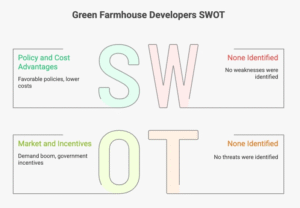
Policy changes are no longer slow, optional, or negotiable. India is entering its strictest-ever regulatory decade, especially in real estate. The coming years will specifically reward every green farmhouse developer India because farmhouse development falls at the intersection of:
Let’s break down the major policy pillars shaping the future:
1. The New Eco-Friendly House / Farmhouse Bye-Laws (2025 Update)
One of the biggest indicators of India’s policy direction is the updated set of Farm House / Eco-Friendly House Building Bye-Laws (Regulation 4.3.7), introduced in 2025.
What do these norms demand?
Energy-efficient construction
Low-carbon materials
Green cover requirements
Rainwater harvesting & groundwater recharge
Natural ventilation planning
Solar-ready roofs
Landscape sustainability
These bye-laws introduce a formal classification for Eco-Friendly Houses, making clear that farmhouse development must evolve beyond conventional RCC structures.
Every green farmhouse developer India who already builds with sustainable practices will now move faster through approvals compared to outdated builders.
2. Model Building Bye-Laws (MBBL 2016) – The National Template for Sustainable Construction
The Model Building Bye-Laws 2016 by the Ministry of Housing and Urban Affairs form the backbone of sustainable urban and rural planning in India.
Key sustainability mandates include:
• Mandatory Rainwater Harvesting
Every new building — including farmhouses — must have rainwater harvesting systems sized according to plot area.
• Solar Power Infrastructure Required
Rooftop solar readiness is now a necessity, not a luxury.
• EV Charging Infrastructure
Homes must be EV-friendly as India accelerates toward 2030 EV targets.
• Green Landscape Provisions
Minimum tree cover, native plant species, stormwater management, and natural habitat conservation.
• Waste Management Requirements
On-site organic waste processing, segregation, and composting.
MBBL is becoming the baseline in many states including Delhi, Haryana, Rajasthan, Karnataka, Telangana, and Uttar Pradesh.
This means that the green farmhouse developer India is not just ahead of the curve — they are the curve.
3. ECBC 2017 & ENS 2018 — Energy Codes That Will Become Mandatory Nationwide
🌞 ECBC 2017 — Energy Conservation Building Code
Applies to buildings with:
Connected load ≥ 100 kW
Contract demand ≥ 120 kVA
Many luxury farmhouses today include:
Recreational spaces
Hospitality units
Clubhouses
Multi-unit villas
These automatically fall under ECBC requirements.
🌿 ENS 2018 — Eco Niwas Samhita (Residential Energy Code)
Applies to all residential buildings, including farmhouses.
ENS governs:
Building orientation
Wall reflectivity
Roof insulation
Window-to-wall ratio
Natural ventilation
Solar heat gain
ENS’s national target:
125 billion units saved annually by 2030.
A farmhouse that ignores ENS requirements becomes obsolete the day it’s built.
This is why the green farmhouse developer India now represents the future-proof alternative for buyers.
4. DDA’s LDRA (Low-Density Residential Area) Regulations
Delhi NCR’s farmhouse segment is dominated by LDRA guidelines — some of the most environmentally focused zoning rules in India.
LDRA enforces:
Strict coverage limits
Mandatory green zones
Landscape preservation
Water conservation systems
Low-impact development
Reduced ground footprint
Minimum tree cover
Why does this matter?
Because LDRA is influencing other states to adopt similar eco-zoning frameworks.
This is perfect for the green farmhouse developer India who already integrates:
regenerative landscapes
soil-friendly construction
native vegetation
water-neutral design
passive cooling techniques
Such developers will rise as compliance leaders while others struggle with approvals.
1. Fast-Track Government Approvals
Projects pre-certified by green rating systems like GRIHA or IGBC enjoy:
Faster environmental clearance
Reduced paperwork
Lower compliance risk
Priority in approval queues
For farmhouse development, where approval anxiety is high, this is a major advantage.
A green farmhouse developer India using pre-certification can deliver projects 3–6 months sooner than traditional developers.
2. Higher FAR, Lower Fees & Government Incentives
Across India, states are offering direct financial rewards for green-certified buildings:
⭐ Nagpur Municipal Corporation
20% property tax rebate for IGBC-certified buildings.
Source: Times of India (Green Incentives coverage)
⭐ Multiple States Provide:
1–5% extra FAR
Reduced development fees
Lower premiums
Subsidized approval costs
Fast-track clearance windows
Examples include:
Punjab
Andhra Pradesh
Telangana
Rajasthan
West Bengal
Karnataka
Haryana
Maharashtra
This means a green farmhouse developer India can actually build more on the same acre — translating into higher revenues and increased saleable area.
3. Lower 30-Year Operating Cost = Higher Buyer Demand
A green farmhouse dramatically reduces long-term costs through:
Solar energy
Efficient glazing
Passive cooling
Low-energy appliances
Rainwater harvesting
Wastewater recycling
Case study:
The Super ECBC building in Andhra Pradesh demonstrates 50% lower energy use compared to conventional structures.
When buyers see operational savings of 20–50% year after year, their trust in a green farmhouse developer India skyrockets.
4. Higher Resale Value, Better Liquidity, and Stronger Investor Interest
Green Farmhouse Developer in india
Luxury buyers, NRIs, and ESG-focused investors are aggressively choosing sustainable assets.
Green homes:
Sell 2–3x faster
Command higher resale value
Attract institutional investors
Reduce depreciation
Stay compliant with future norms
This strengthens the position of every green farmhouse developer India, making their projects more attractive and future-proof.
5. Developers Avoid Future Penalties & Legal Risks
Green Farmhouse Developer in india
Several states (Punjab, Karnataka, West Bengal) have already drafted regulations proposing:
Penalties for non-compliant buildings
Mandatory solar power
This means non-green farmhouses may become legally non-viable in future.
Developers embracing green norms now will avoid:
Every green farmhouse developer India becomes not just compliant — but protected.
Green Farmhouse Developer in india
The farmhouse of the future will not be built with bricks and concrete alone — it will be constructed with data, science, and ecology-first thinking. As climate uncertainty intensifies, the demand for sustainable, resilient, and self-sufficient rural estates will multiply. Every green farmhouse developer India is now designing for 2030, not 2020 — because the buyer mindset has radically shifted.
Below is a detailed look at how the Indian farmhouse will evolve over the next decade:
1. Passive Vastu & Climate-Responsive Architecture
Climate-responsive design is no longer an optional upgrade — it is a foundational requirement for all future farmhouses. According to TERI (The Energy and Resource Institute)
Well-considered passive design can reduce cooling load by up to 30–40% without any mechanical intervention.
Key Passive Design Features in 2030 Farmhouses
North-facing glazing for diffused natural light
South-side insulation and shading to block heat gains
Courtyard-centered layouts for evaporative cooling
Wind tunnels created through aligned openings
Thermal buffering using verandahs
Double-skin facades for better temperature stability
High-reflective white roofs to lower heat load
Solar chimneys to pull hot air upwards and out
Traditional Indian design and modern science merge here — making passive architecture deeply efficient, spiritual, and sustainable. This is why every green farmhouse developer India increasingly collaborates with climatologists and environmental architects.
2. Solar-Ready & EV-Ready Estates
India’s solar mission and EV revolution will redefine how energy flows through rural estates.
Solar Readiness Will Be Mandatory
Under MBBL and national solar policy goals, rooftop solar readiness is becoming a fundamental compliance requirement.
Farmhouses in 2030 are expected to include:
5–10 kW rooftop solar PV
Solar battery storage
Inverters with smart load management
Solar water heating systems
Solar-powered outdoor lighting
These systems reduce energy bills up to 70%, making them a powerful selling point for the green farmhouse developer India who wants to appeal to conscious, cost-saving buyers.
EV Infrastructure Goes Mainstream
With India targeting 30% EV penetration by 2030, EV charging infrastructure is becoming essential in every home Green Farmhouse Developer in india .
Farmhouses will include:
7.2 kW home charging ports
Solar-connected chargers
Dedicated EV parking bays
Wiring conduits pre-installed during construction
This prepares families for the future of mobility — ensuring the farmhouse remains relevant for decades.
3. Water-Positive & Zero-Discharge Designs
Water scarcity is now one of the biggest concerns in India’s rural regions. Future-ready farmhouse development depends on building water-positive estates, not water-consuming ones Green Farmhouse Developer in india.
Key Water-Smart Features in 2030 Farmhouses
Rainwater harvesting with multi-stage filtration
Bioswales & percolation trenches to replenish groundwater
On-site STP (Sewage Treatment Plant) for greywater recycling
Drip irrigation for low-water landscape maintenance
Native plant species that thrive with minimal water
Reed beds for natural water purification
These systems reduce water dependency by 40–70%.
A green farmhouse developer India offering a “zero-discharge estate” will automatically attract premium buyers — especially those concerned about water bills, sustainability, and climate resilience.
4. Regenerative Landscaping: Forest, Farm & Life
Indian farmhouses are no longer about manicured lawns and ornamental plants. The 2030 farmhouse will include:
Food forests
Native-aroma gardens
Pollinator pathways
Butterfly and bird zones
Micro-farming patches
Seasonal orchards
These landscapes are alive, breathing, and healing — not sterile.
TERI and UNDP recommend regenerative landscaping as a key climate mitigation tool.
It reduces heat, improves soil health, increases biodiversity, and creates calming, sensory-rich environments.
This emotional value is precisely why the green farmhouse developer India becomes the developer of choice for next-gen families.
Let’s look at real-world transformations proving that green is not only sustainable — it is also profitable, desirable, scalable, and regulation-friendly.
Case Study 1 — The Super ECBC Building, Andhra Pradesh
The Bureau of Energy Efficiency highlighted Andhra Pradesh’s landmark Super ECBC building, which:
This case study reinforces that energy-efficient design is not futuristic — it is already being executed at scale.
For the green farmhouse developer India, this becomes validation that their construction approach is aligned with the country’s highest-performing environmental standards.
Case Study 2 — Delhi NCR’s Eco-Farmhouse Movement Under LDRA Green Farmhouse Developer in india
The LDRA (Low-Density Residential Area) guidelines in Delhi have reshaped the entire farmhouse market. LDRA requires:
Minimum 15–20% green landscaped area
Low ground coverage
Natural water recharge systems
Sustainable construction guidelines
Controlled built-up area
Developers who embraced LDRA norms early now dominate the premium farmhouse market. Their projects sell faster because families feel emotionally secure knowing the estate sits on environmentally compliant land.
This created a demand surge for the green farmhouse developer India, especially in regions like Chattarpur, Ansal areas, West End Greens, and parts of Gurugram.
Case Study 3 — Europe’s Regenerative Agro-Estate Model
Across Europe, luxury rural estates are now marketed as:
Carbon-neutral
Energy-positive
Biodiversity-rich
Off-grid capable
Zero-waste living ecosystems
Examples include regenerative estates in Portugal, Spain, and Greece where:
Olive groves sustain solar farms
Rainwater systems feed orchards
Passive cooling replaces AC
Building materials are lime, wood, earth, and stone
Micro-forests regulate heat naturally
These estates command 40–80% higher value because sustainability is treated as the highest luxury.
This global trend is now shaping the expectations of India’s ultra-high-net-worth farmhouse buyers — demanding the same living experience. That is why the green farmhouse developer India is uniquely positioned to lead the premium rural market for the next decade.
Case Study 4 — The Rise of Eco-Luxury Retreats in India
Luxury eco-resorts like:
SwaSwara (Gokarna)
Binsar Wildlife Eco Retreat
RARE India properties
Dewdrop Eco Farm Resort
Stone Lodges in Tamil Nadu
These properties showcase:
Earth-based construction
Rainwater recycling
Solar-powered living
Organic food production
Zero-discharge principles
Their soaring popularity proves one truth:
India’s luxury traveller prefers eco-conscious environments — and India’s luxury homebuyer wants the same.
This is why every forward-thinking green farmhouse developer India is now building projects that look and behave like eco-luxury retreats.
The shift toward sustainable, regulated, eco-conscious building is happening now. Developers who ignore this transition will face delays, penalties, and disappearing buyer interest. Meanwhile, every green farmhouse developer India who acts early will enjoy faster sales cycles, higher buyer trust, and regulatory advantages.
Below is a practical, actionable blueprint for developers preparing for the next decade.
1. Conduct a Green Compliance Audit Immediately
A compliance audit helps developers measure their project alignment with:
Local environmental norms
LDRA guidelines (Delhi NCR only)
Focus areas:
Heat insulation
Energy efficiency
Water harvesting
Soil conservation
Natural lighting & shading
Waste management
Rainwater recharge
A project aligned with these codes is approval-ready and future-proof.
2. Pre-Register Farm Projects With GRIHA or IGBC
Before construction begins, every green farmhouse developer India should pre-register the project under a green rating system such as:
GRIHAIGBC
Benefits:
Fast-track environmental clearance
Extra FAR in multiple states
Lower development premiums
Higher branding value
Better buyer confidence
This step alone increases the project’s perceived value by 8–12%.
3. Switch to Low-Carbon Building Materials
Modern farmhouse buyers value materials that are:
Durable
Energy efficient
Non-toxic
Low carbon
Locally sourced
Materials recommended for future-ready farmhouses include:
CSEB (Compressed Stabilized Earth Blocks)
Fly-ash blocks
Rammed earth
Bamboo structural elements
Low-VOC paints
Thermal reflective tiles
Aerated concrete blocks
Using these not only enhances sustainability but also boosts marketability.
A green farmhouse developer India who uses earth-based materials also attracts buyers who value aesthetics, wellness, and timeless architecture.
4. Integrate Passive Design Into Masterplans
Passive design isn’t a trend — it’s a scientifically proven method that can reduce energy bills by 30–50%.
Key steps:
Orient the building to maximize cross ventilation
Position windows for natural cooling
Use verandahs to block western heat
Add courtyards for air circulation
Install horizontal shading devices
Plant dense native greenery on the south-west direction
This ensures that the farmhouse naturally maintains ideal indoor temperatures even during peak summers.
5. Prepare for 2030 Solar & Water Mandates
By 2030, most Indian states are expected to fully adopt:
Mandatory rooftop solar systems
Mandatory rainwater harvesting
Mandatory EV charging points
Mandatory greywater recycling
This means any farmhouse built today must already include these features, or it will require expensive retrofitting later.
A green farmhouse developer India who incorporates these systems upfront saves future costs and avoids legal complications.
6. Build Regenerative Landscapes Instead of Decorative Gardens
The new-era farmhouse landscape is:
Edible
Native
Biodiversity-rich
Low maintenance
Sustainable
Replace lawns with:
Fruit orchards
Native shade trees
Pollinator gardens
Rain-fed vegetation
Medicinal clusters
Mini food forests
These landscapes cut maintenance costs and improve soil health — two things buyers deeply value.
Below are 10 powerful FAQs designed to strengthen the SEO foundation of your blog. Each answer is crafted to improve readability, keyword visibility, and ranking potential.
1. What are the upcoming green building norms for farmhouses in India?
India is adopting stricter sustainability rules under MBBL 2016, ENS 2018, and state-level farmhouse guidelines. These norms require solar readiness, rainwater harvesting, energy-efficient materials, and eco-friendly design. A green farmhouse developer India naturally complies with these evolving mandates.
2. What is Eco Niwas Samhita (ENS) and how does it impact farmhouses?
Eco Niwas Samhita 2018 is the national residential energy code created by the Bureau of Energy Efficiency.
It governs insulation, glazing, shading, natural ventilation, and energy use. Every farmhouse must eventually comply, making early adoption beneficial.
3. Do GRIHA or IGBC certifications offer benefits to farmhouse developers?
Yes. GRIHA and IGBC provide fast-track approvals, extra FAR, lower premiums, and branding advantage. They also improve the resale value of the project. This is why many choose a green farmhouse developer India who offers certified eco-friendly estates.
4. Are green farmhouses more expensive to construct?
Green construction adds only 3–7% to initial cost but reduces long-term operating costs by 30–50%. Over 20 years, it saves lakhs in energy and water bills.
5. How does passive cooling work in farmhouses?
Passive cooling uses architecture to regulate temperature naturally. This includes shading, cross ventilation, reflective roofs, courtyards, and native vegetation. Passive cooling dramatically lowers AC consumption and enhances comfort.
6. Is solar power mandatory in new Green Farmhouse Developer in india farmhouses?
While not yet mandatory nationwide, several states have adopted solar readiness under MBBL 2016. By 2030, rooftop solar is expected to be mandatory for all new homes — especially in rural estates.
7. What water systems are required for an eco-friendly farmhouse?
Systems commonly required include rainwater harvesting, greywater recycling, groundwater recharge, STP units, and drip irrigation networks. These systems ensure water-positive living.
8. What makes a farmhouse “eco-friendly”?
Eco-friendly farmhouses include energy-efficient materials, passive design, low carbon footprint, solar power systems, rainwater harvesting, and regenerative landscapes. This differentiates the green farmhouse developer India from traditional builders.
9. What is the resale value advantage of green farmhouses?
Green homes sell 2–3x faster, command higher resale price, and attract ESG-focused buyers and NRIs. Sustainable design offers better long-term appreciation.
10. Why should developers adopt green Green Farmhouse Developer in india compliance early?
Because future regulations (2030 norms) will penalize non-compliant buildings. Early adoption ensures approvals, lower operational costs, higher saleability, and long-term compliance.
India’s farmhouse market is entering a revolutionary era — one defined by sustainability, conscious luxury, and ecological intelligence. The farmhouse is no longer a simple retreat; it is a regenerative, climate-resilient, self-sufficient ecosystem that protects families from heatwaves, water shortages, and rising energy costs.
Government policies are reshaping the country’s construction landscape, ensuring that only eco-friendly development thrives in the next decade. At the same time, buyers now demand homes that support their well-being, conserve resources, and align with global sustainability values.
This creates a historic opportunity for every forward-thinking green farmhouse developer India. Those who adapt early will not just survive — they will lead the market, command premiums, secure faster approvals, and build legacies that outlive them.
The farmhouse of 2030 is not just a home.
It is a living ecosystem.
A sanctuary.
A sustainable inheritance.
And it will be built by those who choose green today.