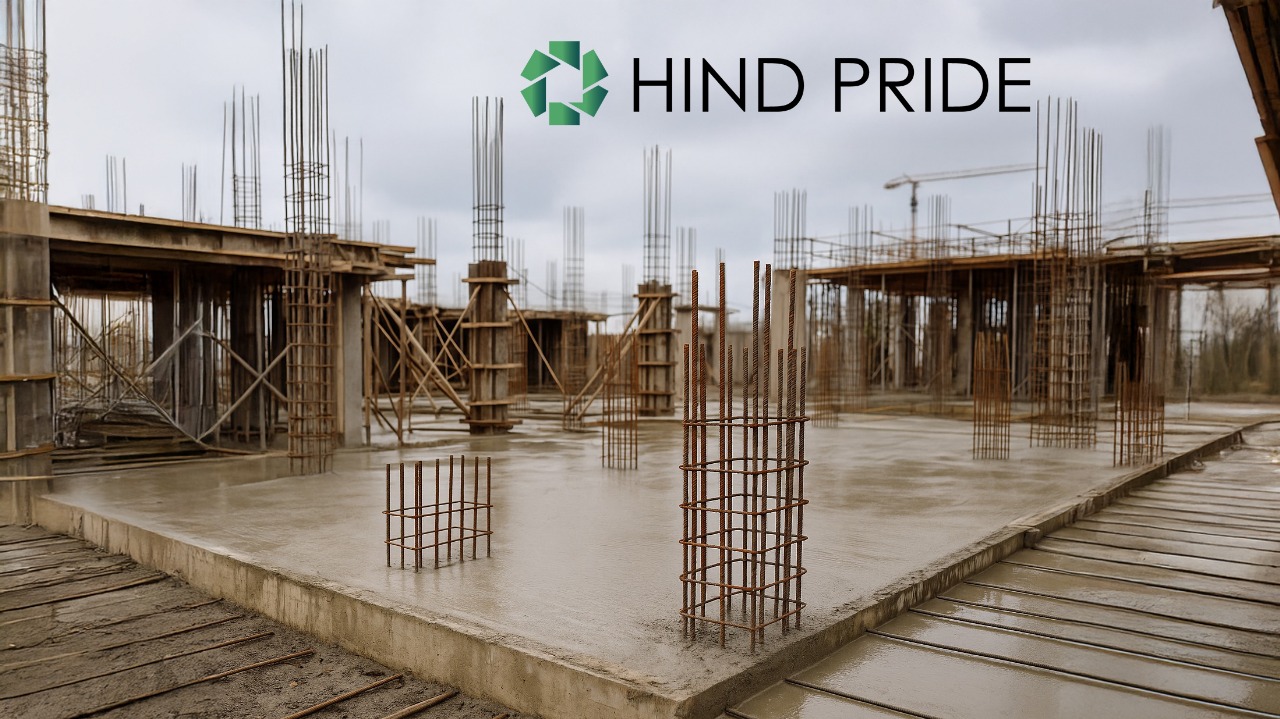
PCC in Construction vs RCC in Delhi Homes (2025): Where Each Makes Sense — and Why It Matters More Than You Think

PCC in Construction vs RCC in Delhi Homes (2025): Where Each Makes Sense — and Why It Matters More Than You Think

Why “PCC in Construction” Matters More Than You Think

When you think about building a home in Delhi or NCR, the big questions are usually about cost, layout, and timelines. Yet one quiet detail — PCC in construction — often decides whether your structure stands solid for decades or cracks within years.

From Plain Cement Concrete (PCC) under your footings to Reinforced Cement Concrete (RCC) beams that hold your walls upright, understanding where each belongs can save you money, rework, and headaches.

In this blog, we decode the PCC vs RCC debate for Delhi homeowners — what each does, where it makes sense, what IS codes say, typical Delhi-NCR costs, and how leading builders like Hindpride Construction ensure both strength and sustainability in every pour.

Understanding PCC in Construction — The Foundation Everyone Forgets

Plain Cement Concrete (PCC) is the unsung hero of every project. It’s the base layer beneath your RCC footings or slabs, providing a clean, level surface that isolates structural concrete from soil and moisture.

What Exactly Is PCC?

  • Composition: Cement + sand + coarse aggregate + water (no steel reinforcement).

  • Purpose: To create a smooth, firm base and prevent direct contact between the foundation concrete and sub-soil.

  • Typical Mixes: 1:3:6 or 1:4:8 (approx. M7.5–M10 grade).

  • Thickness: Usually 75–100 mm.

  • IS Reference: IS 456:2000 defines PCC under plain concrete works.

Delhi homeowners often overlook PCC in construction as a “non-structural” step, but skipping it leads to uneven footing levels, moisture ingress, and long-term settlement cracks.

What Is RCC — The Structural Backbone of Your Home

Where PCC ends, RCC (Reinforced Cement Concrete) begins. This is the mix that takes both compression and tension loads, thanks to embedded steel reinforcement.

Where You’ll See RCC:

  • Footings, columns, beams, slabs, lintels, staircases.

  • Basement retaining walls or water tanks.

  • Structural members exposed to bending or tensile stress.

Typical RCC Grades:

IS 456:2000 and IS 10262:2019 govern RCC design, mix proportioning, and durability checks.

PCC vs RCC — A Simple Comparison Table

Parameter

PCC (Plain Cement Concrete)

RCC (Reinforced Cement Concrete)

Reinforcement

None

Contains steel bars

Load-bearing capacity

Only compressive

Compressive + tensile

Typical mix

1:4:8, 1:3:6

M20+

Use

Leveling base, blinding, sub-floor

Structural elements

IS Code

IS 456:2000

IS 456:2000, IS 10262:2019

Cost range (Delhi, 2025)

₹7,000–₹8,000 per m³

₹9,500–₹12,000 per m³

(Use these cost ranges illustratively, cross-link to the cost page for live rates.)

Why PCC in Construction Is Critical in Delhi’s Soil Conditions

Delhi-NCR sits on alluvial soil with high moisture variability, especially in areas near the Yamuna belt, Dwarka Expressway, and Noida Extension. This makes PCC in construction essential to:

In areas like Gurgaon and Dwarka, fluctuating water tables make the PCC bed an insurance policy against future cracking or dampness.

“You can’t see PCC once the foundation is done — but you’ll feel its absence years later.”

When to Use PCC vs When to Use RCC

Use PCC when:

  • You’re preparing the foundation bed.

  • You need a non-structural levelling course.

  • The structure requires clean segregation between soil and footing.

Use RCC when:

  • The member bears load (footing, beam, slab, column).

  • Tensile strength is essential.

  • Long-term durability and stability are key.

A rule of thumb from structural engineers:

“If it supports load, it’s RCC. If it supports RCC, it’s PCC.”
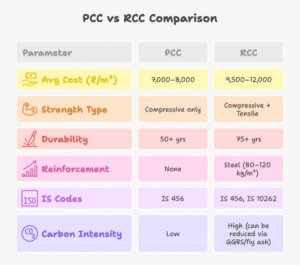
Blueprint-style infographic showing PCC in construction forming the base of RCC structures for Delhi homes.

Delhi-NCR Case Study — Why Smart Builders Still Insist on PCC

Case 1: Gurgaon Independent Floor

  • Soil: Sandy with moderate moisture.

  • Used: PCC 1:4:8 (M7.5), 100 mm thick before RCC footing.

  • Result: Perfect level footing bed and 15% reduction in honeycombing issues.

Case 2: South Delhi Basement Construction

  • Challenge: High groundwater seepage.

  • Used: PCC + DPM layer + M25 RCC footing.

  • Outcome: 0 seepage post-monsoon; no cracks after 18 months.

Case 3: Noida Plot Home

  • Skipped PCC to cut cost → footing exposed to moisture → cracks at base within 1 year.

  • Repaired later at 5× the cost of PCC.

IS Code Compliance — What Homeowners Should Know

  • IS 456:2000: Governs both PCC and RCC — defines minimum grades, curing, cover.

  • IS 10262:2019: Guides mix design for concrete (used for M20 and above).

  • IS 1904:1986: Foundation design and soil considerations.

A compliant builder ensures:
✅ Proper mix ratio (1:4:8 or 1:3:6 for PCC).
✅ Thickness as per drawing (min. 75–100 mm).
✅ Cubes tested for every RCC batch.
✅ Reinforcement checked before pouring.

Cost Comparison — PCC vs RCC in Delhi Homes (2025)

Item

PCC

RCC

Average rate (₹/m³)

₹7,000–₹8,000

₹9,500–₹12,000

Materials

Cement, sand, aggregate

Cement, sand, aggregate, steel

Labour intensity

Low

High

Testing

Simple visual check

Cube tests, slump, cover meter

Maintenance

Minimal

Structural inspection advised every 3–5 years

👉 These costs are indicative — real values depend on site access, design grade, curing method, and reinforcement weight.
For live updates, refer to:

Step-by-Step: How PCC in Construction Is Done on Site

  1. Excavation & cleaning of base

  2. Levelling & compaction

  3. Formwork setup

  4. Mixing concrete (1:4:8)

  5. Pouring and levelling

  6. Curing (48 hours min.)

PCC must project 75 mm beyond the footing on all sides and be cured for at least 2 days before RCC placement.

On-Site QA Checklist (Snippet Section)

✅ Check soil firmness before pouring PCC
✅ Confirm mix proportion with site engineer
✅ Ensure cover blocks are in place for RCC
✅ Verify cube test reports for every batch
✅ Never pour PCC and RCC without proper curing interval

Common Mistakes Delhi Builders Make (and How to Avoid Them)

  • Skipping PCC to save time → leads to uneven footing and contamination.

  • Using weak mixes (below 1:4:8) → causes segregation and poor bonding.

  • Improper curing → leads to cracking and dusting.

  • Using PCC instead of RCC in load-bearing slabs → unsafe and non-compliant.

Hindpride follows zero-compromise QA — from cube testing to 3-level site inspection.

PCC vs RCC — Which Is More Sustainable?

  • PCC: Lower embodied carbon but used in small quantities.

  • RCC: Higher carbon footprint due to steel, but can last >75 years if detailed right.

  • Use supplementary cementitious materials (SCM) like fly ash, GGBS to cut CO₂ by 25%.

  • Use recycled aggregate concrete (RAC) for non-structural PCC works.

FAQs 

  1. What is PCC in construction?
    It’s Plain Cement Concrete — a non-reinforced concrete layer used as a base or levelling course under foundations and slabs.

  2. Is PCC mandatory before RCC footing?
    Generally yes — unless design says otherwise. It ensures a clean, level surface and avoids contamination.

  3. What is the PCC mix ratio?
    Typically 1:4:8 or 1:3:6 depending on site conditions and load.

  4. What is the difference between PCC and RCC?
    PCC has no steel; RCC includes reinforcement to handle tensile stress.

  5. What is the typical thickness of PCC?
    75–100 mm for residential work in Delhi NCR.

  6. Does PCC prevent dampness?
    It reduces capillary rise but must be paired with DPM or waterproofing.

  7. Can I skip PCC to save cost?
    Not advisable; long-term repair costs far outweigh savings.

  8. What grade of RCC is used for homes?
    Usually M20 for footing/slab, M25 for beams/columns.

  9. Is curing important for PCC?
    Yes — minimum 48 hours curing before RCC pour.

  10. What’s the lifespan of PCC and RCC?
    PCC can last 50+ years; RCC 75+ years with proper design and curing.

 Build Smart, Not Just Fast

Whether you’re building a 2BHK in Noida or a villa in Gurgaon, knowing where PCC in construction fits in and where RCC takes over can help you:

  • Avoid costly rework

  • Improve foundation durability

  • Ensure full RERA compliance

  • Get better ROI on every cubic metre of concrete poured

At Hindpride Construction, we believe every layer — even the one you’ll never see — deserves the same precision. Because great homes start below the surface.

Get your free foundation audit & BoQ with transparent PCC/RCC breakup — Contact Hindpride Today.

 

Leave A Comment