For over two decades, Delhi-NCR has lived with pollution as an annual ritual. Winter would arrive, air quality would collapse, emergency measures would be announced, and by spring, the city would collectively pretend the crisis had passed. That illusion no longer holds.
Data from India’s pollution regulators, global health agencies, and repeated enforcement of the Graded Response Action Plan (GRAP) confirm a hard truth: air pollution in Delhi NCR is no longer seasonal — it is structural.
This shift fundamentally changes how homes must be planned, designed, and constructed. The old logic of slow, dust-heavy construction and energy-hungry homes is no longer compatible with the air we breathe or the policies governing our cities.
As we approach 2026, one construction system stands out as both policy-aligned and climate-realistic: PCC panel homes in Delhi NCR.
According to the Central Pollution Control Board (CPCB), Delhi consistently records PM2.5 levels far above safe thresholds not only during winter but across most months of the year. The World Health Organization (WHO) recommends an annual average PM2.5 concentration of 5 μg/m³. In contrast, Delhi-NCR’s annual averages frequently exceed 90 μg/m³, placing residents at nearly 18 times the safe exposure limit.
This persistent exposure has serious consequences: increased respiratory illnesses, cardiovascular disease, reduced productivity, and long-term public health costs. The implication for housing is clear — homes are no longer passive shelters; they are frontline defenses.
Conventional construction practices contribute to the pollution cycle through:
In this context, PCC panel homes in Delhi NCR represent a fundamental shift — replacing chaotic, prolonged on-site work with controlled, factory-based manufacturing and rapid assembly.
The Graded Response Action Plan (GRAP), enforced by the Commission for Air Quality Management (CAQM), is no longer an emergency framework. It has become a permanent governance mechanism.
Under GRAP:
For builders and homebuyers alike, GRAP introduces new risks:
When construction can be halted overnight, time spent on site becomes a liability. The longer a project drags on, the greater its exposure to regulatory shutdowns.
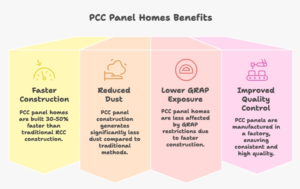
This is where PCC panel homes in Delhi NCR become uniquely relevant. By shifting a large portion of construction off-site and reducing on-site assembly time by 30–50%, PCC panel systems dramatically reduce exposure to GRAP disruptions.
In the past, faster construction was seen as a commercial advantage. In today’s Delhi-NCR, it is a risk-mitigation strategy.
Traditional RCC construction often takes 18–24 months, sometimes longer. Each additional month increases vulnerability to:
By contrast, PCC panel homes in Delhi NCR compress timelines by manufacturing structural elements in controlled environments and assembling them rapidly on site.
Environmental scrutiny is increasing. Construction sites are now evaluated not just on safety but also on dust control and emissions.
Because PCC panels are precast:
This makes PCC panel homes in Delhi NCR inherently more compliant with tightening environmental norms.
PCC (Precast Cement Concrete) panel homes use factory-manufactured concrete panels for walls, floors, and sometimes roofs. These panels are produced under strict quality controls and transported to the site for assembly.
Unlike conventional brick-and-mortar systems, PCC panel homes in Delhi NCR reduce reliance on weather conditions, labour variability, and prolonged on-site activity.
Because the manufacturing happens off-site:
In a region facing chronic air-quality challenges, this is not a marginal benefit — it is a systemic advantage.
India’s building regulations now clearly acknowledge that rising cooling demand is unsustainable.
ECBC 2017: Passive Design Is Mandatory, Not Optional
The Energy Conservation Building Code (ECBC) 2017, issued by the Bureau of Energy Efficiency (BEE), mandates:
India’s Cooling Action Plan aims to reduce overall cooling demand by 20–25% by 2037–38, recognizing that unchecked air-conditioning growth will strain energy systems and worsen urban heat.
These policies make one thing clear: homes must stay cooler by design, not by defaulting to machines.
This is where PCC panel homes in Delhi NCR deliver their most powerful advantage — thermal performance.
Thermal Mass and Heat Regulation
Concrete panels provide high thermal mass, meaning they:
This stabilizing effect is critical in Delhi-NCR’s extreme summers, where temperatures frequently exceed 45°C.
Reduced Dependence on Air Conditioning
By limiting heat gain:
Over time, homeowners in PCC panel homes in Delhi NCR experience tangible reductions in cooling costs — a benefit aligned with both ECBC goals and household economics.
Air pollution is not confined to streets and highways. Indoor air quality is directly affected by:
PCC panel homes in Delhi NCR help create healthier interiors by:
The WHO has confirmed that long-term PM2.5 exposure significantly increases risks of asthma, heart disease, and premature mortality.
In this context, housing design becomes a public-health intervention.
A persistent myth suggests that advanced construction systems are prohibitively expensive. Reality tells a different story.
Construction Economics
Lifecycle Savings
Over a 20–30 year lifespan, PCC panel homes in Delhi NCR often outperform traditional homes on total cost of ownership.
Three irreversible forces converge as we approach 2026:
A December 2025 Reuters report confirms that Delhi continues tightening restrictions to curb pollution, impacting construction, transport, and daily life.
In this landscape, PCC panel homes in Delhi NCR are no longer futuristic experiments — they are logical adaptations.
Hindpride’s approach recognizes that sustainable construction is not about optics — it is about alignment with reality.
By enabling:
Hindpride delivers PCC panel homes in Delhi NCR that respond to pollution, policy, and people — simultaneously.
1. Why are PCC panel homes in Delhi NCR becoming important due to rising pollution?
PCC panel homes in Delhi NCR are gaining importance because air pollution is no longer a short-term seasonal issue. According to the Central Pollution Control Board (CPCB), Delhi-NCR consistently records PM2.5 levels far above safe limits for most of the year, not just during winter months.
Traditional construction methods worsen this problem by generating dust, emissions, and prolonged on-site activity. In contrast, PCC panel homes in Delhi NCR rely on off-site manufacturing and faster assembly, significantly reducing construction-related pollution exposure.
Additionally, the World Health Organization (WHO) confirms that long-term exposure to PM2.5 increases risks of respiratory and cardiovascular diseases, making pollution-resilient housing a necessity rather than a luxury.
As pollution becomes a structural reality, homes must act as protective environments—and PCC panel construction supports that shift.
2. Are PCC panel homes in Delhi NCR affected by GRAP construction bans?
Yes, but PCC panel homes in Delhi NCR are significantly less vulnerable to GRAP-related delays compared to traditional construction. The Graded Response Action Plan (GRAP), enforced by the Commission for Air Quality Management (CAQM), often restricts or halts construction during severe pollution episodes.
Because PCC panel systems reduce on-site construction time by up to 30–50%, they limit exposure to sudden shutdowns. Much of the work is completed in controlled factory environments, which are less affected by GRAP restrictions.
This makes PCC panel homes in Delhi NCR a strategic choice for builders and homeowners seeking timeline certainty in a region where construction bans are now an annual occurrence.
3. How do PCC panel homes in Delhi NCR help reduce construction-related air pollution?
PCC panel homes in Delhi NCR reduce construction-related air pollution primarily by shifting labor-intensive and dust-generating activities away from the site. Unlike brick-and-mortar construction, which involves extensive cutting, grinding, and wet works, PCC panels are precast in factories.
This controlled manufacturing process:
The CPCB has repeatedly highlighted construction dust as a major contributor to urban air pollution.
Source: https://cpcb.nic.in/uploads/airpollution/Construction_Dust.pdf
By lowering on-site pollution, PCC panel construction aligns with tightening environmental regulations and growing enforcement across Delhi NCR.
4. Are PCC panel homes in Delhi NCR energy efficient?
Yes, PCC panel homes in Delhi NCR are inherently energy efficient due to their thermal mass and compatibility with passive cooling strategies. Concrete panels absorb and release heat slowly, reducing indoor temperature fluctuations during extreme summers.
India’s Energy Conservation Building Code (ECBC) 2017, issued by the Bureau of Energy Efficiency (BEE), emphasizes efficient building envelopes to reduce cooling demand.
When designed correctly, PCC panel homes reduce reliance on air conditioning, leading to lower electricity consumption and long-term operational savings—key benefits in a region experiencing rising temperatures and energy costs.
5. Do PCC panel homes in Delhi NCR support passive cooling design?
Absolutely. PCC panel homes in Delhi NCR are highly compatible with passive cooling principles such as:
India’s Cooling Action Plan targets a 20–25% reduction in cooling demand by 2037–38, highlighting the importance of passive-first design.
PCC panels support these goals by creating building envelopes that delay heat transfer, making homes more comfortable even during peak summer conditions without excessive mechanical cooling.
6. Are PCC panel homes in Delhi NCR compliant with Indian building regulations?
Yes, PCC panel homes in Delhi NCR can be fully compliant with Indian regulations when designed and executed correctly. They align with:
The Bureau of Indian Standards (BIS) and BEE both recognize precast construction systems when they meet structural and safety criteria.
Compliance-ready construction is especially important as regulatory scrutiny increases in pollution-affected regions like Delhi NCR.
7. How long does it take to build PCC panel homes in Delhi NCR?
On average, PCC panel homes in Delhi NCR can be completed 30–50% faster than traditional RCC construction. While conventional homes often take 18–24 months, PCC panel systems significantly compress timelines by:
Faster construction not only saves time but also reduces exposure to GRAP shutdowns and cost overruns—making PCC panel homes a resilient choice in today’s regulatory environment.
8. Do PCC panel homes in Delhi NCR improve indoor air quality?
Yes. PCC panel homes in Delhi NCR improve indoor air quality by:
The WHO confirms that indoor exposure to PM2.5 significantly contributes to health risks when outdoor pollution levels are high.
Well-designed PCC panel homes help create healthier indoor environments, especially important in high-pollution zones like Delhi NCR.
9. Are PCC panel homes in Delhi NCR cost-effective in the long term?
While initial construction costs may appear comparable to traditional methods, PCC panel homes in Delhi NCR often deliver better long-term value due to:
Lifecycle cost analysis shows that energy-efficient, durable construction systems outperform conventional homes over 20–30 years—making PCC panel homes a financially sound investment.
10. Why are PCC panel homes in Delhi NCR expected to grow rapidly after 2025?
Post-2025 growth of PCC panel homes in Delhi NCR is driven by three converging forces:
A Reuters report from late 2025 confirms Delhi’s continued tightening of pollution controls affecting construction and daily life.
Delhi-NCR’s pollution crisis has permanently altered the rules of urban living. GRAP is here to stay. Cooling demand will rise. Health risks will intensify.
Homes built in 2026 cannot be designed for nostalgia. They must be designed for resilience.
PCC panel homes in Delhi NCR represent:
If 2025 taught us anything, it is this: the future belongs to homes that respect air, time, and human life.