India’s cities are building taller, denser, and faster than ever before. Yet, one uncomfortable truth continues to surface after every major building fire — fire safety is still treated as a retrofit, not a foundation decision.
From high-rise residential towers to commercial complexes and industrial parks, post-incident investigations repeatedly point to the same weak links: combustible partitions, poorly constructed masonry walls, and non-compliant structural detailing. In response, authorities across states are tightening scrutiny under the National Building Code of India (NBC) 2016, especially Part IV: Fire and Life Safety.
This regulatory shift has brought fire-resistant precast concrete wall panels in India into sharp focus. No longer viewed only as a speed or cost-saving construction method, precast and PCC wall systems are now being evaluated as core fire-safety infrastructure — walls that can contain fire, protect escape routes, and maintain structural integrity under extreme heat.
Fire safety today is not about adding fire-retardant coatings after construction. It is about choosing wall systems that are inherently non-combustible, predictable in performance, and code-aligned from day one. This is where fire-resistant precast concrete wall panels in India are redefining how developers, architects, and regulators think about safe construction.
Over the past decade, India has witnessed a steady rise in fire-related incidents in residential, commercial, and mixed-use buildings. High population density, increased electrical load, basement parking, and vertical construction have all contributed to higher fire risk.
Recognising this, the Government of India consolidated modern fire-safety principles into the National Building Code 2016, making fire and life safety a non-negotiable design parameter.
The NBC 2016, published by the Bureau of Indian Standards (BIS), lays out mandatory requirements for:
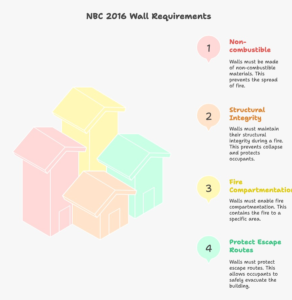
Under NBC Part IV, walls are no longer seen as simple partitions. They are required to perform during a fire — containing flames, limiting heat transfer, and protecting load-bearing elements long enough for evacuation and firefighting.
This regulatory intent directly supports the adoption of fire-resistant precast concrete wall panels in India, which offer consistency and tested performance that traditional on-site masonry often fails to deliver.
One of the most common misconceptions in Indian construction is confusing fire retardant treatments with fire-resistant construction.
Fire retardant paints, coatings, or boards may slow ignition, but they do not guarantee structural stability during prolonged fire exposure. NBC compliance, however, is based on fire resistance, which measures:
Concrete, by its very nature, is non-combustible and exhibits excellent fire resistance due to its thermal mass and low heat conductivity. This is why fire-resistant precast concrete wall panels in India are increasingly preferred in fire-compartment walls, stair cores, lift shafts, and service enclosures.
The fire resistance behaviour of reinforced concrete is recognised under IS 456: Plain and Reinforced Concrete – Code of Practice, which includes provisions related to fire exposure and concrete cover for reinforcement.
Unlike brick masonry, whose fire performance depends heavily on workmanship quality, mortar composition, and on-site supervision, precast concrete panels are manufactured under controlled factory conditions, ensuring predictable fire behaviour.
In a fire event, walls perform three life-critical functions:
NBC 2016 explicitly stresses compartmentation, where fire-resistant walls divide buildings into zones, buying crucial time for occupants to escape. Poorly constructed masonry walls often crack, spall, or collapse under fire, breaching these compartments.
This is where fire-resistant precast concrete wall panels in India offer a structural advantage. Their uniform thickness, dense concrete matrix, and proper reinforcement detailing allow them to:
Fire safety in modern buildings is not just about extinguishing fire — it is about slowing it down structurally. Precast PCC walls are designed to do exactly that.
The credibility of fire-resistant precast concrete wall panels in India is not theoretical — it is rooted in Indian Standards.
The primary governing document is IS 15916: Prefabricated Concrete – Code of Practice, issued by BIS. This standard lays down:
IS 15916 works in conjunction with NBC 2016 and IS 456, creating a clear compliance pathway for developers using precast wall systems. When designed and executed correctly, precast concrete walls can seamlessly meet fire-safety objectives outlined in NBC Part IV.
This alignment between NBC and BIS standards is a major reason fire-resistant precast concrete wall panels in India are now being accepted — and often encouraged — by approving authorities and fire departments.
Conventional brick and block masonry has served Indian construction for decades, but modern fire-safety expectations expose its limitations:
Even small construction defects can become failure points during a fire. In contrast, fire-resistant precast concrete wall panels in India are designed, cast, cured, and inspected under factory-controlled conditions, drastically reducing variability.
Fire safety today is about certainty, not assumptions — and that certainty is difficult to achieve with site-dependent masonry systems.
Fire safety under NBC 2016 Part IV is not achieved by materials alone — it is achieved by design logic. The Code emphasises compartmentation, protected escape routes, and structural stability during fire exposure. This is precisely where fire-resistant precast concrete wall panels in India demonstrate a decisive advantage.
Unlike traditional masonry, which is assembled piece by piece on site, precast wall systems are engineered as complete fire-resisting elements. Thickness, reinforcement cover, concrete grade, and connection detailing are finalised at the design stage, not improvised during execution.
NBC 2016 clearly mandates that walls separating fire compartments, staircases, lift shafts, and service cores must be constructed using non-combustible materials with proven fire resistance. Concrete naturally fulfils this requirement, and when manufactured as precast PCC panels, its fire performance becomes repeatable and verifiable.
This design-led approach is why approving authorities increasingly view fire-resistant precast concrete wall panels in India as a safer and more auditable solution for high-occupancy and high-risk buildings.
One of the most underappreciated concepts in Indian construction is fire compartmentation. NBC 2016 does not assume that fires can always be prevented. Instead, it assumes fires will occur — and focuses on containing them.
Fire compartments are created by walls and floors that can:
Poor-quality masonry walls often fail at joints, service chases, or due to cracks formed by thermal stress. Once a compartment wall fails, fire spreads rapidly, rendering evacuation routes unusable.
This is where fire-resistant precast concrete wall panels in India perform exceptionally well. Their monolithic behaviour, uniform density, and controlled reinforcement detailing allow them to act as reliable fire barriers, especially in:
The fire safety principles for compartment walls are further supported by IS 1642: Fire Safety of Buildings – Details of Construction, which stresses the importance of wall integrity and continuity.
While brick masonry is non-combustible, its fire performance is highly dependent on execution quality. Variations in brick strength, mortar composition, workmanship, and site supervision can all compromise fire resistance.
In contrast, fire-resistant precast concrete wall panels in India are manufactured under strict quality control protocols, ensuring consistency across the entire building.
Parameter | Brick / Block Masonry | Precast PCC Wall Panels |
Material combustibility | Non-combustible | Non-combustible |
Construction consistency | Variable | Highly consistent |
Fire compartment integrity | Often compromised | Strong & continuous |
Joint performance in fire | Weak points | Engineered connections |
Audit readiness | Low to moderate | High |
NBC compliance is not just about material selection — it is about predictable behaviour under fire. This predictability is difficult to achieve with site-built masonry but is inherent in fire-resistant precast concrete wall panels in India.
Fire resistance in concrete is closely linked to:
IS 456 explicitly recognises the role of adequate concrete cover in protecting steel reinforcement during fire exposure. When reinforcement heats up too quickly, structural failure becomes imminent.
Precast manufacturing environments allow:
This level of control significantly improves the fire performance of fire-resistant precast concrete wall panels in India, especially in load-bearing applications and critical fire-separation walls.
On-site masonry, by contrast, is exposed to weather variability, labour inconsistency, and rushed timelines — all of which increase fire-risk uncertainty.
The shift towards precast construction in India is not accidental. Government agencies have actively promoted industrialised building systems to improve safety, speed, and quality.
The Ministry of Housing and Urban Affairs (MoHUA) introduced the Global Housing Technology Challenge (GHTC) and Light House Projects (LHP) to demonstrate advanced construction technologies, including precast concrete systems.
These projects were designed to showcase:
The Building Materials & Technology Promotion Council (BMTPC), a government body under MoHUA, has also published technical documentation supporting precast concrete technologies.
Such initiatives further legitimise the use of fire-resistant precast concrete wall panels in India as a future-ready construction solution aligned with national safety goals.
Fire safety failures rarely occur in the middle of walls — they occur at joints, penetrations, and interfaces.
NBC 2016 stresses that fire-resisting elements must maintain continuity even where services pass through walls. In traditional construction, uncontrolled chasing and post-installation drilling often compromise wall integrity.
Precast systems address this challenge through pre-engineered detailing, including:
By planning service coordination at the design stage, fire-resistant precast concrete wall panels in India significantly reduce the risk of fire breaches caused by last-minute site modifications.
This makes precast systems especially suitable for:
Fire incidents do not only result in loss of life and property — they expose developers to:
Buildings that fail fire audits often face costly retrofits, including wall strengthening, fireproofing additions, or even partial demolition.
By adopting fire-resistant precast concrete wall panels in India, developers reduce:
Fire safety, when integrated structurally, becomes a risk-mitigation strategy, not an expense.
Fire safety codes do not exist in isolation — they respond to real building failures. When authorities evaluate a project under NBC 2016, they focus on high-risk zones, where fire spread, smoke accumulation, and structural collapse can occur fastest.
This is precisely where fire-resistant precast concrete wall panels in India deliver their strongest value.
High-Risk Building Zones Identified Under NBC 2016
NBC Part IV identifies several building areas that demand enhanced fire resistance:
These zones require non-combustible, structurally stable walls that can withstand prolonged fire exposure. Traditional masonry, while non-combustible, often fails due to cracking, joint failure, or unsealed service penetrations.
By contrast, fire-resistant precast concrete wall panels in India are routinely specified in these zones because they provide uniform fire performance and detailing precision that meets NBC intent.
One of the most common mistakes developers make is assuming that any precast wall automatically qualifies as fire resistant. Fire performance depends on design specification, not just material choice.
Key Specification Parameters That Matter
When specifying fire-resistant precast concrete wall panels in India, project teams must address:
These parameters must align with IS 15916 (Prefabricated Concrete – Code of Practice) and IS 456 to ensure fire performance is predictable and auditable.
Without this level of specification, even precast systems can fall short of their fire-safety potential.
Fire audits rarely fail because of wall thickness alone. They fail because of poor detailing.
Approving authorities and fire departments focus heavily on:
This is where fire-resistant precast concrete wall panels in India demonstrate a structural advantage. Because panels are designed digitally and manufactured in controlled conditions, service openings and joint details can be pre-engineered and tested.
The importance of construction detailing is reinforced in IS 1642: Fire Safety of Buildings – Details of Construction, which highlights the role of continuous fire-resisting barriers.
Precast construction allows fire-stopping strategies to be built into the system rather than applied as corrective measures after construction.
The Government of India has repeatedly emphasised quality-driven, standardised construction as a way to improve building safety outcomes.
Under the Global Housing Technology Challenge (GHTC) and Light House Projects (LHP), MoHUA showcased advanced construction technologies — including precast concrete systems — to demonstrate improvements in:
Additionally, the Building Materials & Technology Promotion Council (BMTPC) has published technical resources supporting precast construction as a reliable, code-aligned system.
These initiatives reinforce the growing consensus that fire-resistant precast concrete wall panels in India align closely with national safety and housing objectives.
Fire safety is no longer just a compliance issue — it is a financial and reputational variable.
Insurance providers increasingly assess:
Projects that rely on uncertain or poorly documented fire performance often face:
By adopting fire-resistant precast concrete wall panels in India, developers gain:
Fire-safe construction also enhances brand credibility, especially in commercial, industrial, and premium residential segments where safety perception directly impacts asset value.
Modern real estate valuation increasingly considers:
Walls that are inherently fire resistant contribute to:
This long-term thinking is pushing more developers toward fire-resistant precast concrete wall panels in India as a strategic construction choice rather than a tactical one.
FAQ1: Are precast concrete wall panels fire resistant in India?
Yes, precast concrete wall panels are inherently fire resistant in India because concrete is a non-combustible material with high thermal mass. Under Indian regulations, fire resistance is not defined by marketing claims but by material behaviour, thickness, reinforcement protection, and detailing.
The National Building Code of India (NBC) 2016 – Part IV (Fire & Life Safety) recognises concrete as a suitable material for fire-resisting construction when designed correctly. Concrete walls slow heat transfer, protect steel reinforcement, and maintain structural integrity longer than many alternative wall systems.
When manufactured as fire-resistant precast concrete wall panels in India, these walls benefit from controlled concrete quality, consistent thickness, and predictable fire performance — key requirements for NBC compliance.
FAQ 2: Which BIS standards apply to fire-resistant precast concrete wall panels in India?
The primary Indian Standard governing precast construction is IS 15916: Prefabricated Concrete – Code of Practice, issued by the Bureau of Indian Standards (BIS). This standard provides guidance on:
Fire performance of concrete elements is further supported by IS 456: Plain and Reinforced Concrete – Code of Practice, which includes provisions related to fire exposure and concrete cover for reinforcement.
Together, IS 15916 and IS 456 create a clear compliance framework for fire-resistant precast concrete wall panels in India when used in NBC-governed buildings.
FAQ 3: Does NBC 2016 allow the use of precast wall panels for fire compartments and staircases?
Yes. NBC 2016 explicitly allows precast concrete wall systems, provided they meet the fire resistance, non-combustibility, and structural stability requirements outlined in Part IV – Fire & Life Safety.
NBC does not restrict construction to traditional masonry. Instead, it focuses on performance-based outcomes, such as:
Because fire-resistant precast concrete wall panels in India are non-combustible and can be engineered to maintain integrity during fire exposure, they are widely used for:
FAQ 4: How do precast concrete walls perform compared to brick masonry in a fire?
While both brick masonry and concrete are non-combustible, their fire performance consistency differs significantly.
Brick masonry relies heavily on:
In real-world conditions, cracks, weak joints, and unsealed service penetrations often compromise masonry walls during fire.
In contrast, fire-resistant precast concrete wall panels in India are factory-manufactured under controlled conditions, ensuring:
This consistency makes precast walls more reliable during fire audits and emergency scenarios.
Fire detailing requirements are further outlined in IS 1642: Fire Safety of Buildings – Details of Construction, which stresses wall continuity and joint integrity.
FAQ 5: Why are government bodies promoting precast construction for safer buildings?
Government agencies promote precast construction to address long-standing issues in Indian construction, including inconsistent quality, safety lapses, and delays.
The Ministry of Housing and Urban Affairs (MoHUA) has actively supported precast and industrialised construction through initiatives like the Global Housing Technology Challenge (GHTC) and Light House Projects (LHP). These projects demonstrated how precast systems improve:
Additionally, the Building Materials & Technology Promotion Council (BMTPC) — a government body — has published technical documents endorsing precast concrete technologies.
These initiatives strengthen the case for fire-resistant precast concrete wall panels in India as a future-ready, regulation-aligned construction solution.
Fire safety cannot be bolted on at the end of a project. It must be designed into the structure, starting with the walls.
Fire-resistant precast concrete wall panels in India offer:
For developers and builders aiming to future-proof their projects against stricter regulations and rising safety expectations, the message is clear — fire safety starts at the wall.