India’s Future Luxury Will Be Climate-Ready, Energy-Efficient, and Sustainable
India’s definition of luxury is undergoing a major transformation. For decades, luxury homes were associated with imported interiors, marble flooring, skyline views, lavish clubhouses, and premium addresses. Today, however, a new generation of homebuyers and investors is redefining what luxury truly means.
In 2026, luxury is no longer just about appearance — it is increasingly about performance, sustainability, thermal comfort, energy efficiency, climate resilience, and intelligent living.
As India experiences rising temperatures, intense heatwaves, growing urbanization, and increasing energy costs, sustainable homes in India are emerging as the new standard for future-ready living. Homebuyers, HNIs, NRIs, businessmen, and long-term investors are now evaluating properties not only for aesthetics but also for how effectively they can perform in India’s changing climate conditions.
According to India Brand Equity Foundation (IBEF), India’s green building market is projected to reach nearly US$85 billion by FY2032. This growth is being driven by increasing environmental awareness, rising energy costs, policy support, and the growing demand for sustainable real estate.
This shift is creating a new category of premium housing in India — climate-conscious homes that combine sustainability, wellness, modern infrastructure, and long-term investment value.
For investors and future-focused homebuyers, sustainable homes are no longer a niche trend. They are becoming an intelligent lifestyle and wealth-preservation decision.
India’s luxury real estate market has matured significantly over the last decade. Earlier, luxury was defined by excess — larger spaces, imported materials, decorative finishes, and symbolic status elements. However, climate realities and changing buyer priorities are reshaping consumer behavior.
Modern luxury homebuyers increasingly prioritize:
This transformation is particularly visible among:
These buyers are increasingly aware that future luxury must also provide:
Globally, sustainable real estate is already viewed as a premium asset class. India is now moving rapidly in the same direction.
According to Knight Frank India Wealth Report, luxury buyers are increasingly prioritizing future-ready assets that combine wellness, sustainability, and long-term value preservation.
This shift has led to the rise of sustainable homes in India as a premium housing category.
India is facing a rapidly intensifying climate challenge. Heatwaves are becoming more frequent, longer, and more severe across multiple states.
Urban centers are particularly vulnerable due to:
According to India Meteorological Department (IMD), several Indian cities have witnessed record-breaking summer temperatures in recent years, with heatwave frequency continuing to rise.
The implications for housing are significant.
Traditional concrete-heavy buildings absorb and retain large amounts of heat. Poorly ventilated structures often remain hot even during nighttime, increasing dependence on air conditioning and energy consumption.
Research published through climate studies and urban heat observations indicates that indoor temperatures in conventional urban structures can remain dangerously high during peak summers, especially in densely built cities.
This is fundamentally changing how people evaluate homes.
Today’s buyers increasingly seek:
As a result, climate-conscious housing is rapidly becoming one of the most important real estate trends in India.
The growing interest in sustainable homes in India is not only driven by environmental awareness. It is also strongly supported by investment logic.
Future-ready sustainable homes offer multiple long-term advantages:
Lower Operational Costs
Energy-efficient homes significantly reduce:
Over time, these savings improve the long-term financial viability of the property.
Better Long-Term Asset Value
Globally, sustainable and green-certified buildings are increasingly commanding:
India is beginning to witness similar patterns.
According to JLL India Research Reports, sustainable and ESG-aligned real estate assets are attracting increasing institutional and investor interest.
As sustainability regulations strengthen and climate awareness grows, climate-resilient properties are likely to perform better over the long term.
Future-Proof Real Estate
Real estate investors are increasingly considering climate risk while evaluating assets.
Properties that provide:
are expected to remain more relevant and valuable in future markets.
This is why sustainable homes in India are increasingly viewed as future-proof investments rather than temporary market trends.
One of the biggest misconceptions about sustainable construction is that it is only about environmental protection.
In reality, sustainable construction directly improves human living conditions.
Well-designed sustainable homes provide:
These benefits significantly improve everyday quality of life.
Modern sustainable construction increasingly uses advanced eco-friendly materials designed to improve efficiency and reduce environmental impact.
Common sustainable building materials include:
These materials help reduce:
At the same time, they improve:
According to Indian Green Building Council (IGBC), green building practices can substantially improve energy performance while supporting healthier living conditions.
One of the most important developments in modern sustainable construction is the growing adoption of PCC panels and advanced prefabricated construction systems.
Most conventional construction methods generate:
Modern PCC panel systems help address many of these challenges.
Faster Construction
Pre-engineered systems help accelerate project timelines.
Reduced Construction Waste
Controlled manufacturing environments reduce material wastage significantly.
Factory-manufactured panels improve precision and quality control.
Improved Thermal Performance
Well-designed PCC systems can support better insulation and reduce heat transfer.
Climate-Responsive Construction
Modern construction systems are increasingly being aligned with sustainable infrastructure and climate-conscious design.
This is where the future of sustainable homes in India becomes highly relevant.
Instead of positioning PCC panels only as “faster construction technology,” the future narrative is shifting toward:
This positioning is becoming increasingly important for premium housing markets.
One of the most effective aspects of sustainable homes in India is passive cooling architecture.
Passive cooling refers to architectural and design strategies that naturally reduce indoor heat without excessive dependence on mechanical cooling systems.
These techniques are becoming increasingly valuable in India’s climate conditions.
Cross Ventilation
Allows natural airflow throughout the home.
Shaded Openings and Balconies
Reduce direct solar heat gain.
Thermal Insulation
Helps maintain indoor temperature stability.
Reflective Roofing
Reduces roof heat absorption.
Strategic Orientation
Minimizes exposure to harsh sunlight.
Courtyard and Green Integration
Improves airflow and natural cooling.
These strategies significantly improve thermal comfort while reducing energy consumption.
As energy prices rise, passive cooling architecture is likely to become one of the defining features of future luxury homes in India.
Solar integration is rapidly becoming a key component of sustainable homes in India.
The Indian government is strongly encouraging rooftop solar adoption through various policy initiatives.
One of the most important initiatives is the PM Surya Ghar Muft Bijli Yojana.
The scheme aims to support rooftop solar adoption across millions of Indian households through subsidies and infrastructure support.
Benefits of solar-powered homes include:
Solar-powered sustainable homes are increasingly being viewed as intelligent lifestyle investments rather than purely environmental choices.
According to the Ministry of New and Renewable Energy (MNRE), India’s renewable energy infrastructure continues to expand rapidly, supporting long-term adoption of clean energy systems.
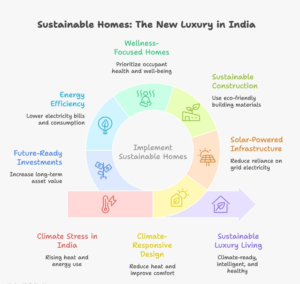
Luxury housing trends are increasingly converging with wellness-focused living.
Modern buyers are paying greater attention to:
Sustainable homes in India naturally align with these priorities.
Well-designed eco-friendly homes can help create:
This wellness-oriented lifestyle positioning is becoming one of the strongest drivers of sustainable luxury housing.
For affluent buyers, sustainable homes are increasingly associated with:
India’s policy ecosystem is increasingly supporting sustainable infrastructure and green housing development.
This policy support is accelerating the growth of sustainable homes in India.
The Energy Conservation Building Code (ECBC) promotes energy-efficient building practices across India.
The framework encourages:
Eco-Niwas Samhita
India’s Eco-Niwas Samhita Guidelines focus on residential energy efficiency and climate-responsive building design.
These frameworks are shaping the future of residential construction across India.
India’s urban planning approach is increasingly integrating:
As climate resilience becomes a national priority, sustainable housing is expected to become an essential part of future urban development.
The luxury housing market in India is entering a new phase.
The next generation of premium homes is likely to be defined by:
Developers and investors are increasingly recognizing that future luxury cannot depend only on appearance.
It must also deliver:
This shift is creating major opportunities within India’s sustainable real estate sector.
According to World Green Building Council, sustainable buildings globally are increasingly viewed as higher-performing and more future-resilient assets.
India is moving rapidly toward similar priorities.
Many developers and construction brands now promote:
However, a major content gap still exists in the Indian market.
Most competitors focus heavily on:
Very few deeply explain:
Similarly, PCC panel competitors often market:
But very few position PCC systems as:
This creates a major educational opportunity for brands focused on sustainable infrastructure and climate-smart construction.
India’s future real estate landscape will increasingly be shaped by climate adaptation and sustainable urban development.
Several long-term trends support this shift:
As these factors continue to strengthen, sustainable homes in India are likely to move from premium niche products to mainstream housing expectations.
Future luxury living will increasingly prioritize:
This transformation represents one of the most important structural changes currently happening within Indian real estate.
1. What are sustainable homes in India?
Sustainable homes in India are residential properties designed using eco-friendly construction methods, energy-efficient systems, climate-responsive architecture, and environmentally responsible materials. These homes focus on:
Modern sustainable homes in India often include:
2. Why are sustainable homes becoming the new luxury in India?
Luxury housing in India is evolving beyond aesthetics and premium interiors. Today’s homebuyers increasingly value:
As temperatures rise across Indian cities, sustainable homes in India are becoming attractive because they offer:
This shift is especially visible among HNIs, NRIs, and long-term investors seeking future-ready real estate assets.
3. How do sustainable homes help during extreme Indian summers?
Sustainable homes in India use climate-responsive architecture and eco-friendly materials that reduce indoor heat buildup.
Features such as:
help maintain better indoor temperatures naturally.
This reduces:
4. What is passive cooling in sustainable homes?
Passive cooling is an architectural approach that reduces indoor heat without relying heavily on air conditioners or mechanical cooling systems.
Common passive cooling techniques include:
Passive cooling plays a major role in sustainable homes in India because it improves thermal comfort while reducing energy consumption.
5. How do PCC panels support sustainable construction in India?
PCC panels and modern prefabricated systems help improve construction efficiency and sustainability.
Benefits include:
In sustainable homes in India, PCC panel systems are increasingly viewed as climate-conscious construction solutions that support future-ready infrastructure.
6. Are sustainable homes more expensive than traditional homes?
The initial construction cost of sustainable homes may sometimes be slightly higher depending on the technology, materials, and systems used.
However, sustainable homes in India often provide:
Over time, these savings can offset higher upfront costs while improving long-term property value.
7. How do solar-powered homes improve long-term living costs?
Solar-powered sustainable homes in India reduce dependence on traditional electricity grids.
Benefits include:
The Indian government is also supporting rooftop solar adoption through subsidy-based initiatives.
8. Why are investors interested in sustainable real estate in India?
Investors increasingly view sustainable homes in India as future-resilient assets because they align with:
Sustainable real estate is also associated with:
9. What government policies support sustainable housing in India?
India is actively promoting sustainable infrastructure and energy-efficient housing through various policies and frameworks.
Major initiatives include:
These frameworks encourage climate-conscious construction and sustainable urban planning.
10. What materials are commonly used in eco-friendly construction?
Eco-friendly construction materials used in sustainable homes in India include:
These materials help reduce:
while improving long-term building performance.
India’s future luxury homes will not simply be larger, taller, or more expensive.
They will be:
As India faces rising temperatures, rapid urbanization, and growing energy demands, sustainable homes in India are emerging as one of the most intelligent and future-ready forms of real estate development.
Eco-friendly construction, climate-conscious architecture, PCC panels, passive cooling systems, solar integration, and sustainable infrastructure are no longer optional innovations — they are becoming essential pillars of future housing.
For investors, HNIs, NRIs, and long-term real estate stakeholders, sustainable homes represent more than environmental responsibility.
They represent:
The next chapter of Indian luxury real estate will not be defined only by how homes look.
It will increasingly be defined by how intelligently they perform in a changing world.