In 2026, the global conversation around infrastructure is undergoing a fundamental shift. What was once viewed as a progressive choice—sustainable construction—has now become a structural necessity. Across continents, climate instability, rising energy demand, and resource depletion are forcing governments, investors, and developers to rethink how buildings are designed, constructed, and operated.
The built environment today is at the center of the climate challenge. According to the United Nations Environment Programme (UNEP), buildings and construction account for nearly 34% of global CO₂ emissions and 32% of global energy consumption. These figures alone underline the urgency to transform conventional practices into sustainable construction models that can align with global climate goals.
At the same time, urban populations are rapidly expanding. The United Nations projects that nearly 68% of the world’s population will live in urban areas by 2050, increasing pressure on infrastructure systems, energy resources, and environmental stability. In such a scenario, continuing with traditional construction methods is no longer viable.
This is where sustainable construction emerges—not as an alternative, but as the only forward path. It represents a shift toward efficiency, resilience, and long-term value creation. For investors, policymakers, and business leaders, understanding the importance of sustainable construction is no longer optional—it is critical for future readiness.
Climate Change and the Built Environment
The impact of climate change is no longer theoretical. Rising global temperatures, extreme weather events, and increasing urban heat stress are directly affecting how buildings perform. Reports from organizations like the World Meteorological Organization (WMO) confirm that recent years have been among the hottest on record, with intensified heatwaves and unpredictable climate patterns.
Traditional construction methods were never designed to operate under such volatile environmental conditions. Buildings constructed without climate responsiveness are becoming inefficient, expensive to maintain, and increasingly vulnerable to environmental stress.
In contrast, sustainable construction integrates climate-resilient design principles, ensuring buildings remain functional and efficient even under extreme conditions.
High Carbon Footprint of Conventional Construction
One of the biggest limitations of traditional construction lies in its heavy dependence on carbon-intensive materials such as cement and steel. According to UNEP and the International Energy Agency (IEA), these materials contribute significantly to global emissions, with construction materials alone accounting for nearly 18% of global carbon output.
The issue is further compounded by embodied carbon—the emissions generated during the manufacturing, transportation, and installation of materials. Conventional construction rarely accounts for this lifecycle impact.
Sustainable construction, however, addresses both operational and embodied carbon, making it a comprehensive solution for reducing environmental impact.
Resource Depletion and Construction Waste
The construction industry is also one of the largest consumers of natural resources. From sand and water to minerals and metals, traditional building practices rely on extraction-heavy processes that are not sustainable in the long run.
Additionally, the industry generates over 2 billion tonnes of construction and demolition waste annually, according to global studies by organizations like GlobalABC. This linear “build-use-dispose” model is increasingly incompatible with future environmental goals.
Sustainable construction introduces circular practices—reusing materials, minimizing waste, and optimizing resource use—making it far more efficient and responsible.
Energy Inefficiency and Rising Costs
Buildings designed without energy efficiency considerations are becoming economically unsustainable. High cooling demands, especially in regions like India and the Middle East, are driving up operational costs.
The International Energy Agency highlights that buildings must significantly reduce energy consumption intensity by 2030 to align with global net-zero targets. Traditional construction simply does not meet these requirements.
This is why sustainable construction, with its focus on energy efficiency and passive design, is becoming essential.
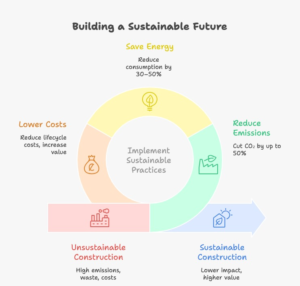
Sustainable construction in 2026 is no longer limited to basic green certifications. It represents a holistic approach that considers the entire lifecycle of a building—from design and materials to operation and eventual reuse.
A Lifecycle-Based Approach
Unlike traditional methods, sustainable construction focuses on whole-life performance. This includes:
This lifecycle perspective ensures long-term efficiency and reduced environmental impact.
Core Pillars of Sustainable Construction
Emerging Innovations
Modern sustainable construction is also driven by innovation:
These advancements are redefining what future-ready buildings look like.
Regulatory Transformation
Governments worldwide are introducing stricter building codes and sustainability regulations. For example:
These policies are making sustainable construction a compliance requirement rather than a voluntary choice.
Economic Advantages for Investors
From an investment perspective, sustainable construction offers significant long-term benefits:
Studies by the International Finance Corporation (IFC) show that green buildings can deliver substantial financial returns over time.
Risk Mitigation and Future Security
Climate risks, regulatory penalties, and rising energy costs are becoming major concerns for investors. Buildings that are not aligned with sustainability standards may face:
Sustainable construction mitigates these risks, ensuring long-term asset stability.
ESG and Capital Flow Trends
Global investment trends are shifting toward ESG (Environmental, Social, Governance) compliance. Institutional investors are increasingly prioritizing assets that align with sustainability principles.
This makes sustainable construction a key factor in attracting global capital.
Financial Efficiency
Sustainable buildings significantly reduce energy and maintenance costs over their lifecycle. This improves profitability and long-term asset value.
Health and Productivity
Research by the World Green Building Council indicates that better indoor environments can improve occupant well-being and productivity.
Environmental Impact
Sustainable construction reduces carbon emissions, conserves resources, and minimizes environmental degradation.
Urban Development Advantages
Sustainable buildings contribute to smarter, more resilient cities, reducing pressure on infrastructure and resources.
Net Zero Movement
Countries are committing to net-zero targets, pushing the adoption of sustainable construction practices.
Circular Economy in Construction
Material reuse and recycling are becoming central to reducing waste.
Technology Integration
AI, IoT, and smart systems are enhancing building performance.
Growth of Green Investments
Sustainable real estate is becoming a multi-trillion-dollar opportunity globally.
The future of construction will be defined by sustainability. With global building space expected to double by 2060, the importance of sustainable construction will only increase.
The International Energy Agency emphasizes that all new buildings must be zero-carbon-ready by 2030 to meet climate targets.
This indicates a clear shift: traditional construction models will gradually become obsolete.
For high-level investors and policymakers, sustainable construction represents strategic positioning.
Early adoption offers:
Ignoring sustainability is no longer a viable option in modern real estate and infrastructure development.
1. What is sustainable construction and why is it important in 2026?
Sustainable construction refers to designing, building, and operating structures in a way that reduces environmental impact while improving efficiency and long-term performance. In 2026, its importance has increased due to climate change, rising energy costs, and stricter global regulations. Buildings currently contribute nearly 34% of global CO₂ emissions, making sustainable construction essential for reducing environmental damage and achieving climate goals.
2. How does sustainable construction help reduce carbon emissions?
Sustainable construction reduces carbon emissions by using energy-efficient designs, renewable energy systems, and low-carbon materials such as recycled steel and alternative cement. It also addresses embodied carbon—the emissions generated during material production and construction—making it a comprehensive approach to lowering overall environmental impact.
3. Why is traditional construction no longer viable for the future?
Traditional construction relies heavily on resource-intensive materials and inefficient energy systems, making it unsustainable in the long term. With increasing climate risks and regulatory pressure, buildings constructed using outdated methods face higher costs, lower efficiency, and potential compliance issues. This is why sustainable construction is rapidly becoming the new standard.
4. What are the key benefits of sustainable construction for investors?
For investors, sustainable construction offers long-term financial advantages, including reduced operational costs, higher asset value, and better return on investment. Sustainable buildings are also more attractive to tenants and buyers, especially as ESG (Environmental, Social, Governance) considerations become central to global investment strategies.
5. How does sustainable construction improve energy efficiency in buildings?
Sustainable construction improves energy efficiency through passive design strategies, advanced insulation, efficient HVAC systems, and renewable energy integration. These features significantly reduce energy consumption, lowering utility costs and environmental impact while improving building performance.
6. What role does sustainable construction play in climate resilience?
Sustainable construction enhances climate resilience by designing buildings to withstand extreme weather conditions, such as heatwaves, floods, and storms. Climate-responsive architecture, better materials, and efficient systems ensure that buildings remain functional and safe under changing environmental conditions.
7. What are sustainable building materials used in modern construction?
Modern sustainable construction uses materials like recycled steel, low-carbon concrete, bamboo, engineered wood, and other renewable or recycled resources. These materials reduce environmental impact while maintaining structural integrity and performance.
8. How do government policies support sustainable construction?
Governments worldwide are introducing policies and building codes that promote sustainable construction. Examples include the European Union’s Energy Performance of Buildings Directive and India’s Energy Conservation and Sustainable Building Code (ECSBC 2024), which set standards for energy efficiency and environmental performance.
9. What is the future of sustainable construction globally?
The future of sustainable construction is centered around net-zero buildings, circular construction practices, and smart technologies. With global building space expected to double by 2060, adopting sustainable methods is critical to reducing emissions and ensuring long-term environmental and economic stability.
10. Why is sustainable construction considered a necessity and not a choice?
Sustainable construction is now a necessity because it addresses multiple global challenges simultaneously—climate change, resource depletion, rising energy costs, and regulatory compliance. As governments, investors, and industries move toward sustainability, buildings that do not align with these standards risk becoming obsolete.
The future of construction is not defined by scale, but by sustainability. The decisions made today will determine the resilience, efficiency, and livability of tomorrow’s cities.
Sustainable construction is no longer an emerging concept—it is the foundation of future development. It addresses climate challenges, improves economic outcomes, and aligns with global regulatory and investment trends.
For organizations like Hindpride, this represents an opportunity to lead—not by following trends, but by shaping the future of responsible construction.
The shift is clear. The need is urgent. The direction is irreversible.
The future will belong to those who build sustainably.