Why Construction Projects in India Rarely Fail on Paper — But Collapse on Site
Every construction project in India begins with certainty on paper. Drawings are approved, consultants sign off, cost sheets are aligned, and timelines are confidently committed to lenders and buyers. Yet, across residential, commercial, hospitality, and infrastructure projects, the same pattern repeats: schedules slip, costs escalate, and quality conversations quietly change tone midway through execution.
This failure is rarely due to poor architectural design or weak intent. Instead, it stems from how construction risk is concentrated at the site level.
That is why the conversation around prefab vs conventional construction India has fundamentally evolved. It is no longer about whether prefabrication is faster or more modern. It is about which construction approach gives developers greater control over risk.
India’s regulatory ecosystem already reflects this shift. The National Building Code (NBC) 2016, published by the Bureau of Indian Standards (BIS), formally recognises prefabrication and systems-based construction as part of mainstream building practice.
Further, BIS has issued IS 15916:2011, a dedicated code of practice covering the planning, design, manufacture, transport, erection, and jointing of prefabricated concrete buildings.
At the policy level, the Ministry of Housing and Urban Affairs (MoHUA) launched the Global Housing Technology Challenge (GHTC-India) to mainstream faster, cost-effective, and scalable construction technologies across India’s housing ecosystem.
Together, these signals confirm one thing clearly: the prefab vs conventional construction India debate is no longer theoretical — it is institutional, regulatory, and economic.
This article breaks the debate down using a developer risk lens, not marketing claims.
Before comparing prefab vs conventional construction India, developers must confront a critical truth:
Most real estate projects in India do not fail because of design errors. They fail because of execution uncertainty.
Execution uncertainty arises when too many variables are allowed to fluctuate simultaneously — labour, weather, site logistics, sequencing, and supervision.
The Three Core Construction Risks in India
Across projects of all scales, risk consistently clusters around three areas:
Conventional construction concentrates all three risks at the site. In contrast, prefabrication redistributes many of these risks into controlled environments.
This redistribution is the real reason prefab vs conventional construction India has become a boardroom-level discussion for developers.
Conventional construction remains dominant in India for valid reasons. It is flexible, familiar, and supported by a deep contractor ecosystem. However, its execution model is structurally exposed to delay risk.
Sequential Dependency: The Core Weakness
In conventional construction, activities follow a strict sequence:
Each step depends entirely on the successful completion of the previous one. If labour is unavailable, weather turns unfavourable, or inspections are delayed, the entire chain stalls.
This sequential nature is precisely why timelines become fragile.
The National Building Code 2016 provides a comprehensive framework for safe and systematic construction, but it cannot eliminate on-site variability inherent to conventional methods.
In the prefab vs conventional construction India comparison, it is important to understand that delays are rarely isolated events. One missed pour can lead to:
Over long timelines, delay risk compounds — eroding margins and credibility.
Labour is the single most underestimated risk in Indian construction planning.
Why On-Site Labour Is Inherently Unstable
India’s construction workforce is characterised by:
When construction slows or halts — whether due to regulatory pauses, environmental restrictions, or cashflow interruptions — labour migrates immediately. Restarting work often means rebuilding teams from scratch.
This volatility directly impacts schedules, supervision quality, and workmanship consistency.
Prefab’s Structural Advantage on Labour
In prefab vs conventional construction India, prefabrication changes labour deployment fundamentally:
While prefab does not eliminate labour dependence, it reduces on-site manpower intensity, making project timelines more resilient.
Quality drift is not sudden failure — it is gradual erosion.
Why Quality Drifts in Conventional Projects
Common drivers include:
Once embedded, quality issues are difficult to reverse without rework.
Prefab and Quality Control
One of the strongest arguments in prefab vs conventional construction India is consistency.
The BIS code IS 15916:2011 governs:
Factory environments allow:
However, prefab quality is not automatic. Without strict adherence to standards, failures can be systemic and expensive.
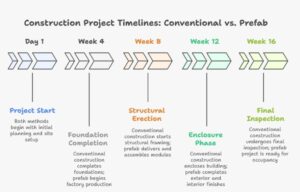
The difference between prefab vs conventional construction India becomes most visible in timeline engineering.
Conventional Construction: Sequential Execution
In traditional models:
Any delay pushes the entire schedule.
Prefabrication: Parallel Workstreams
Prefab enables:
This parallelism compresses critical paths and improves predictability.
Recognising this advantage, MoHUA’s GHTC-India explicitly promotes construction technologies that enable faster and scalable housing delivery.
A mature prefab vs conventional construction India analysis must acknowledge that prefab shifts risk, not removes it.
Risk 1: Early Design Freeze
Prefab demands:
Late changes are costly.
Risk 2: Vendor and Supply Chain Dependence
Developers must evaluate:
Risk 3: Transport and Erection Planning
IS 15916 explicitly covers transport and erection — highlighting their importance.
Poor planning here can negate prefab advantages.
A major myth is that prefab operates outside regulatory norms. This is incorrect.
NBC recognises prefabrication within its structural framework, reinforcing its legitimacy.
BIS Standards
IS 15916 formalises prefabricated concrete construction across its lifecycle.
Execution Discipline
The CPWD Works Manual 2022 emphasises quality assurance, inspections, and systematic execution — principles aligned with prefab methodologies.
Prefab strengthens governance when used correctly.
A balanced prefab vs conventional construction India decision depends on project context.
Prefab Works Best When:
Conventional Construction Works When:
Many successful projects adopt hybrid models, combining prefab structures with conventional finishes.
Hindpride approaches prefab not as a trend, but as a risk-management system.
By aligning:
developers can reduce uncertainty without sacrificing quality.
This aligns with India’s regulatory and policy direction — from NBC 2016 to GHTC-India — toward predictable, scalable construction.
FAQ 1: What is the core difference between prefab vs conventional construction India?
The core difference between prefab vs conventional construction India lies in where construction activities are executed.
In conventional construction, most activities—structural work, curing, finishing, and coordination—take place entirely on site, making outcomes highly dependent on labour availability, weather conditions, and supervision quality. In prefabricated construction, significant portions of the structure are manufactured in controlled factory environments and then transported to the site for assembly.
This shift reduces on-site uncertainty, improves repeatability, and allows parallel execution of activities, which is why prefab is increasingly viewed as a risk-management strategy, not just a speed solution.
India formally recognises prefabrication under the National Building Code (NBC) 2016, reinforcing its legitimacy within mainstream construction practice.
FAQ 2: Is prefabricated construction legally approved in India?
Yes. Prefabricated construction is fully recognised and governed under India’s regulatory framework.
The National Building Code 2016, published by the Bureau of Indian Standards (BIS), includes provisions for prefabrication and systems-based construction. Additionally, IS 15916:2011 provides a dedicated code of practice for prefabricated concrete buildings, covering design, manufacture, transportation, erection, and jointing.
This means the prefab vs conventional construction India debate is not about legality but about execution quality and compliance discipline.
FAQ 3: Does prefab construction actually reduce project delays in India?
Prefab construction can significantly reduce delay risk, but only when planned correctly.
In conventional construction, activities are sequential and highly site-dependent. Any disruption—labour shortage, inspection delay, weather interruption—can stall progress. Prefabrication enables parallel workstreams, where site preparation and component manufacturing happen simultaneously.
This approach shortens critical paths and improves schedule predictability. Recognising this benefit, the Ministry of Housing and Urban Affairs (MoHUA) launched the Global Housing Technology Challenge (GHTC-India) to promote faster and scalable construction technologies.
However, prefab does not eliminate risk—it redistributes it. Poor logistics planning or late design changes can still cause delays.
FAQ 4: How does labour availability affect prefab vs conventional construction India?
Labour volatility is one of the biggest differentiators in prefab vs conventional construction India.
Conventional construction relies heavily on on-site manpower, which is subject to migration, seasonal availability, and productivity variation. Any disruption often results in immediate schedule slippage.
Prefab construction shifts a significant portion of labour to factory environments, where:
This reduces on-site labour intensity and makes project timelines more resilient, especially for large-scale developments.
FAQ 5: Is quality better in prefab construction compared to conventional construction?
Prefab construction offers greater quality consistency, but only when executed under proper standards.
Factory-controlled environments allow better curing, tighter tolerances, and repeatable processes. BIS IS 15916:2011 specifically addresses quality aspects such as joint detailing, tolerances, manufacturing controls, and erection procedures.
In conventional construction, quality is more dependent on workmanship, supervision, and site conditions, increasing the risk of quality drift over time.
That said, prefab quality is not automatic. Without proper QA/QC systems and compliance, failures can be systemic rather than isolated.
FAQ 6: Is prefab construction more expensive than conventional construction in India?
Cost comparisons in prefab vs conventional construction India must consider lifecycle costs, not just initial material expenses.
Prefab may involve:
However, these are often offset by:
For time-sensitive or repetitive projects, prefab often proves cost-efficient in the long run.
FAQ 7: What types of projects benefit most from prefab construction in India?
Prefab construction works best for projects that require:
In prefab vs conventional construction India, prefab is especially effective for affordable housing, mass housing, healthcare facilities, and hospitality projects—segments actively supported under government initiatives like GHTC-India.
FAQ 8: When does conventional construction still make more sense?
Conventional construction remains suitable when:
A realistic prefab vs conventional construction India strategy often involves hybrid solutions, combining prefabricated structural systems with conventional finishes.
FAQ 9: What are the biggest risks developers must manage in prefab construction?
Prefab construction introduces new risks that must be actively managed:
IS 15916 specifically addresses transportation and erection, highlighting their critical role in successful prefab projects.
Developers who underestimate these factors often fail to realise prefab’s benefits.
FAQ 10: How should developers decide between prefab vs conventional construction India?
The decision should be based on risk profiling, not trends.
Developers should evaluate:
The most successful projects adopt a system-based mindset, selecting prefab, conventional, or hybrid approaches based on project-specific risk exposure, not ideology.
In today’s construction environment, speed alone is not enough. Developers need predictability, compliance, and quality assurance—not just faster timelines.
At HINDPRIDE, we don’t treat prefab as a shortcut. We engineer systems-based construction solutions that align with:
Whether your project demands prefabricated, precast, hybrid, or conventional solutions, our approach focuses on reducing delay risk, controlling quality drift, and stabilising execution outcomes.
👉 Talk to Hindpride to evaluate the right construction strategy for your project—based on data, compliance, and long-term value, not assumptions.
Certainty Is the New Competitive Advantage
The real lesson from prefab vs conventional construction India is simple:
Conventional construction offers flexibility but carries uncertainty.
Prefabrication demands discipline but rewards predictability.
Developers who understand where risk originates — and how to redistribute it — will deliver projects faster, with better quality, and fewer surprises.
In today’s Indian real estate market, certainty is not optional — it is a competitive advantage.
Partner with HINDPRIDE to explore prefabricated, precast, and hybrid construction solutions engineered for compliance, quality, and predictable delivery.