India’s urban skyline is evolving at an unprecedented pace. New homes, offices, malls, and mixed‑use developments are rising rapidly to accommodate an expanding population and growing economy. But this transformation brings a pressing question: Can our buildings grow without consuming the planet’s resources at an unsustainable rate?
Traditional construction practices have led to increased energy consumption, excessive water use, waste generation, and poorer indoor environments. These challenges are particularly acute in India, where climate pressures, resource scarcity, and urban density demand smarter solutions. This has brought the concept of sustainable buildings to the forefront — but it’s no longer just a choice or a marketing label. As we approach 2026, green construction in india 2026 is increasingly becoming a mandatory approach, shaped by policy, economics, environmental urgency, and market demand.
In this comprehensive article, we will explore what green construction really means, why it matters more than ever as we approach 2026, how it benefits people and the planet, and what practical steps and regulations are making sustainability a necessity rather than an option.
What Is Green Construction?
At its core, green construction refers to building design, development, and operations that minimize environmental impact while maximizing resource efficiency over the entire lifecycle of a structure — from planning and material sourcing to construction, occupancy, and eventual reuse or demolition.
This approach addresses energy use, water efficiency, indoor environmental quality, the carbon footprint of materials, waste reduction, and site impact — moving beyond the traditional focus solely on aesthetics or upfront cost.
A building designed with sustainability in mind aims not only to do less harm, but to provide positive benefits to occupants, communities, and ecosystems.
Traditional vs. Green Construction
Aspect | Traditional Construction | Green Construction |
Energy Efficiency | Minimal focus | High efficiency, renewable integration |
Water Management | Standard plumbing | Rainwater harvesting, recycling |
Materials | Conventional | Low‑impact, recycled, local |
Indoor Air Quality | Standard | Ventilation & low toxins |
Waste | Minimal reuse | Segregation & recycling |
This shift in philosophy — from conventional to green — is at the heart of green construction in India 2026.
1. Environmental Pressures Demand Change
Buildings today are among the largest consumers of energy and water. According to global studies, nearly 40% of global energy consumption and a significant portion of carbon emissions come from the building sector due to heating, cooling, lighting, and construction processes.
With India’s rapid urbanization and climate commitments, reducing this footprint isn’t just an ideal — it’s an urgent necessity.
2. Policy and Regulation Are Pushing Sustainability
India is transitioning from voluntary adoption of green practices to regulatory enforcement. The most significant policy driving this change is the Eco‑Niwas Samhita (ENS) — an energy performance code for residential buildings developed by the Bureau of Energy Efficiency under the Ministry of Power.
ENS requires new residential constructions above specified plot sizes to meet energy efficiency standards — covering elements such as:
You can explore the official Eco‑Niwas Samhita document here:
Enforcement of such policies means green construction in India 2026 is not simply best practice — it is becoming a compliance requirement tied to construction approvals, occupancy certificates, and municipal regulations.
3. Market Forces Are Rewarding Sustainable Buildings
Consumers, investors, and occupants are increasingly aware of the benefits of sustainable building environments. Data shows that:
These benefits contribute to demand among homeowners and investors alike, strengthening the economic case for sustainable practices.
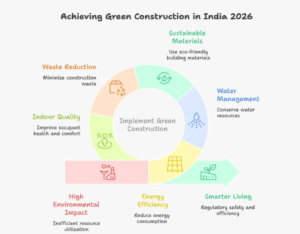
To understand green construction in India 2026, it is essential to break down the key design and execution principles that define it.
1. Energy Efficiency and Renewable Integration
Energy consumption in buildings accounts for a substantial portion of total energy use. Improving energy performance involves:
Research shows that energy-efficient buildings can use 20–40% less energy than conventional buildings when designed and executed correctly.
2. Water Conservation and Management
India’s water scarcity concerns make efficient water use a priority. Sustainable buildings incorporate:
These measures not only conserve water but also reduce dependence on municipal supplies and lower utility bills.
3. Sustainable Materials and Waste Reduction
Construction traditionally generates significant waste and uses high‑impact materials such as cement and steel. Green construction strategies include:
Reducing waste and emissions improves environmental performance and aligns with the Green Construction in India 2026 goals.
4. Indoor Environmental Quality (IEQ)
Occupant well‑being is central to sustainable design. Good IEQ includes:
Studies consistently show that healthier indoor environments improve productivity, reduce illness, and raise satisfaction among occupants — from homes to workplaces.
A common misconception around sustainability is that it always costs more. The reality tells a different story:
Lower Long‑Term Operational Costs
While initial investment in green technologies or materials may be higher, the operational savings — from lower energy and water bills — quickly offset these upfront costs. Over the lifecycle of a building, this can mean thousands of rupees saved annually.
Increased Property Value
Sustainable buildings are in high demand. Buyers and tenants are willing to pay premiums for:
This demand translates to stronger resale values and quicker market absorption.
Incentives and Rebates
Government incentives, rebates on energy‑efficient appliances, and preferential financing from some banks make green construction more financially attractive.
According to industry projections, the green building market in India was projected to reach around $39 billion by 2025 — a strong testament to the economic momentum behind sustainability. (Source: Economic Times
Despite the benefits of green construction in India 2026, certain challenges persist:
Higher Initial Costs
While long‑term savings are significant, the upfront cost of green materials and systems can be perceived as a barrier. However:
Knowledge and Skill Gaps
Many construction teams are trained primarily in conventional methods. Overcoming this requires:
Material Availability
Sourcing sustainable materials may be difficult in some regions. Solutions include:
Regulatory Understanding
Understanding compliance with ENS and related codes can be complex. Educating owners and developers on policy specifics early in the design phase can prevent delays and non‑compliance issues.
The landscape of sustainable building is evolving rapidly. As we approach 2026, several trends are shaping the future of green construction in india 2026:
1. Net‑Zero and Energy‑Positive Buildings
Net‑zero buildings — which generate as much energy as they consume — are no longer futuristic. With rooftop solar, energy‑efficient appliances, and clever design, buildings can achieve remarkable energy independence.
2. Intelligent Energy Management Systems
Smart sensors, IoT devices, and AI‑driven analytics enable buildings to monitor energy usage in real time, optimizing performance and reducing waste.
3. Circular Economy in Construction
Reusing materials, modular construction, and designing for future disassembly are gaining ground — minimizing waste throughout the building lifecycle.
4. Urban Heat Island Mitigation
Green roofs, reflective surfaces, and increased vegetation reduce ambient temperatures in urban areas — improving comfort and reducing cooling energy demand.
These advancements highlight that green construction in india 2026 encompasses design innovation, technology integration, and environmental stewardship.
The most significant driver behind making sustainable building mandatory in India is policy enforcement. The Eco‑Niwas Samhita (ENS) is the most comprehensive code targeting residential energy performance.
ENS encourages:
Compliance with ENS can affect building permits, municipal approvals, and even occupancy certificates. In many urban local bodies, regulations are already being updated to align with ENS requirements, making green construction in India 2026 a regulatory expectation rather than an aspirational goal.
You can read more details about ENS and its provisions.
While policy and economics are powerful motivators, sustainable construction ultimately benefits people — whether you are a homeowner, renter, developer, or designer.
Green buildings consume less energy and water, leading to consistently lower utility costs — often by 20–30%.
2. Enhanced Comfort and Health
Better ventilation, natural lighting, and reduced use of harmful chemicals make homes and offices healthier places to live and work.
3. Future‑Proof Homes
With evolving regulations, buildings that embrace sustainable design today will avoid costly retrofits tomorrow and remain compliant with future standards.
4. Positive Environmental Impact
Choosing green construction contributes to reduced carbon emissions, lower resource depletion, and greater resilience against climate change.
1: What is green construction in India 2026?
Answer:
Green construction in India 2026 refers to a modern approach to building design and construction that prioritizes energy efficiency, resource conservation, and environmental sustainability. It involves using eco-friendly materials, optimizing energy and water use, managing waste responsibly, and creating healthier indoor environments for occupants. By 2026, green construction is increasingly being shaped by regulatory requirements like the Eco-Niwas Samhita (ENS), which sets energy and sustainability standards for residential buildings.
The goal is not only to reduce the environmental footprint of buildings but also to lower operational costs, improve occupant comfort, and future-proof structures against stricter regulations. Green construction integrates renewable energy, smart energy management, and sustainable water practices, ensuring that homes and offices are efficient and environmentally responsible.
2: Why is green construction becoming mandatory in India 2026?
Answer:
The shift towards mandatory green construction in India is largely driven by government policies and environmental imperatives. With regulations like the Eco-Niwas Samhita (ENS), residential buildings above certain plot sizes must meet energy efficiency and sustainability requirements.
This mandatory approach ensures that buildings consume less energy, reduce greenhouse gas emissions, and utilize resources efficiently. As India faces rising energy demand, water scarcity, and urban pollution, compliance with green construction standards is essential to meet climate targets and create livable urban spaces.
For homeowners and developers, this means designing buildings to reduce operational costs, enhance indoor air quality, and increase market value. The 2026 shift emphasizes that sustainability is no longer optional — it is a regulatory and societal expectation.
3: What are the key principles of green construction in India 2026?
Answer:
Green construction in India 2026 is guided by five core principles:
These principles ensure that buildings comply with emerging regulations, reduce environmental impact, and provide long-term financial and health benefits. Integrating them into design and construction processes is essential for future-ready homes and workplaces.
4: How does Eco-Niwas Samhita affect green construction in India 2026?
Answer:
The Eco-Niwas Samhita (ENS) is a key government policy that influences green construction in India 2026. ENS establishes energy efficiency and sustainability standards for residential buildings, including requirements for thermal insulation, renewable energy systems, water efficiency, and indoor environmental quality.
Compliance with ENS affects approvals for construction projects and occupancy certificates, making sustainability a mandatory aspect of building design. For homeowners and developers, ENS ensures that buildings are energy-efficient, cost-effective, and environmentally responsible, aligning with India’s climate goals.
By 2026, ENS compliance will be a significant factor in construction planning, ensuring that new buildings are prepared for stricter sustainability standards in the future.
5: Are green buildings cost-effective in the long run?
Answer:
Yes. While green construction in India 2026 may require slightly higher upfront costs due to sustainable materials or energy-efficient technologies, the long-term savings outweigh the initial investment.
Energy-efficient designs reduce electricity bills, water-saving measures cut utility costs, and renewable energy integration lowers dependence on the grid. According to the Economic Times, green buildings in India are projected to grow to a $39 billion market by 2025, reflecting strong economic viability.
Additionally, sustainable buildings often command higher resale value and appeal to environmentally conscious buyers, making them a financially sound choice. Long-term benefits also include compliance with regulations like ENS, reducing potential costs for retrofits or fines.
6: How can homeowners adopt green construction practices in 2026?
Answer:
Homeowners can adopt green construction in India by 2026 by incorporating energy-efficient designs, sustainable materials, and water-saving solutions during planning and construction. Practical measures include:
Understanding ENS guidelines helps homeowners ensure compliance, avoid penalties, and create energy-efficient, healthy living spaces. By planning proactively, homeowners can reduce operational costs and improve indoor comfort.
7: What are the environmental benefits of green construction in India in 2026?
Answer:
Green construction in India 2026 provides multiple environmental benefits:
These practices not only protect the environment but also enhance urban resilience against climate change. Following green construction principles helps India meet its national climate commitments and supports sustainable urban development.
8: What challenges do builders face with green construction in India in 2026?
Answer:
Builders face several challenges in adopting green construction in India 2026, including:
These challenges can be addressed by proper planning, phased implementation, collaboration with certified green consultants, and early engagement with suppliers and regulators. Overcoming these obstacles ensures compliance, financial viability, and long-term sustainability.
9: What are the key trends shaping green construction in India 2026?
Answer:
Several emerging trends define green construction in India 2026:
These trends reflect the growing focus on technology, environmental responsibility, and regulatory compliance. Developers, homeowners, and architects who embrace these trends are likely to build efficient, future-ready, and sustainable structures.
10: How does green construction improve health and indoor comfort?
Answer:
Green construction in India 2026 emphasizes indoor environmental quality (IEQ), which directly impacts health and comfort. Features include:
Research shows that occupants of green buildings report fewer respiratory issues, higher productivity, and improved satisfaction. Beyond environmental and financial benefits, green construction ensures that residents enjoy healthier and more comfortable living and working spaces.
As India approaches 2026, the era of conventional, resource-intensive construction is gradually coming to an end. The combination of policy mandates, environmental imperatives, and growing market awareness is reshaping the way buildings are designed, constructed, and maintained. Green construction in India 2026 is no longer a voluntary trend—it is rapidly becoming a regulatory and practical necessity, driven by frameworks like the Eco-Niwas Samhita (ENS).
The benefits of embracing green construction are far-reaching. At a fundamental level, these practices reduce energy consumption, conserve water, minimize waste, and lower carbon emissions, contributing directly to India’s climate action goals. Beyond environmental impact, sustainable buildings improve the quality of life for occupants, offering healthier indoor air, better ventilation, access to natural light, and safer materials. These advantages lead to enhanced productivity, comfort, and well-being for families, employees, and communities.
Economically, green construction represents a smart long-term investment. Although initial costs may be slightly higher, operational savings on energy and water bills, coupled with increased property value, make sustainable buildings financially advantageous. Moreover, compliance with ENS and other emerging regulations safeguards homeowners and developers against potential legal or financial penalties, ensuring that buildings remain future-ready. Market trends indicate that green buildings are increasingly preferred by investors and buyers, with the sector projected to reach billions of dollars in value by 2025.
For builders, architects, and homeowners, 2026 represents a pivotal moment: a time to adopt innovative designs, sustainable materials, and energy-efficient systems that align with both regulatory requirements and environmental responsibility. Incorporating renewable energy, modular construction techniques, smart sensors, and water management systems ensures that buildings not only meet today’s standards but also anticipate the evolving demands of urban living and climate resilience.
In conclusion, green construction in India 2026 is more than a compliance obligation; it is a holistic approach that integrates environmental stewardship, economic efficiency, and human well-being. By prioritizing sustainability, stakeholders can future-proof their investments, enhance the quality of life for occupants, and contribute positively to India’s journey toward a low-carbon, resource-efficient built environment.
Ultimately, embracing green construction is a commitment to responsible development—a conscious choice to build structures that stand the test of time, benefit communities, and respect the planet. As the nation moves toward 2026, every decision made today about design, materials, and energy use will define the legacy of our urban landscapes. Sustainable buildings are not just smart; they are essential. They are the blueprint for a resilient, healthy, and prosperous India.