For years, housing conversations in India were driven mainly by location, size, and price. Those factors still matter, but in 2026, another layer has become impossible to ignore: how a home performs over time. More people are now asking whether a home can stay comfortable in extreme weather, whether it uses energy efficiently, whether it manages water responsibly, and whether its design supports healthier daily living. That is exactly why sustainable homes in 2026 have become one of the most relevant housing conversations in the country.
This shift is not based on fashion alone. It is being shaped by real conditions. India’s residential electricity demand has been rising at an average 8% CAGR, and the residential sector is projected to account for 36.5% of total electricity consumption by 2032, according to the Bureau of Energy Efficiency’s Eco-Niwas Samhita 2024. That means housing is no longer only a real estate issue; it is also an energy, comfort, and long-term livability issue. Eco-Niwas Samhita 2024
The broader global picture points in the same direction. UNEP reports that buildings and construction consume 32% of global energy and contribute 34% of global CO2 emissions. It also notes that materials such as cement and steel are responsible for 18% of global emissions, which shows that the future of housing is tied not just to how homes operate, but also to how they are built.
Seen together, these changes explain why sustainable homes in 2026 are being viewed more seriously. The idea is no longer limited to “green branding.” It now includes energy-efficient design, passive cooling, better water management, healthier interiors, and more responsible construction practices. In other words, the home of the future is increasingly defined by performance, resilience, and resource intelligence.
One reason sustainable homes in 2026 matter so much is that Indian households are entering a period where everyday operating performance is becoming a bigger concern. A home that overheats quickly, depends heavily on artificial cooling, wastes water, or ignores daylight and ventilation may still look attractive on the surface, but it places more pressure on both residents and infrastructure over time. The real value of a home increasingly lies in how efficiently it supports daily life.
This is where the current policy direction becomes important. Eco-Niwas Samhita 2024 is not a narrow document focused on just one feature. It frames residential sustainability through a wider lens that includes energy conservation, water conservation, waste management, renewable energy systems, and indoor environmental quality. That signals a major shift in how future-ready housing is being understood in India. Eco-Niwas Samhita 2024
This makes sustainable homes in 2026 especially relevant for Indian conditions. They respond to heat, rising utility pressure, and long-term resource use in a practical way. They are not about rejecting conventional housing or criticizing any location or project format. They are about improving the way homes are designed and built so they remain more comfortable, efficient, and future-ready.
A sustainable home is not defined by one visible element. Solar panels alone do not make a home sustainable. Landscaping alone does not make it sustainable. Even premium finishes do not make it sustainable. What defines sustainable homes in 2026 is how different systems work together to reduce waste, improve comfort, and strengthen long-term building performance.
At the design level, this begins with the building envelope. Orientation, shading, roof treatment, wall design, glazing, and ventilation paths all influence how much heat enters the building and how much energy is later required to keep the interiors comfortable. Good design can reduce the dependence on mechanical cooling before any equipment is installed.
At the systems level, sustainability includes efficient lighting, better water fixtures, renewable energy readiness, improved airflow, rainwater harvesting, and waste management. At the experience level, it includes thermal comfort, better daylight, healthier air, and a more stable indoor environment. This broader definition is reflected directly in Eco-Niwas Samhita 2024, which includes provisions linked to envelope performance, building services, water use reduction, daylight availability, ventilation, and indoor environmental quality. Eco-Niwas Samhita 2024
That is why sustainable homes in 2026 should be understood as better-performing homes. They are not only environmentally aware; they are also more practical for the realities of modern urban and semi-urban living.
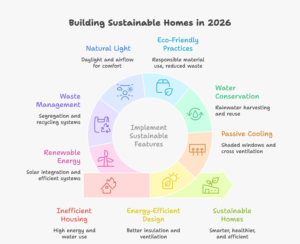
One of the strongest reasons the idea of sustainable homes in 2026 is gaining momentum is that energy-efficient design is becoming more central to residential quality. A well-designed home not only reduces energy use on paper. It can improve everyday comfort, support lower long-term operational demand, and create more stable indoor conditions.
This matters because design decisions often shape long-term performance more deeply than appliances do. A home with poor orientation or excessive heat gain may require more cooling year after year. A home with thoughtful shading, better ventilation, and stronger envelope logic can reduce some of that burden from the start. In many ways, efficiency begins with design intelligence rather than gadgets.
This is also why energy-efficient housing is increasingly being supported by organized frameworks. IGBC states that green homes can deliver 20–30% energy savings and 30–50% water savings, while also improving air quality, daylight, and occupant wellbeing. That makes the case for sustainable homes in 2026 stronger because the benefits are both environmental and practical.
In simple terms, an energy-efficient home is not just a lower-consumption home. It is often a more comfortable, more durable, and more future-ready home. That is why efficiency is now becoming part of how residential quality itself is judged.
For India, one of the most meaningful parts of the sustainable homes in 2026 conversation is passive cooling. As temperatures rise and cooling demand grows, passive design becomes more important not just for environmental reasons, but for comfort and affordability as well.
The India Cooling Action Plan makes this especially relevant. According to the Press Information Bureau, the plan aims at reducing cooling demand, enhancing energy efficiency, and improving cooling access through a long-term vision. The same PIB note also states that, to promote passive cooling in buildings, BEE has brought out the Energy Conservation Building Code for large commercial buildings and Eco-Niwas Samhita for residential buildings.
Passive cooling strategies can include better orientation, shaded openings, cross ventilation, roof treatments that reduce heat absorption, and landscape elements that help moderate the microclimate. These approaches do not replace all active cooling needs, but they can reduce the intensity of dependence on mechanical systems.
That is why sustainable homes in 2026 are especially relevant in India. They support a design language that works with climate realities instead of constantly fighting them. This is not about criticizing any current housing model. It is about recognizing that design can evolve to make homes better suited to contemporary conditions.
A strong discussion of sustainable homes in 2026 should not stop at operations. It also needs to consider the construction stage. The materials used, the amount of waste generated, and the durability of the finished structure all shape a project’s long-term environmental impact.
UNEP’s buildings report highlights the significance of construction materials by noting that cement and steel are responsible for 18% of global emissions and are also major contributors to construction waste. That is a reminder that housing sustainability begins before possession.
This is where eco-friendly construction becomes important. It is not simply about using “green” language. It is about reducing unnecessary waste, improving planning discipline, selecting materials more thoughtfully, and building for durability and long-term performance. Homes that are designed and executed with more care can often age better, perform better, and require fewer corrective interventions later.
In this context, sustainable homes in 2026 represent an upgrade in building logic. They encourage a more complete view of housing quality, one that values efficient use of resources alongside comfort and design appeal.
Energy is only one side of the story. Sustainable homes in 2026 are also deeply connected to water. As Indian cities continue to grow, water stress is becoming a major planning concern, which makes water-conscious housing more important.
Eco-Niwas Samhita 2024 includes sections on site water use reduction, building water use reduction, monitoring, rainwater harvesting, recycled water use, and wastewater reuse. This shows that future-ready residential design is increasingly expected to account for water systems, not merely energy systems. Eco-Niwas Samhita 2024
IGBC’s data adds another practical dimension by stating that green homes can save 30–50% water. That is an important point because it makes sustainability easier to understand at the household level. Water efficiency is not only a larger environmental virtue; it can also support more responsible daily resource use.
This is one more reason sustainable homes in 2026 are being taken seriously. They are better aligned with the resource realities of the coming decade.
One of the most relatable strengths of sustainable homes in 2026 is that they often create better everyday living conditions. People may not always discuss codes or emissions, but they do notice when a home feels bright without glare, airy without discomfort, and cooler without constant dependence on heavy cooling.
IGBC highlights improved air quality, excellent daylighting, and health and well-being among the key benefits of green homes. These points matter because they connect sustainability to lived experience.
Similarly, the broader residential code approach in India increasingly acknowledges indoor environmental quality as a core issue. That makes the case for sustainable homes in 2026 even more complete. They are not just about reducing consumption. They are also about improving the quality of the indoor environment where people spend most of their time.
The strongest reason sustainable homes in 2026 will remain relevant is that they sit at the meeting point of policy, climate response, and practical household benefit. Better energy performance, better water systems, passive cooling, healthier interiors, and more responsible construction are not short-term talking points. They respond to real, ongoing needs.
This is why the idea should be treated as an evolution in housing rather than a niche category. It does not require criticizing conventional homes, projects, or locations. It simply recognizes that the expectations around housing performance are becoming more advanced. The future home is expected to do more than look good. It is expected to function well over time.
1. What are sustainable homes in 2026?
Sustainable homes in 2026 refer to residential buildings designed to reduce energy consumption, manage water efficiently, improve indoor comfort, and minimize environmental impact during construction and operation. These homes typically incorporate climate-responsive architecture, energy-efficient building envelopes, better ventilation, water conservation systems, and responsible construction practices.
In India, frameworks like Eco-Niwas Samhita (ENS) 2024 guide residential sustainability by focusing on energy efficiency, water management, indoor environmental quality, and responsible resource use. These standards help ensure that housing developments align with long-term environmental and infrastructure needs.
2. Why are sustainable homes becoming important in India?
Sustainable homes are gaining importance because India’s residential energy demand is growing rapidly as urban populations increase and cooling needs rise. According to the Bureau of Energy Efficiency, residential electricity consumption has been increasing steadily and is expected to represent a major share of the country’s total energy use in the coming decades.
Homes designed with better insulation, ventilation, daylight management, and energy-efficient systems can reduce electricity demand and improve comfort. As cities expand, sustainable housing solutions help support more balanced use of energy, water, and land resources.
3. What are the key features of sustainable homes in 2026?
Modern sustainable homes combine several design and operational elements that work together to improve efficiency and livability. Key features often include:
These features help homes operate efficiently while supporting comfortable living conditions for residents.
4. Do sustainable homes actually reduce energy consumption?
Yes. Homes designed with energy-efficient architecture and systems can significantly reduce energy consumption over time. Studies from the Indian Green Building Council (IGBC) suggest that green homes can achieve 20–30% energy savings compared to conventional homes.
Energy efficiency improvements may come from better insulation, optimized orientation, improved natural lighting, energy-efficient lighting systems, and efficient appliances.
5. How does passive cooling work in sustainable homes?
Passive cooling is a design approach that reduces indoor heat without relying entirely on mechanical air-conditioning systems. It uses architectural strategies such as:
India’s India Cooling Action Plan promotes passive cooling and energy-efficient building practices as part of the country’s long-term strategy to reduce cooling demand.
6. Are sustainable homes more expensive to build?
The construction cost of sustainable homes can vary depending on design choices and materials. However, many sustainable features—such as passive cooling, better daylight access, and efficient water systems—focus on smarter design rather than expensive technology.
Over time, energy savings, water efficiency, and lower operational costs can offset the initial investment. This is why many housing experts view sustainable homes as long-term value investments rather than short-term cost increases.
7. What role does eco-friendly construction play in sustainable housing?
Eco-friendly construction focuses on reducing environmental impact during the building process. This includes improving material efficiency, reducing construction waste, and selecting durable building materials that last longer.
According to the UNEP Global Status Report for Buildings and Construction, the building sector accounts for a large share of global energy consumption and emissions, which highlights the importance of improving construction practices worldwide.
8. How do sustainable homes manage water efficiently?
Water efficiency is a major component of sustainable residential design. Homes can incorporate several water-saving measures, such as:
These practices help reduce overall water demand and support more responsible resource management in growing urban environments.
9. Do sustainable homes improve indoor living conditions?
Yes. Sustainable homes often focus on indoor environmental quality by improving ventilation, increasing access to natural light, and reducing indoor pollutants. These design improvements can make homes more comfortable and support healthier daily living.
Research from green building organizations shows that well-designed homes with natural daylight and ventilation can contribute to improved occupant well-being and comfort.
10. How can buyers identify a sustainable home project?
Buyers interested in sustainable housing can look for several indicators when evaluating a residential project:
These indicators can help buyers understand whether a home is designed to perform efficiently over time rather than simply appearing environmentally friendly.
The housing conversation in India is gradually moving beyond surface-level features and into a deeper discussion about performance, resilience, and long-term livability. That is why sustainable homes in 2026 are increasingly seen not just as environmentally responsible buildings, but as a practical response to the changing realities of modern living. As cities grow, climates shift, and infrastructure systems face greater demand, homes that use energy, water, and materials more intelligently are becoming more relevant for both residents and the broader urban ecosystem.
One of the most important reasons sustainable homes are gaining attention in 2026 is the growing recognition that housing must align with resource efficiency. According to the Bureau of Energy Efficiency, India’s residential electricity consumption is rising steadily, and improving the energy performance of buildings is essential for managing future demand. Frameworks such as Eco-Niwas Samhita 2024 encourage residential developments to adopt better building envelopes, efficient systems, improved ventilation, and responsible water management practices. These measures demonstrate how sustainability in housing can support comfort, efficiency, and long-term performance simultaneously.
At the global level, similar conclusions are being reached. The UNEP Global Status Report for Buildings and Construction highlights that the buildings sector accounts for about 32% of global energy consumption and 34% of global carbon emissions, making improvements in building design and construction an important part of sustainable development strategies worldwide. This broader perspective reinforces why sustainable homes in 2026 are becoming an essential part of conversations about the future of housing rather than a niche category within it.
Another important dimension of sustainable homes in 2026 is their potential to improve everyday living conditions. Homes designed with thoughtful daylighting, better ventilation, passive cooling strategies, and efficient water systems can create more comfortable indoor environments while reducing resource consumption. Organizations such as the Indian Green Building Council (IGBC) highlight that green homes can achieve 20–30% energy savings and up to 30–50% water savings, while also supporting healthier indoor environments for occupants.
When viewed together, these developments suggest that the evolution of housing is not simply about adopting new technologies. It is about integrating better design principles, climate-responsive architecture, and responsible construction practices into the way homes are planned and built. In this sense, sustainable homes in 2026 represent a broader shift toward housing that balances modern aspirations with environmental awareness and long-term functionality.
For the real estate and construction industry, this transition presents an opportunity to rethink how residential spaces are designed for the future. Builders, planners, and architects increasingly recognize that homes built today will shape the environmental and urban conditions of tomorrow. As a result, the focus is gradually shifting toward housing models that prioritize efficiency, durability, and responsible resource use without compromising comfort or design quality.
Within this evolving landscape, companies working in eco-friendly construction—including Hindpride—have an opportunity to contribute to the larger movement toward more sustainable and future-ready housing. By aligning building practices with energy-efficient design principles, responsible material use, and environmentally conscious planning, such developers can help shape residential spaces that support both modern living and long-term environmental balance.
Ultimately, the conversation around sustainable homes in 2026 is not about promoting one building approach over another or criticizing existing developments. Instead, it is about recognizing that housing is entering a new phase where efficiency, resilience, and environmental awareness are becoming central to the definition of quality. As India continues to grow and urbanize, homes that combine thoughtful design with responsible resource management will likely play an increasingly important role in shaping the future of residential living.