The global real estate and construction sectors are undergoing one of the most significant transformations in modern history. Climate change, rising energy costs, increasing urbanization, resource scarcity, and evolving consumer preferences are reshaping how homes are designed, built, and valued. Across the world, governments, investors, developers, and homebuyers are moving beyond traditional construction methods and embracing a future centered on sustainability, resilience, and efficiency.
In India, this shift is becoming increasingly visible. As one of the world’s fastest-growing economies, India is expected to witness substantial urban expansion over the coming decades. However, this growth brings challenges related to carbon emissions, energy consumption, water scarcity, construction waste, and climate vulnerability. These challenges are driving demand for sustainable, eco-friendly homes that combine environmental responsibility with long-term economic value.
At the same time, modern construction technologies such as PCC (Precast Concrete Construction) Panels are emerging as powerful solutions to improve efficiency, reduce waste, enhance quality, and accelerate project delivery. Together, sustainable housing principles and PCC panel technology are creating a new blueprint for intelligent living.
For investors, HNIs, NRIs, policymakers, and business leaders, understanding this transition is no longer optional. It represents a long-term structural trend that is likely to influence the future of India’s real estate market for decades to come.
The built environment plays a critical role in global sustainability efforts. According to the United Nations Environment Programme (UNEP), buildings and construction account for approximately 34–37% of global carbon emissions and nearly one-third of global energy consumption.
As governments commit to climate goals and net-zero targets, the pressure to reduce the environmental footprint of buildings continues to increase.
Why Traditional Construction Models Are Under Pressure
Conventional construction methods often face challenges such as:
These inefficiencies create both environmental and economic concerns, particularly in rapidly urbanizing countries.
Climate Change Is Reshaping Housing Demand
Modern homebuyers are increasingly prioritizing:
Heatwaves, flooding events, water scarcity, and rising utility costs are making sustainable living a practical necessity rather than a lifestyle preference.
As a result, sustainable eco-friendly homes are becoming a preferred choice among informed investors and future-focused homeowners.
A sustainable eco-friendly home is designed to minimize environmental impact while maximizing efficiency, comfort, and long-term value.
Unlike traditional homes that primarily focus on immediate construction costs, sustainable homes consider the entire lifecycle of the building.
Energy Efficiency
Energy-efficient design reduces electricity consumption through:
Water Conservation
Water management systems often include:
Sustainable Building Materials
Environmentally responsible construction may utilize:
Healthy Indoor Environments
Features include:
These elements collectively enhance quality of life while reducing environmental impact.
One of the most important innovations supporting sustainable construction is the adoption of PCC (Precast Concrete Construction) Panels.
What Are PCC Panels?
PCC panels are factory-manufactured concrete components produced in controlled environments and assembled at the project site.
These panels can be used for:
Unlike conventional on-site construction, PCC panel systems are manufactured with precision before installation.
Faster Project Delivery
Because manufacturing and site preparation occur simultaneously, project timelines can be significantly reduced.
Benefits include:
Improved Quality Control
Factory-controlled production enables:
Lower Construction Waste
Traditional construction often generates substantial waste due to cutting, breakage, weather exposure, and rework.
PCC panel manufacturing optimizes material utilization and reduces unnecessary wastage.
The global precast concrete market continues to expand due to rising demand for efficient and sustainable construction.
Market analysis indicates that the global precast concrete industry is projected to reach approximately USD 191 billion by 2033.
The growth is being driven by:
Environmental performance is one of the strongest arguments supporting sustainable housing.
Reduced Carbon Emissions
Buildings contribute significantly to greenhouse gas emissions through:
Sustainable eco-friendly homes help reduce operational emissions through energy-efficient design and resource optimization.
According to UNEP, decarbonizing the building sector is essential to achieving global climate targets.
Reduced Construction Waste
Construction waste remains one of the largest waste streams globally.
PCC panel systems support waste reduction through:
Water Conservation
Water stress is becoming an increasingly important issue across India.
Sustainable eco-friendly homes address this challenge through:
Reducing water dependence enhances both environmental sustainability and long-term cost efficiency.
Efficient Resource Utilization
Sustainable homes optimize:
This integrated approach supports long-term environmental stewardship.
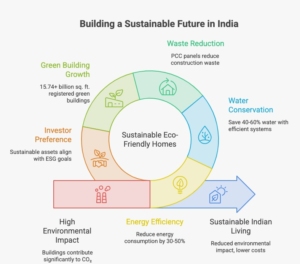
Beyond environmental benefits, sustainable eco-friendly homes offer compelling economic advantages.
Lower Operating Costs
Energy-efficient homes generally consume less electricity and water.
Over the lifespan of a property, savings can accumulate through:
These operational efficiencies contribute to stronger lifecycle economics.
Enhanced Asset Value
As sustainability becomes a mainstream consideration, environmentally responsible properties may benefit from stronger long-term demand.
Factors influencing value include:
Globally, investors are increasingly evaluating environmental performance when assessing real estate assets.
ESG-Oriented Investment Trends
Environmental, Social, and Governance (ESG) investing continues to grow worldwide.
Institutional investors increasingly favor assets aligned with sustainability objectives.
This trend is expected to influence residential and commercial real estate development across emerging markets, including India.
Future-Proofing Real Estate Investments
Sustainable eco-friendly homes are positioned to benefit from:
For long-term investors, these factors represent important risk management considerations.
Climate resilience is becoming one of the most important drivers of future housing demand.
Preparing for a Changing Climate
India faces increasing exposure to:
Future-ready housing must be designed to adapt to these challenges.
Resilient Design Principles
Climate-resilient homes often incorporate:
Passive Cooling
Reducing dependence on air conditioning through:
Thermal Efficiency
Maintaining comfortable indoor temperatures while reducing energy consumption.
Water Security
Supporting long-term resilience through water conservation systems.
Durable Construction
PCC panel technology contributes to durability, consistency, and long-term structural performance.
Investors increasingly evaluate:
Climate resilience is becoming an important component of asset preservation and future value creation.
India has emerged as one of the world’s leading green building markets.
The Indian Green Building Council (IGBC) reports:
These figures demonstrate growing acceptance of sustainable construction practices across sectors.
Green Building Certifications Driving Change
Several certification frameworks guide sustainable development in India.
IGBC
The Indian Green Building Council promotes sustainable construction across residential, commercial, and industrial sectors.
GRIHA
The Green Rating for Integrated Habitat Assessment serves as India’s national green building rating system.
LEED
Widely recognized internationally, LEED certification remains influential among global investors and developers.
Key programs include:
These initiatives encourage resource-efficient urban development and energy-conscious construction practices.
The future of real estate is increasingly linked to sustainability performance.
Sustainability as Wealth Preservation
High-net-worth investors often focus on:
Sustainable eco-friendly homes align with these objectives.
Growing Demand for Future-Ready Living
Consumer preferences continue to evolve.
Modern buyers increasingly value:
These factors influence both purchasing decisions and property valuation.
Policy and Regulatory Alignment
Global and national sustainability frameworks are encouraging:
Properties aligned with these trends may be better positioned for future compliance requirements.
The coming decade is expected to bring significant changes to the construction and housing sectors.
Industrialized Construction Will Accelerate
Construction methods are becoming increasingly technology-driven.
Growth areas include:
Net-Zero Housing Will Gain Momentum
Future residential developments are expected to increasingly incorporate:
Smart Sustainable Communities Will Expand
Integrated developments may include:
Sustainability Will Become Mainstream
What is considered innovative today may become standard practice tomorrow.
Developments that prioritize:
are likely to define the next generation of real estate assets.
Indicator | Data |
Global Building Emissions | 34–37% of total emissions |
Global Building Energy Demand | Approximately 32% |
India’s Registered Green Building Footprint | 15.74+ Billion Sq. Ft. |
Registered IGBC Projects | 19,000+ |
Global Precast Concrete Market Forecast | USD 191 Billion by 2033 |
Sources:
1. What are sustainable eco-friendly homes, and why are they becoming important in India?
Sustainable eco-friendly homes are residential properties designed to reduce environmental impact through energy efficiency, water conservation, sustainable materials, and resource optimization. As India faces increasing urbanization, climate challenges, and rising utility costs, these homes offer a practical solution for long-term sustainable living.
2. How do sustainable eco-friendly homes help reduce carbon emissions?
Sustainable eco-friendly homes reduce carbon emissions through energy-efficient design, natural ventilation, improved insulation, renewable energy integration, and reduced resource consumption. Efficient buildings require less energy for cooling, heating, and lighting, resulting in lower greenhouse gas emissions over their lifecycle.
3. What role do PCC Panels play in sustainable eco-friendly homes?
PCC (Precast Concrete Construction) Panels support sustainable eco-friendly homes by reducing construction waste, improving quality control, accelerating project timelines, and optimizing material usage. Factory-controlled manufacturing ensures greater efficiency and consistency compared to conventional construction methods.
4. Are sustainable eco-friendly homes more cost-effective in the long run?
Yes. While initial investments may vary depending on design and technology choices, sustainable eco-friendly homes often generate long-term savings through lower electricity bills, reduced water consumption, lower maintenance requirements, and improved building durability.
5. How do sustainable eco-friendly homes improve energy efficiency?
Sustainable eco-friendly homes incorporate energy-saving features such as passive solar design, efficient insulation, natural ventilation, LED lighting, smart energy management systems, and renewable energy sources like rooftop solar panels.
6. Can sustainable eco-friendly homes help address water scarcity issues?
Absolutely. Many sustainable eco-friendly homes integrate rainwater harvesting, greywater recycling, water-efficient fixtures, and sustainable landscaping practices that significantly reduce dependence on municipal water supplies and help conserve valuable resources.
7. What certifications should buyers look for in sustainable eco-friendly homes?
Homebuyers can evaluate sustainable eco-friendly homes through recognized certifications such as GRIHA, IGBC, and LEED. These certifications assess factors including energy efficiency, water conservation, indoor environmental quality, and sustainable construction practices.
8. Why are investors increasingly interested in sustainable eco-friendly homes?
Investors view sustainable eco-friendly homes as future-ready assets because they align with global ESG trends, climate resilience goals, and evolving consumer preferences. Sustainable properties may also benefit from stronger long-term demand and operational cost efficiencies.
9. Are sustainable eco-friendly homes better prepared for climate change?
Yes. Sustainable eco-friendly homes are often designed with climate resilience in mind, incorporating features such as thermal efficiency, passive cooling, water management systems, durable construction materials, and site planning strategies that help withstand environmental challenges.
10. What is the future outlook for sustainable eco-friendly homes in India?
The future of sustainable eco-friendly homes in India looks promising due to growing environmental awareness, government sustainability initiatives, green building certifications, smart city development, and increasing adoption of advanced construction technologies such as PCC Panels. These factors are expected to drive significant growth through 2035 and beyond.
The future of housing is being shaped by sustainability, resilience, efficiency, and intelligent design. As climate concerns intensify and resource management becomes increasingly important, sustainable eco-friendly homes are emerging as a practical solution for modern living.
At the same time, PCC panel technology is transforming how buildings are constructed by improving efficiency, reducing waste, enhancing quality, and supporting scalable development.
For investors, HNIs, NRIs, policymakers, and business leaders, these trends represent more than environmental progress. They reflect a broader shift toward long-term value creation, operational efficiency, and future-ready real estate development.
The next decade is likely to reward projects that successfully combine sustainability, climate resilience, technological innovation, and responsible resource management. In this evolving landscape, sustainable eco-friendly homes supported by advanced construction technologies such as PCC panels are positioned to become a defining feature of India’s future built environment.