India is building at a scale never seen before. From urban housing and commercial hubs to expressways, metros, and smart cities, construction activity is accelerating across regions. But alongside growth comes an invisible crisis—construction and demolition waste.
According to the Central Pollution Control Board (CPCB), India generates over 150 million tonnes of construction and demolition waste every year, and this figure is rising rapidly with urbanisation and redevelopment projects. Yet, less than 1% of this waste is scientifically processed or recycled.
To address this growing environmental and urban management challenge, the Government of India notified the construction and demolition waste rules 2016 under the Environment (Protection) Act. These rules fundamentally changed how developers, contractors, and project owners are expected to handle construction debris.
Today, the construction and demolition waste rules 2016 are no longer just a regulatory document—they are a compliance checkpoint, an approval requirement, and increasingly, a risk factor that can stall projects, invite penalties, and damage reputations.
This blog is a complete, fact-based compliance playbook that explains the construction and demolition waste rules 2016 in simple, actionable terms for Indian developers.
The construction and demolition waste rules 2016 were notified by the Ministry of Environment, Forest and Climate Change (MoEFCC) to regulate waste generated from construction, renovation, repair, and demolition activities.
Scope of the Rules
Under the construction and demolition waste rules 2016, C&D waste includes:
The rules apply to:
In short, every construction activity in India falls under the construction and demolition waste rules 2016, regardless of project size.
Unregulated dumping of construction debris had become a major contributor to:
The CPCB highlights that construction waste contributes significantly to PM10 and PM2.5 pollution, especially in cities like Delhi-NCR.
The construction and demolition waste rules 2016 were introduced to:
One of the most misunderstood aspects of the construction and demolition waste rules 2016 is responsibility.
Who Is the “Waste Generator”?
Under Rule 3 of the construction and demolition waste rules 2016, the waste generator includes:
This means liability cannot be outsourced.
Even if a contractor or vendor handles debris, legal responsibility remains with the waste generator.
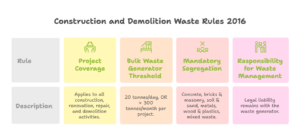
The construction and demolition waste rules 2016 clearly define mandatory duties:
1. Segregation at Source
Waste must be segregated into:
Mixing C&D waste with municipal solid waste is a direct violation.
2. Storage Within Premises
Waste must be stored:
It must not obstruct:
3. Transportation to Authorised Facilities
Waste must only be transported to:
The bulk waste generator clause is the most enforced part of the construction and demolition waste rules 2016—and also the most ignored.
Who Is a Bulk Waste Generator?
You qualify as a bulk waste generator if:
Mandatory Requirements for Bulk Generators
Under the construction and demolition waste rules 2016, bulk generators must:
Failure to comply can result in:
Storage, Transport, and Disposal Rules Explained Simply
The construction and demolition waste rules 2016 strictly prohibit:
Transport Norms
With cities now using GPS-enabled vehicles and digital tracking, illegal dumping is increasingly traceable.
The construction and demolition waste rules 2016 are actively enforced, especially in metro regions.
In 2024, the Municipal Corporation of Delhi reported ₹1.8 crore in fines imposed on construction sites for pollution and waste violations.
This clearly shows that non-compliance now has real financial consequences.
A key objective of the construction and demolition waste rules 2016 is to promote recycled construction materials.
Recycled Aggregates
Processed C&D waste can be reused as:
The Bureau of Indian Standards (BIS) permits recycled aggregates under IS 383:2016, subject to quality control.
This reduces:
Delhi-NCR is emerging as India’s most regulated region for C&D waste.
Delhi’s Tehkhand plant processes thousands of tonnes of construction waste daily.
Ward-Level Debris Sites
The city is also rolling out ward-level debris collection centres.
These developments indicate that enforcement infrastructure is expanding rapidly.
Before Construction
During Construction
Post Construction
Developers who align early with the construction and demolition waste rules 2016 benefit from:
Compliance is no longer a cost—it is a competitive advantage.
The construction and demolition waste rules 2016 mark a shift in how India builds. They demand accountability, discipline, and foresight from every developer.
In an era where approvals are data-driven and enforcement is visible, ignoring construction waste compliance is no longer an option.
For developers committed to responsible building, material efficiency, and long-term value creation, aligning with the construction and demolition waste rules 2016 is not just about following the law—it’s about building smarter, cleaner, and future-ready India.
1. What are the construction and demolition waste rules 2016 in India?
The construction and demolition waste rules 2016 are regulations notified by the Ministry of Environment, Forest and Climate Change (MoEFCC) to scientifically manage waste generated from construction, renovation, repair, and demolition activities across India.
These rules mandate segregation at source, authorised transport, recycling, and safe disposal of construction debris to prevent air pollution, land degradation, and illegal dumping.
2. Who must comply with the construction and demolition waste rules 2016?
Under the construction and demolition waste rules 2016, compliance is mandatory for all waste generators, including:
The rules clearly state that legal responsibility remains with the waste generator, even if debris handling is outsourced.
3. What qualifies as construction and demolition waste under the 2016 rules?
The construction and demolition waste rules 2016 define C&D waste as material generated from:
This includes concrete, bricks, soil, metals, wood, plastics, and mixed debris.
According to CPCB, India generates over 150 million tonnes of C&D waste annually, making proper classification critical for compliance.
4. What is a bulk waste generator under construction and demolition waste rules 2016?
A bulk waste generator under the construction and demolition waste rules 2016 is any entity that generates:
Bulk generators must submit a C&D Waste Management Plan, segregate waste on-site, and obtain approval from the local authority before starting work.
5. Is segregation of construction waste mandatory under the 2016 rules?
Yes. The construction and demolition waste rules 2016 mandate segregation at source into categories such as:
Mixing construction waste with municipal solid waste is a direct violation and can lead to penalties or rejection at processing plants.
6. Where should construction and demolition waste be disposed of legally?
Under the construction and demolition waste rules 2016, C&D waste must be disposed of only at:
Dumping on roadsides, vacant plots, drains, or water bodies is strictly prohibited.
Many cities, including Delhi, are setting up ward-level debris collection sites to enforce compliance.
7. What penalties apply for violating construction and demolition waste rules 2016?
Penalties under the construction and demolition waste rules 2016 are imposed by local authorities and may include:
In 2024, Delhi authorities imposed ₹1.8 crore in fines on construction sites for pollution and waste violations.
8. Can construction waste be recycled under construction and demolition waste rules 2016?
Yes. One of the core objectives of the construction and demolition waste rules 2016 is to promote recycling and reuse.
Recycled C&D waste can be used for:
The Bureau of Indian Standards permits recycled aggregates under IS 383:2016, subject to quality standards.
9. How do construction and demolition waste rules 2016 help reduce air pollution?
Construction dust is a major contributor to PM10 and PM2.5 pollution, especially in urban areas.
By enforcing:
the construction and demolition waste rules 2016 directly reduce dust emissions, illegal dumping, and open debris burning.
10. Why should developers proactively follow construction and demolition waste rules 2016?
Developers who proactively comply with the construction and demolition waste rules 2016 gain:
With cities expanding C&D waste processing infrastructure—such as the Tehkhand plant in Delhi—enforcement is becoming stricter, not optional.
The construction and demolition waste rules 2016 are not just regulatory guidelines—they are now a defining benchmark for responsible, future-ready development in India.
With cities tightening enforcement, digital tracking of construction debris, and increasing scrutiny on site-level practices, compliance is no longer optional. It directly impacts project approvals, execution timelines, ESG ratings, and long-term brand credibility.
At HINDPRIDE, we understand that developers don’t just need materials—they need systems that reduce waste, improve site efficiency, and align seamlessly with the construction and demolition waste rules 2016.
Take the Next Step Toward Responsible Construction
Whether you are planning a residential project, a commercial development, or an infrastructure build, aligning early with the construction and demolition waste rules 2016 can save costs, prevent delays, and protect your project’s long-term value.
Partner with HINDPRIDE to build smarter, cleaner, and more compliant structures—without compromising on strength, speed, or design.
👉 Explore Hindpride’s sustainable construction solutions
👉 Speak to our technical team for compliance-ready building systems
👉 Future-proof your next project with materials designed for India’s evolving construction regulations