
For decades, construction decisions were largely driven by one question: “What is the lowest possible upfront cost?” Today, that question is rapidly evolving. Investors, policymakers, developers, business leaders, and property owners are increasingly evaluating a different metric—Sustainable Construction ROI.
As climate risks intensify, energy prices fluctuate, and sustainability regulations become more prominent, the economics of construction are changing. Buildings are no longer viewed simply as physical assets; they are long-term investments whose performance is measured through operational efficiency, resilience, resource consumption, and future market relevance.
According to the United Nations Environment Programme (UNEP), the building and construction sector accounts for approximately 37% of global energy-related carbon emissions. At the same time, governments, financial institutions, and investors worldwide are encouraging the transition toward more sustainable and resource-efficient infrastructure.
This shift has brought Sustainable Construction ROI into the spotlight. Rather than focusing solely on initial construction expenditure, sustainable construction evaluates the complete lifecycle performance of a building—from energy consumption and water efficiency to maintenance costs, asset appreciation, and environmental impact.
For investors, High-Net-Worth Individuals (HNIs), Non-Resident Indians (NRIs), industrialists, and infrastructure stakeholders, understanding Sustainable Construction ROI has become essential for making informed long-term decisions. The discussion is no longer about whether sustainability is desirable; it is about how sustainability influences financial performance.
In this article, we explore the economic principles behind Sustainable Construction ROI, examine the factors driving value creation, and analyze why sustainable buildings are increasingly viewed as resilient, future-ready assets.
Sustainable Construction ROI refers to the measurable financial and operational returns generated through environmentally responsible building practices over the entire lifecycle of a project.
Unlike conventional construction models that prioritize initial cost savings, sustainable construction evaluates performance across several dimensions:
The concept recognizes that a building’s true cost extends far beyond its construction phase.
For example, a property may cost slightly more to develop using energy-efficient systems and sustainable materials. However, lower utility bills, reduced operational costs, improved market demand, and stronger resilience may significantly improve overall returns over the asset’s lifespan.
This broader perspective is the foundation of Sustainable Construction ROI.
Traditional construction often focuses on:
In contrast, Sustainable Construction ROI incorporates:
This distinction is particularly important for long-term investors who evaluate wealth preservation rather than short-term gains.
Several global trends are increasing the importance of Sustainable Construction ROI.
Rising Energy Costs
Energy remains one of the largest operating expenses for commercial and residential buildings.
According to the International Energy Agency (IEA), improving building efficiency remains one of the most cost-effective pathways to reducing long-term energy demand.
Buildings designed with:
can significantly reduce operational expenditure over time.
These savings directly contribute to stronger Sustainable Construction ROI.
Climate Risk Is Becoming Financial Risk
Extreme weather events are increasingly influencing investment decisions.
Heat waves, flooding, water scarcity, and changing climate patterns are affecting property performance globally.
The Intergovernmental Panel on Climate Change (IPCC) continues to highlight the economic risks associated with climate-related disruptions.
Buildings designed with climate resilience strategies often experience:
These factors strengthen Sustainable Construction ROI over the lifespan of the asset.
Growth of ESG Investing
Environmental, Social, and Governance (ESG) considerations are becoming increasingly important in investment decisions.
Institutional investors, sovereign funds, and global asset managers are placing greater emphasis on sustainability metrics when evaluating real estate and infrastructure projects.
As ESG adoption expands, assets that demonstrate strong sustainability performance may attract broader investor interest, further enhancing Sustainable Construction ROI.
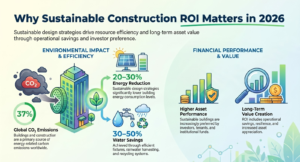
Understanding Sustainable Construction ROI requires examining the mechanisms through which value is generated.
1. Energy Cost Savings
Energy efficiency remains one of the most visible contributors to Sustainable Construction ROI.
Key strategies include:
Over time, reduced energy consumption can generate substantial cost savings while improving building performance.
2. Water Efficiency
Water scarcity is becoming a critical concern in many regions.
Sustainable buildings often incorporate:
These measures reduce water consumption and operational expenses, strengthening Sustainable Construction ROI.
3. Lower Maintenance Costs
Durable materials and efficient design strategies often result in:
The cumulative effect of these benefits contributes significantly to long-term Sustainable Construction ROI.
4. Enhanced Occupant Productivity
Research consistently suggests that indoor environmental quality can influence occupant comfort and productivity.
Factors such as:
can create healthier environments for occupants.
For commercial buildings, these improvements may support stronger occupancy rates and tenant satisfaction.
5. Increased Asset Value
One of the most compelling aspects of Sustainable Construction ROI is its potential impact on asset valuation.
Properties that demonstrate strong environmental performance may benefit from:
As sustainability becomes more integrated into market expectations, these advantages may become increasingly significant.
Property value is influenced by more than location and design. Operational efficiency and future readiness are becoming increasingly important considerations.
According to insights from World Green Building Council and global real estate consultancies such as JLL and CBRE, sustainable assets are receiving greater attention from investors seeking long-term value creation.
Several factors contribute to this trend:
Collectively, these factors enhance the financial profile of sustainable assets and support stronger Sustainable Construction ROI.
1. What is Sustainable Construction ROI, and why is it important for investors?
Sustainable Construction ROI refers to the long-term financial, environmental, and operational returns generated by sustainable building practices. Unlike traditional ROI calculations that focus primarily on upfront construction costs, Sustainable Construction ROI evaluates lifecycle benefits such as energy savings, water efficiency, reduced maintenance expenses, improved asset value, and resilience against future regulatory and climate-related risks.
For investors, Sustainable Construction ROI provides a more comprehensive framework for assessing the long-term performance of real estate and infrastructure assets.
2. Does Sustainable Construction ROI justify the higher initial cost of green buildings?
In many cases, Sustainable Construction ROI can justify higher upfront investments because sustainable buildings often generate operational savings throughout their lifespan. Energy-efficient systems, water conservation measures, and durable construction materials can reduce recurring expenses while enhancing asset performance.
The focus should not only be on construction costs but on total lifecycle costs and value creation over several decades.
Reference Sources:
3. How does Sustainable Construction ROI impact property value?
Sustainable Construction ROI can positively influence property value through lower operating costs, improved resource efficiency, stronger market demand, and enhanced future readiness. Investors increasingly consider sustainability metrics when evaluating assets, particularly in commercial real estate and institutional-grade developments.
Buildings designed for long-term efficiency may attract greater interest from environmentally conscious buyers, tenants, and investment funds.
4. What factors contribute most to Sustainable Construction ROI?
Several factors influence Sustainable Construction ROI, including:
The combination of these factors determines the overall economic performance of a sustainable asset throughout its lifecycle.
5. How long does it take to achieve positive Sustainable Construction ROI?
The payback period for Sustainable Construction ROI varies depending on project type, location, technologies used, and operational efficiencies achieved. Some energy-efficient upgrades may generate returns within a few years, while broader sustainability strategies often create value throughout the building’s entire lifespan.
Investors typically evaluate Sustainable Construction ROI over periods ranging from 10 to 30 years rather than focusing solely on short-term returns.
6. How does Sustainable Construction ROI support ESG investment strategies?
Environmental, Social, and Governance (ESG) principles are increasingly influencing investment decisions worldwide. Sustainable Construction ROI aligns with ESG objectives by promoting resource efficiency, reducing environmental impact, improving occupant well-being, and supporting long-term resilience.
As ESG reporting requirements become more prominent, sustainable buildings may become increasingly attractive to institutional investors and asset managers.
7. What role do government regulations play in Sustainable Construction ROI?
Government regulations can significantly influence Sustainable Construction ROI through energy-efficiency standards, building codes, sustainability incentives, and climate-related policies. In India, frameworks such as the Energy Conservation Building Code (ECBC) encourage more efficient building design and operation.
Understanding regulatory trends helps investors prepare for future compliance requirements while enhancing long-term asset performance.
Yes. Climate resilience is becoming an increasingly important component of Sustainable Construction ROI. Buildings designed to withstand heat waves, flooding, water scarcity, and extreme weather events may experience lower repair costs, reduced operational disruptions, and stronger long-term usability.
Climate-adaptive design can help protect both asset value and investment returns.
9. Is Sustainable Construction ROI relevant only for commercial projects?
No. Sustainable Construction ROI applies to residential, commercial, industrial, institutional, and infrastructure projects. Homeowners, developers, investors, and policymakers can all benefit from understanding how sustainability measures influence long-term costs, efficiency, and asset value.
Whether evaluating a luxury residence, industrial facility, or office building, Sustainable Construction ROI provides valuable insights into long-term performance.
10. What is the future of Sustainable Construction ROI in India?
The future of Sustainable Construction ROI in India is closely linked to urbanization, infrastructure development, ESG adoption, climate commitments, and resource efficiency goals. As India advances toward its sustainability objectives, demand for energy-efficient and climate-resilient buildings is expected to increase.
Investors who understand Sustainable Construction ROI today may be better positioned to evaluate future opportunities in green buildings, sustainable infrastructure, and environmentally responsible real estate.
For investors, evaluating Sustainable Construction ROI is increasingly becoming a strategic necessity rather than a niche consideration.
Investors typically assess:
Sustainable buildings address many of these priorities simultaneously.
For HNIs and NRIs seeking long-term wealth preservation, sustainable infrastructure offers a framework that combines environmental responsibility with economic performance.
Rather than focusing solely on immediate returns, investors are increasingly examining how buildings will perform over the next 20 to 50 years.
This long-term perspective is precisely where Sustainable Construction ROI demonstrates its greatest value.