
Why Banks Suddenly Care About Your Solar Panels (The Era of Green Money Has Arrived)
There’s a quiet revolution happening in India’s real estate market—one that doesn’t smell of fresh paint or wet cement, but of policy shifts, global capital, and an unprecedented appetite for sustainability. If you look closely, you’ll notice something extraordinary:
Banks are finally giving cheaper loans to people who choose sustainable, eco-friendly homes.
This is not a marketing gimmick.
It’s not a seasonal offer.
It is a structural shift in global finance.
And it’s creating a new class of buyers—people who are buying smart, solar-ready, energy-efficient homes because banks will literally reward them for it through green home loan India schemes.
The home itself hasn’t changed.
The money behind it has.
Today’s real estate is no longer funded by just traditional domestic savings. It is fueled by green deposits, ESG-targeted capital, sustainability-linked bonds, international climate funds, and government-approved green frameworks.
Banks have access to funds that must be deployed into eco-friendly, certified, sustainable housing projects. And if your home qualifies—even partially—it becomes cheaper for you to finance.
This is the moment where conscious living merges with financial intelligence.
This is the rise of the green home loan India ecosystem.
“If banks have so much green capital, certified homes get first priority.”
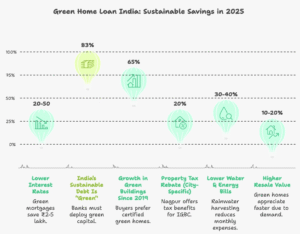
Over the past three years, India has witnessed an explosion in sustainable financing. As per the Climate Bonds Initiative, India’s cumulative GSS+ (Green, Social, Sustainability & Sustainability-Linked) debt reached a massive USD 55.9 billion by December 2024, representing a 186% jump since 2021.
But here’s the more interesting part:
👉 83% of this debt is green.
👉 Most issues fall in the USD 100–500 million range—perfect for large infrastructure and real-estate portfolios.
👉 Institutional investors are actively demanding green-certified assets.
This means global investors—from development banks to sovereign funds—are pouring money into Indian sustainability projects. And because this money has conditions (it must only fund “green” activities), Indian banks must deploy it into:
If you are buying a home from such a project—or building one that aligns with these principles—you become eligible for green home loan India options.
And that changes everything.
A 0.25% to 0.50% interest reduction might seem small, until you realize it can save up to ₹5 lakh over a 20-year loan.
This is not charity.
It’s financial realignment.
“RBI already told banks what to fund—now banks are finally following the rulebook.”
In April 2023, the Reserve Bank of India released something monumental:
The Framework for Acceptance of Green Deposits.
Under this rule:
✔ Banks must create a Green Deposit Policy
✔ Funds from these deposits can ONLY be deployed into certified green projects
✔ Banks must conduct independent third-party verification
✔ Projects must align with India’s upcoming Green Taxonomy
✔ Annual disclosures and impact reporting are mandatory
This single framework changed the landscape.
It forced banks to categorize which projects are “green enough” for concessional funding. It forced developers to adopt certifications and sustainability measures. It forced customers to rethink the type of homes they buy.
Suddenly:
…became more affordable through green home loan India schemes.
Because that is exactly where banks must deploy their green capital.
The RBI has essentially told banks:
“If you want access to green funds, you must prove your money is going into verified sustainable assets.”
And nothing proves sustainability more easily than a home that is IGBC, GRIHA, or LEED certified—or at least designed on those principles.
“If you’re not reporting ESG, don’t expect discounted loans.”
On the developer side, another force is reshaping Indian real estate: SEBI’s ESG frameworks.
SEBI’s BRSR (Business Responsibility & Sustainability Report) is now mandatory for the top 1,000 listed companies in India.
In 2023, SEBI introduced BRSR Core, a deeper, more auditable set of 49 KPIs focused on:
Banks prefer developers who meet these standards because:
✔ Their projects have lower long-term operational risks
✔ Their construction quality is higher
✔ They maintain environmental compliance
✔ They align with international climate funds
✔ Their assets qualify for cheaper ESG-linked lending
This is why developers with strong ESG disclosures are securing:
This is no longer a niche.
“A 0.25% discount looks tiny—until you see how it quietly saves you ₹5 lakh.”
Let’s break down the most misunderstood but powerful financial shift in India’s home-loan ecosystem:
👉 Green mortgages.
A green mortgage—also known as an energy-efficient home loan, ESG home loan, or green home loan India—is a special category of housing finance that rewards homebuyers for choosing environmentally responsible, energy-efficient, and certified green homes.
Banks structure these loans differently because the capital they use to fund them is cheaper. This capital often comes from:
All of these institutions want one thing:
Their money must only fund green assets.
So banks give you lower rates when your home is:
Most banks offer 10–50 basis points reduction depending on the property’s sustainability rating.
If you take a ₹50 lakh loan at 7.5% for 20 years:
Total savings: ~₹2,00,000 – ₹5,00,000 over the tenure.
That’s the hidden power of the green home loan India ecosystem—your home doesn’t just save you energy; it saves you money from Day 1.
“If SBI—the country’s biggest lender—is doing it, you know this is the future.”
The State Bank of India, which controls nearly 23% of the home loan market, has reintroduced and expanded its Green Home Loan Scheme to encourage sustainable housing.
But the biggest shift is what came next.
“Soon, every SBI home loan will quietly carry a solar clause—and buyers will love it.”
A landmark report by the Economic Times revealed that SBI is planning to bundle rooftop solar installations with home loans to channel green funds from its climate action pools.
This means:
✔ Homes will come solar-ready
✔ Buyers may be encouraged (or required) to add solar panels
✔ Interest rates will be lower for solar-enabled homes
✔ Loan disbursement may prioritize sustainable projects
This is huge.
It means the bank is shifting from simply financing homes to financing sustainable homes.
Because SBI receives long-term climate funds from:
These funds come with one condition:
👉 Deploy only into green assets.
Home loans, therefore, are becoming green products by design.
This is why the demand for green home loan India options is skyrocketing—banks are actively incentivizing the transition.
“The incentives are so generous that NOT choosing a green home is becoming expensive.”
India has two of the world’s most respected green rating systems:
1. IGBC – Indian Green Building Council
2. GRIHA – Green Rating for Integrated Habitat Assessment
State-wise incentives page:
https://grihaindia.org
Both systems are recognized by various state governments, which offer substantial incentives for certified projects.
🏡 Maharashtra
🏡 Gujarat
🏡 Kerala
🏡 Madhya Pradesh
🏡 Nagpur (one of the biggest examples)
Nagpur Municipal Corporation announced up to:
👉 20% property tax rebate for IGBC-certified green buildings.
Source: Times of India
https://timesofindia.indiatimes.com
These incentives are real money.
A ₹15,000/year property tax becomes ₹12,000.
Over ten years, that’s ₹30,000 saved.
Over twenty years, that’s ₹60,000 saved.
Add that to:
✔ lower electricity bills
✔ solar energy savings
✔ water efficiency
✔ lower EMI through green home loan India benefits
…and suddenly a green home is 10–30% cheaper across its lifecycle.
“Developers who achieve sustainability targets literally pay lower interest.”
Real estate financing is undergoing a massive shift.
Until recently, developers relied on:
Today, they have a new option:
Sustainability-Linked Bonds (SLBs)
An SLB rewards the developer if they hit certain ESG targets such as:
If they meet these targets:
👉 Interest rate drops.
If they miss targets:
👉 Interest rate increases.
Case Study: Mindspace Business Parks REIT
Mindspace issued:
Funding was used for:
✔ green-certified office expansions
✔ energy-efficiency upgrades
✔ renewable infrastructure
This is clear proof:
ESG performance now directly affects interest rates.
Developers who align with ESG get cheaper capital.
Buyers who choose such projects get cheaper home loans.
Banks get better compliance.
It’s a win-win-win.
And it ties directly back to the rising popularity of green home loan India schemes.
“Green homes don’t just feel better—they perform better financially, emotionally, and environmentally.”
Across India’s major metros, tier-2 cities, and luxury real estate corridors, something powerful is happening:
Homebuyers—especially millennials, NRIs, and UHNI families—are shifting from ‘good-looking homes’ to ‘high-performing homes.’
A “high-performing” home is now defined by:
And the market is responding accordingly.
1. Green-certified inventory is surging
According to the Economic Times, Grade-A green-certified office stock in India has surged 65% since 2019, proving that sustainability is mainstream.
When offices go green, residential buyers follow the same path.
2. Buyers prefer eco-friendly homes for long-term savings
Green homes typically deliver:
3. NRIs are leading the sustainability-first buying trend
NRIs purchasing in India want:
This aligns perfectly with India’s green mortgage movement.
4. Environmental consciousness is rising
Post-pandemic, families want homes that:
A green home is no longer a luxury; it is a health decision.
“If you tick these boxes, banks will open their cheapest green credit lines for you.”
For developers, sustainability is no longer a branding choice.
It is a financing strategy.
To qualify for green mortgages, ESG-linked funding, and concessional credit, a developer must meet clear criteria.
Below is the official Bank-Approved Green Project Checklist (2025):
1. Green Certifications (Minimum Requirement)
These certifications prove to banks that the project meets green standards.
2. Renewable-Ready Infrastructure
Banks prefer homes that can integrate:
Because these features align with India’s climate finance goals.
3. Passive Cooling Architectural Design
Homes with:
…have naturally lower carbon impact and lower energy usage.
Banks measure this during green loan approvals.
4. Water Sustainability Systems
To qualify for green financing, a project must include:
These features support state and national water mandates.
5. Waste Management & Construction Sustainability
Banks check:
These reduce the project’s carbon footprint—essential for ESG scoring.
6. Biodiversity Preservation
A green home must:
Projects with high landscape and tree cover score better in ESG metrics and green loan assessments.
7. ESG Disclosures & Third-Party Verification
Developers must maintain:
This aligns with SEBI’s BRSR & BRSR Core frameworks.
This includes:
Such features improve green mortgage eligibility.
When a project meets these 8 criteria, it qualifies for ESG-linked loans and green home loan India tie-ups with multiple banks.
“Your future home shouldn’t just look beautiful—it should save you money every single month.”
Here’s how a buyer can ensure their home qualifies for India’s new wave of green mortgages:
1. Check the Project’s Certification Status
Ask the builder:
Higher ratings = lower interest benefits.
2. Ask for the Environmental Compliance Report
Every green project should share:
3. Prefer Homes with Solar-Ready Architecture
If the home is future-proofed for solar panels, many banks offer additional benefits.
4. Choose Homes with Measurable Energy Efficiency
This includes:
5. Understand the Bank’s Certification Requirement
Different banks accept different certifications:
6. Get a Green Home Loan Approval Letter
Once you show certification documents, banks give:
This is the core advantage of the green home loan India movement—banks reward you for choosing sustainable housing.
“Within five years, green home loans won’t be the alternative—they’ll be the default.”
India’s sustainability financing ecosystem is accelerating faster than any major market.
Here’s what experts forecast for 2025–2030:
1. Every major bank will launch its own green mortgage product
HDFC, SBI, ICICI, Axis, Kotak—all have already begun offering green-linked products.
By 2030, this will be standard.
2. Government may introduce tax incentives for green homes
Proposed benefits:
3. More banks will bundle rooftop solar with home loans
SBI is already leading this wave.
Soon, net-metering-ready homes will be the default requirement for green mortgages.
4. Carbon credits for green residential buildings
Developers who reduce carbon emissions could earn carbon credits monetized on domestic or international platforms.
Buyers benefit indirectly through lower maintenance and lower EMIs.
5. ESG reporting will become mandatory for all large developers
SEBI’s BRSR Core will expand, making ESG the backbone of construction finance
6. Green-certified homes will command a 10–20% resale premium
As more financial benefits bundle in, non-certified homes will lose value.
Green homes will become the A-grade inventory.
1. What is a Green Home Loan India scheme and how is it different from a regular home loan?
A green home loan India scheme is a special home financing product offered by banks for environmentally sustainable, energy-efficient, or green-certified homes. Unlike regular home loans, green mortgages offer lower interest rates (10–50 bps), higher LTV, faster approvals, and long-term savings. Banks provide these benefits because the funds they use come from green deposits, climate funds, or ESG-linked credit pools, which must be deployed into sustainable housing.
2. Who is eligible for a green home loan in India?
Eligibility depends on whether the home or project is:
IGBC, GRIHA, LEED, or EDGE certified
Solar-ready or renewable-energy integrated
Built with water/waste sustainability systems
Energy-efficient by architectural design
If the project meets sustainability criteria, the buyer automatically qualifies for green home loan India benefits.
3. Which banks in India currently offer green home loans?
Major banks offering green mortgage benefits include:
State Bank of India (SBI)
HDFC Home Loans
ICICI Bank
Axis Bank
IIFL Home Finance (strong GRIHA partnerships)
SBI is the largest provider through its Green Home Loan Scheme, which offers 10–25 bps interest concessions for certified homes.
4. How much money can I actually save through a green home loan India program?
A 0.25%–0.50% rate reduction can save:
₹2–5 lakh on a ₹50 lakh loan
₹4–10 lakh on a ₹1 crore loan
₹6–15 lakh on a ₹1.5 crore loan
Savings come from:
Lower EMI
Lower total interest outgo
Lower property taxes (varies by state)
Lower electricity & water bills
5. What type of homes qualify for green home loan discounts in India?
The following types of homes typically qualify:
IGBC Gold/Platinum rated apartments
GRIHA 4–5 star homes
LEED/EDGE certified projects
Solar-integrated villas or farmhouses
Homes with passive-cooling architecture
Projects with rainwater harvesting, STP, and natural resource efficiency
6. Do I need to submit special documents for a green mortgage?
Banks usually ask for:
Green certification proof (IGBC/GRIHA/LEED)
Sustainability architectural plans
Environmental clearance certificate
Solar/power efficiency documents
Builder’s declaration of green specifications
These documents help banks validate your eligibility for the green home loan India incentives.
7. Can I apply for a green home loan for under-construction projects?
Yes. Many banks provide green home loans for pre-certified under-construction projects.
IGBC and GRIHA both offer pre-certification, allowing buyers to access concessional rates even before the home is completed.
8. Are there government incentives for green-certified homes in India?
Yes, several state and local governments offer incentives such as:
20% property tax rebate (e.g., Nagpur)
Extra FSI/FAR for green-certified projects
Lower approval fees
Stamp duty benefits (varies by state)
These incentives make certified homes more attractive in combination with green home loan India schemes.
9. Does installing solar panels help me get green home loan benefits?
Yes. Solar-ready or solar-integrated homes often get:
Additional rate discounts
Faster loan approvals
Higher credit scores under green mortgage assessment
SBI is already planning to bundle rooftop solar with home loans, making solar a key component in future green financing.
10. Do green home loans impact my home’s resale value?
Absolutely. Green-certified homes enjoy:
10–20% higher resale premiums
Faster resale timelines
Better valuation by banks
More buyer trust due to sustainability
Since future buyers will also get green home loan India benefits, the demand for certified homes will continue rising—making them financially future-proof assets.
“A green-certified home pays you back in ways a conventional home never can.”
India is entering a new real-estate era—one where banks, regulators, governments, and global investors are all moving in the same direction:
👉 Reward sustainability.
👉 Reduce carbon footprint.
👉 Finance green homes at cheaper rates.
Whether you are a homebuyer or developer, embracing this shift is not optional anymore.
A green home gives you:
And more importantly—it aligns your lifestyle with the future of India’s environmental and financial policies.
Green isn’t the alternative anymore.
Green is the upgrade.
Green is the savings.
Green is the future.