The idea of building structures that harmonise with the environment rather than harm it has moved from theory to mainstream reality. Around the world — and especially in India — people are increasingly asking: What does sustainable construction really look like? Is it worth the cost? And how can we be sure it delivers real benefits?
At the heart of this shift is the concept of green building in India — an approach that prioritises energy efficiency, resource optimisation, occupant well‑being, and reduced environmental impact from design through operation. In this blog, we’re going to explore this idea deeply, backed by data, trends, common concerns, and practical insights for anyone curious about sustainable buildings in the Indian context.
Whether you are a homeowner considering your first eco‑friendly home, a developer exploring modern trends, or an investor assessing long‑term value, this guide will walk you through everything you need to know — without promotional fluff.
At its core, green building in India refers to the practice of designing, constructing, and operating buildings in a way that reduces the overall impact on the environment and human health. Traditional construction often prioritises cost and speed, while green building emphasises efficiency, sustainability, and long‑term performance.
Green buildings are engineered to:
The Indian construction sector has increasingly adopted this philosophy, especially as environmental awareness grows and regulatory frameworks tighten.
To ensure these goals are met, projects often seek certification from recognised bodies such as:
Both frameworks help measure performance based on factors like energy use, materials selection, indoor air quality, and site sustainability.
India is one of the fastest‑urbanising countries in the world. With rapid growth comes an urgent need to rethink how buildings are planned and constructed. This is where green building in India becomes not just an option, but a strategic necessity.
Market Growth & economic context
According to recent industry reports:
In practical terms, these figures mean that sustainability isn’t just environmentally responsible — it’s economically significant. Developers, investors, and residents are recognising that green building in India isn’t a trend, but a long‑term structural shift in real estate.
To understand the real meaning of green building in India, it’s important to explore the building blocks of sustainable design and construction.
Energy Efficiency
Energy is one of the largest operational costs for any building, and one of the biggest contributors to environmental impact. Green buildings integrate measures such as:
This not only reduces fossil fuel dependence but directly cuts utility costs for building owners.
Water Conservation
Water scarcity is a pressing issue in many Indian cities. Sustainable buildings reduce water demand through:
These practices not only save resources but reduce the load on municipal water infrastructure.
Sustainable & Healthy Materials
Traditional building materials can be resource‑intensive and may emit harmful chemicals. Green construction prioritises:
This connects directly to healthier indoor environments and reduced environmental strain.
Indoor Environmental Quality
Occupant health is a core focus of sustainable design. Through improved ventilation, natural lighting, air purification, and non‑toxic materials, green buildings often deliver:
All of this reinforces the value proposition of green building in India beyond just environmental metrics.
As sustainable construction gains traction, several important trends are influencing how green building in India evolves — and how stakeholders approach design and investment.
A net‑zero building aims to generate as much energy as it consumes, often through onsite renewable sources like solar or wind. India’s green rating systems, like IGBC’s net‑zero program, are encouraging more projects to adopt this framework.
Digital technologies — including sensors, building management systems (BMS), and AI optimisation — help buildings dynamically monitor and manage energy, water, and indoor air quality. These tools enable real‑time insights and optimisation that traditional systems can’t match.
Regulatory frameworks and building codes in some Indian states are now gradually embedding sustainability criteria. For example:
This reflects a broader shift where green building in India is increasingly supported by public policy.
Market Premiums for Certified Buildings
Certified green buildings often command higher rental yields and resale value, especially in commercial real estate. Studies show that organisations increasingly prefer green certified offices due to cost savings and ESG (environmental, social, governance) alignment.
One of the most important reasons green building in India matters is the tangible value it delivers to people — economically, environmentally, and socially.
Lower Operating Costs
Green buildings typically use:
These savings translate into lower operational expenses over the life of a building, affecting both homes and commercial spaces.
Increased Property Value
Properties with sustainability certifications often show:
Investors recognise that these structures are future‑ready and resilient to rising energy and water costs.
Healthier Indoor Environments
Indoor environmental quality (IEQ) is a critical benefit of green buildings. With better ventilation, non‑toxic materials, and daylight optimisation, occupants experience:
Environmental Conservation
Across India, the adoption of green building in India has already achieved impressive environmental benefits — including nearly 199 billion litres of water savings annually from certified projects.
These numbers show that sustainable construction isn’t philosophical — it’s measurable.
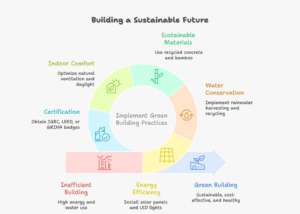
Even with growing momentum, many people still hesitate when they first encounter green building in India. Let’s address some common questions and misconceptions.
“Isn’t green building more expensive upfront?”
Yes, initial costs can be higher due to quality materials and systems. But this is where lifecycle thinking becomes important. When you factor in energy savings, water efficiency, and higher resale value, the return on investment often outweighs the premium.
“Are these buildings really more comfortable?”
Yes. Sustainable design often enhances occupant comfort through natural lighting, improved airflow, and healthier materials — all backed by research into human performance and comfort.
“Are green certifications difficult to achieve?”
Certification can be complex without expertise, but frameworks like IGBC and LEED provide clear criteria and tools. Partnering with experienced designers and consultants can demystify the process.
If you’re interested in pursuing sustainable construction — whether for your home, office, or investment property — here are best practices based on industry experience:
Start Sustainability Planning Early
Environment‑centric decisions are most effective when made at the beginning of the design process, not as an afterthought.
Use Energy Modelling Tools
Simulation tools help predict how design choices affect energy performance. This data‑driven approach refines decisions before construction begins.
Source Certified Materials
Look for materials with recognised sustainability credentials — this helps with both performance and certification goals.
Incorporate Renewable Energy
Solar photovoltaics, biogas systems, and passive cooling can dramatically reduce operating energy demand.
Monitor Performance Continuously
Bring in smart sensors and building management systems to track energy, water, and indoor air quality — turning green building in India from a static certificate to an ongoing performance culture.
Across urban India, green building in India is no longer hypothetical — it’s happening in large infrastructure and civic projects:
Green Certified Transit Hubs
Major train stations and mobility hubs have adopted sustainability principles, reducing energy use and improving commuter comfort.
Airport terminals that apply green design not only save operational costs but also enhance traveller experience.
Commercial Office Growth
India has seen a strong uptick in green office stock, with certified commercial spaces increasing significantly.
These success stories show that green building in India is measurable, scalable, and economically meaningful — not just a theoretical ideal.
Looking forward to 2026 and beyond, several key forces will shape the future of green building in India:
Policy Evolution
Government and regulatory frameworks are expected to increasingly incorporate sustainability standards — making green building protocols standard practice rather than optional.
Smart systems and IoT will continue to enhance building performance, making real‑time adjustments for energy, water, and comfort.
Market Demand
Homeowners, tenants, and investors will increasingly favour buildings that are energy efficient, healthy, and future‑proof.
1. What is Green Building in India and How Is It Defined?
A green building is a structure designed to minimise environmental impact while maximising efficiency of energy, water, and resources, compared to conventional buildings. The Indian Green Building Council (IGBC) describes a green building as one that uses less water, optimises energy efficiency, conserves natural resources, generates less waste, and provides healthier spaces for occupants.
Green building standards cover a wide range of factors — from site selection and sustainable design to indoor air quality and resource conservation — to ensure sustainability throughout the entire building lifecycle.
2. What Are the Major Green Building Certification Systems in India?
Several certification systems guide green building in India, but the most prominent are:
✔ IGBC Green New Buildings Rating System – Focuses on sustainability for new construction, including energy, water efficiency, indoor quality and innovation.
✔ IGBC Green Existing Buildings O&M – For existing structures, focusing on performance and operational sustainability practices.
✔ IGBC Green Homes Rating System – Specifically for residential buildings, improving comfort, efficiency and durability.
Each certification awards levels like Certified, Silver, Gold and Platinum based on points earned in various sustainability categories, shaping how green building in India is benchmarked.
3. How Do Green Buildings Save Energy and Water Compared to Conventional Buildings?
Green buildings are engineered to reduce energy and water consumption dramatically. Typical savings include:
These gains come from passive design strategies, efficient lighting and HVAC systems, rainwater harvesting, wastewater recycling, smart sensors and renewable integration.
For example, efficient plumbing systems, low‑flow fixtures, and greywater reuse significantly reduce water consumption, while optimised building envelopes and solar integration cut down energy use.
These efficiency measures not only reduce resource demand but also lower operating costs over the life of the building.
4. Are Green Buildings More Expensive to Build Than Conventional Ones?
It is a common concern that green construction costs substantially more initially. According to industry reports:
However, these incremental costs are increasingly offset by lower utility bills, government incentives, and higher asset value. Over time, lower operating costs and environmental benefits can make green buildings financially attractive in the long run.
5. What Are the Key Benefits of Green Buildings for Occupants and Owners?
Green buildings deliver a mix of tangible and intangible benefits:
🌿 Environmental
💡 Economic
😊 Social & Health
These benefits combine to make green building in India not just environmentally desirable, but economically and socially valuable.
6. How Do Green Building Certifications Help in India?
Certification systems such as IGBC provide structured frameworks for sustainability. They help builders and designers:
Certified buildings are also more attractive to tenants and buyers who prioritise comfort, lower utility costs, and climate‑friendly design.
Practical take: IGBC’s rating systems cover different project types — new builds, existing buildings, homes, factories, metros and more — making certification opportunities available across sectors.
7. What Is the Role of Government and Policy in Promoting Green Building in India?
Policy support is rapidly improving across Indian states:
Additionally, national initiatives and collaboration with councils such as CII‑IGBC support wider adoption of green building in India through incentives, awareness and standardisation.
This growing policy momentum shows that sustainability is transitioning from voluntary practice to a key part of urban planning and real estate regulation.
8. How Does Green Building Impact Property Value and Marketability?
Buildings certified under green standards often command higher rental yields and resale value for several reasons:
Certified green offices, for example, have been shown to attract tenants willing to pay a premium for energy efficiency, indoor comfort and sustainability credentials.
This economic benefit strengthens investor confidence in green building in India as a strategic long‑term asset.
9. What Are the Challenges of Implementing Green Building Practices in India?
Despite its advantages, green construction faces some challenges:
However, these barriers are diminishing as awareness grows, technologies mature, and policy frameworks become more supportive.
10. What Makes a Building Eligible for IGBC or Similar Certification?
To earn a green rating, a project must satisfy mandatory requirements and earn credit points across categories such as:
Different rating systems — such as IGBC Green Homes for residential or IGBC Green New Buildings for commercial projects — have tailored criteria.
Achieving certification usually involves:
Successfully certified buildings not only demonstrate compliance but also serve as benchmarks for green building in India.
The evolution of green building in India is more than a fleeting trend — it represents a fundamental shift in how we conceive, design, and live in built environments. Over the past decade, sustainability has moved from a niche concern to a core consideration in construction, urban planning, and real estate investment. For homeowners, investors, and developers alike, understanding this shift is no longer optional; it is a critical step toward future-ready living and responsible investment.
Green buildings deliver measurable environmental, economic, and social benefits. They help conserve precious natural resources, reduce energy consumption, and lower greenhouse gas emissions, directly contributing to India’s climate goals. At the same time, these structures offer tangible economic advantages: lower operating costs, higher resale and rental values, and reduced risk associated with changing regulatory frameworks. Studies show that certified green buildings in India save billions of litres of water annually, optimise energy use, and improve occupant comfort — benefits that are real, measurable, and increasingly valued in the market.
Empowering Smarter Decisions Through Knowledge
One of the key advantages of green construction lies in the knowledge it generates. From understanding material lifecycles and energy modelling to optimising indoor environments, every step of a green building project empowers stakeholders to make data-driven, intelligent decisions. For investors, this knowledge reduces uncertainty; for homeowners, it ensures healthier and more comfortable living; for developers, it builds credibility and long-term market differentiation.
Meeting the Needs of Today While Preparing for Tomorrow
Urbanisation, climate change, and resource scarcity are pressing challenges that India faces. Green building is not just a solution for today — it is a strategy for resilience. By integrating sustainability at the design, construction, and operational stages, buildings can remain efficient, comfortable, and relevant for decades, even as energy costs rise and environmental regulations evolve. The focus on renewable energy, low-carbon materials, and smart building systems ensures that investments are future-proof, both economically and environmentally.
Ultimately, the story of green building in India is about conscious action. Every decision — from choosing certified materials to incorporating renewable energy systems — contributes to a more sustainable, healthy, and productive built environment. By embracing green building principles, individuals and organisations can make choices that benefit not just themselves, but communities and the planet as a whole.
Green building represents a unique intersection of responsibility, opportunity, and innovation. Those who understand its principles and benefits today will not only enjoy superior quality of life and economic advantage but will also be pioneers in shaping India’s sustainable urban future.