The Science Behind Sustainable Building in India
As conversations around sustainability grow louder, one fundamental question keeps appearing across search engines, architecture forums, and homeowner discussions: Is khadar eco-friendly construction, or is it simply another revived traditional practice being romanticized in the modern green building movement?
With climate change accelerating, urban heat intensifying, and resource depletion becoming impossible to ignore, construction today is under scrutiny like never before. Buildings account for nearly 40% of global carbon emissions, and India’s rapidly growing housing demand adds urgency to the question of how—and with what—we build.
This article takes a neutral, scientific, and practical look at is khadar eco-friendly construction, examining it through measurable environmental, health, and lifecycle performance lenses rather than nostalgia or marketing claims.
Before deciding whether is khadar eco-riendly construction, it’s important to understand what eco-friendly construction actually means in measurable terms.
What Eco-Friendly Construction Really Means
True eco-friendly construction is evaluated across the full lifecycle of the building, rather than relying on one-off “green” features. The critical factors include:
Many modern buildings labeled “green” focus heavily on operational efficiency, sometimes at the cost of ignoring embodied carbon in materials. This is where the question is khadar eco-friendly construction becomes especially relevant: khadar relies on low-processed, locally sourced materials with minimal environmental impact.
According to the United Nations Environment Programme (UNEP), material manufacturing contributes nearly half of construction-related emissions worldwide.
Common Myths Around Green Buildings in India
One widespread misconception is that adding solar panels or energy-efficient appliances automatically makes a building sustainable. In reality, a structure built using high-carbon materials may take decades to offset its environmental impact.
This raises an essential question for homeowners and planners alike: is khadar eco friendly construction when evaluated beyond surface-level green features?
To evaluate is khadar eco-friendly construction, Khadar must be understood not as “mud walls,” but as a systematic construction method refined over centuries.
What Is Khadar Construction?
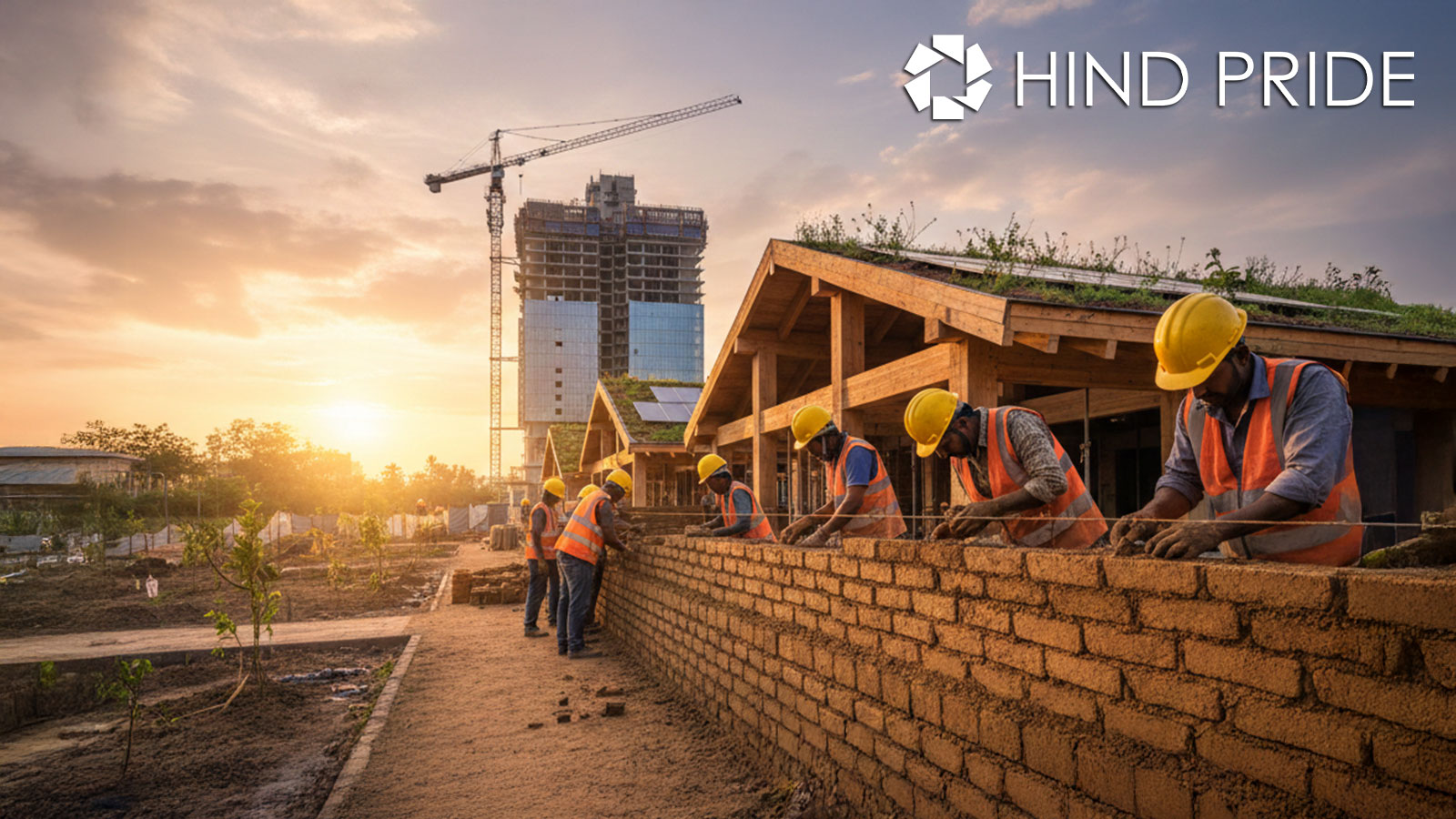
Khadar construction uses natural soil mixes enhanced with mineral binders, layered techniques, and breathable finishes. Unlike industrial materials, khadar walls are:
This approach drastically reduces dependency on cement, steel, and chemical additives, which are responsible for significant carbon emissions globally.
The Central Building Research Institute (CBRI), Roorkee, has documented the structural and thermal benefits of earth-based building materials when correctly engineered.
Reinforced Cement Concrete (RCC) relies heavily on industrial manufacturing, long supply chains, and high embodied energy. In contrast, khadar construction emphasizes:
This distinction forms the foundation of the debate around is khadar eco-friendly construction in contemporary India.
To objectively answer is khadar eco friendly construction, we must examine measurable scientific parameters.
Embodied Energy Comparison
Cement production alone accounts for nearly 8% of global CO₂ emissions, according to the International Energy Agency (IEA).
Khadar construction dramatically reduces embodied energy because:
When comparing is khadar eco-friendly construction to cement-based systems, khadar consistently demonstrates a lower carbon footprint during the construction phase.
A building’s true environmental cost extends beyond construction into maintenance, repair, and end-of-life disposal.
Khadar structures:
From a lifecycle perspective, research published by the World Green Building Council confirms that buildings using natural materials show significantly lower total carbon impact over 30–50 years.
This strengthens the argument that is khadar eco friendly construction is not merely theoretical, but measurable.
One of the strongest scientific arguments supporting is khadar eco-friendly construction lies in its thermal behavior.
Khadar walls possess high thermal mass, allowing them to:
The Bureau of Energy Efficiency (BEE) promotes such passive cooling strategies as essential for India’s future housing.
Performance Across Indian Climate Zones
Studies from the Indian Institute of Science (IISc), Bengaluru, show that climate-responsive buildings outperform mechanical cooling systems in long-term energy efficiency.
From hot-dry to warm-humid zones, khadar construction adapts naturally, reinforcing the case for is khadar eco-friendly construction across diverse regions.
This adaptability makes khadar a practical option even as India faces rising temperatures and increasing energy demand.
When people ask is khadar eco friendly construction, they often overlook its health implications.
Unlike sealed concrete structures, khadar walls allow vapor diffusion, which:
Toxic-Free Living Environment
Modern construction materials often release volatile organic compounds (VOCs), linked to respiratory and neurological issues.
The World Health Organization (WHO) emphasizes that indoor air pollution is a major health risk globally.
Because khadar construction avoids synthetic chemicals, the answer to is khadar eco-friendly construction increasingly includes human health as a key metric.
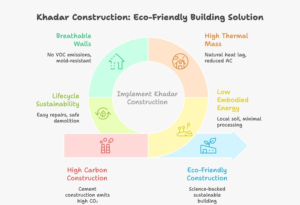
A common concern surrounding is khadar eco-friendly construction is durability.
Structural Strength of Engineered Khadar Homes
Properly designed khadar structures:
Documentation from INTACH (Indian National Trust for Art and Cultural Heritage) highlights centuries-old earth buildings still in use today.
Unlike concrete buildings that often require demolition after structural failure, khadar homes can be repaired locally, reducing waste and cost.
Over 40 years, lifecycle assessments consistently show khadar structures to be more resource-efficient, reinforcing is khadar eco-friendly construction from an economic sustainability perspective.
Khadar vs “Green Cement Homes” — A Reality Check
Not all “green” buildings are equal.
Where Cement-Based Green Buildings Fall Short
Even with energy-efficient systems, cement-heavy buildings retain:
This raises the question again: is khadar eco-friendly construction compared to modern green-certified homes?
When Khadar Makes More Environmental Sense
Khadar construction is particularly effective for:
The World Economic Forum acknowledges the importance of low-carbon materials in future construction.
Policy alignment is another factor in evaluating is khadar eco friendly construction.
Alignment with CPWD & Passive Design Principles
The Central Public Works Department (CPWD) encourages:
Khadar construction naturally aligns with these principles without heavy technological intervention.
India’s Net-Zero Construction Vision
India’s commitment to net-zero emissions by 2070 places increasing importance on traditional, low-carbon construction systems, further validating is khadar eco-friendly construction within future policy frameworks.
Understanding is khadar eco-friendly construction also depends on context.
Khadar is not a one-size-fits-all solution, but for specific needs, it offers unmatched sustainability benefits.
1- Is khadar construction truly eco-friendly compared to modern concrete buildings?
Ans- Yes. Khadar construction uses locally sourced natural soils and minimal processing, avoiding cement and chemical additives that contribute heavily to carbon emissions. Studies show earth-based construction reduces embodied energy by up to 70% compared to conventional concrete.
2- How does Khadar construction affect indoor air quality?
Ans- Khadar walls are breathable, allowing moisture regulation and preventing mold growth. Unlike modern synthetic materials, they do not emit VOCs (volatile organic compounds), promoting healthier indoor air for residents.
3- Can Khadar Construction reduce energy bills?
Ans- Yes. Khadar walls have high thermal mass, absorbing heat during the day and releasing it at night. This passive temperature regulation reduces dependence on air conditioning and heating, cutting energy bills significantly.
4- Is khadar construction durable enough for modern homes?
Ans- Properly engineered khadar homes can last 50–100 years. Historical evidence, such as heritage earth structures, demonstrates that with maintenance, khadar can be as durable as conventional construction. Repairs are simple and local, extending the building’s lifecycle.
5- Can Khadar construction be used in multi-storey buildings?
Ans- Traditionally used for low-rise homes, modern engineering adaptations (reinforced foundations and hybrid designs) now allow khadar to be used in multi-storey structures safely, while maintaining eco-friendly benefits.
6- Is Khadar construction suitable for all Indian climate zones?
Ans- Yes. Different soil mixes and layer techniques make khadar adaptable for:
Hot-dry zones (retain cool interiors)
Warm-humid zones (manage moisture)
Moderate climates (balanced indoor temperatures)
7- How does Khadar construction impact carbon emissions?
Ans- Khadar construction avoids cement and steel, the two largest contributors to CO₂ emissions in building materials. Lifecycle assessments confirm Khadar homes have a significantly lower carbon footprint than conventional concrete buildings.
8- What are the maintenance requirements for khadar homes?
Ans- Maintenance is simple and cost-effective. Minor cracks can be repaired using local soil mixtures, reducing the need for demolition or chemical repairs. Over decades, this results in lower resource consumption and costs.
9- Are there government policies supporting khadar and natural building methods?
Ans- Yes. Agencies like CPWD and BEE promote climate-responsive, low-energy buildings that align with natural material use. India’s net-zero construction goals further encourage low-carbon methods like khadar construction.
10- Who should consider Khadar construction?
Ans- Khadar is ideal for:
Homeowners seeking chemical-free, healthy homes
Low-rise residential projects
Landowners in climate-sensitive zones
Investors focused on long-term, low-carbon value
Reference: World Economic Forum – Low-Carbon Construction Materials
So, is khadar eco friendly construction truly the way forward for sustainable building in India?
When evaluated scientifically—across multiple measurable dimensions—the answer increasingly leans toward yes, provided that the construction is properly designed, engineered, and executed. Let’s break this down:
Buildings contribute nearly 40% of global carbon emissions, with conventional cement and steel production being major contributors. By using locally sourced soil, minimal processing, and avoiding industrial additives, khadar construction dramatically reduces embodied carbon compared to traditional RCC structures. Lifecycle studies confirm that earth-based buildings consistently exhibit a lower total carbon footprint over decades.
Thermal Performance and Energy Efficiency
Khadar walls naturally provide high thermal mass, absorbing heat during the day and releasing it slowly at night. This passive temperature regulation reduces reliance on mechanical cooling and heating systems, improving energy efficiency and reducing operational carbon emissions. The Bureau of Energy Efficiency highlights passive building design as critical for India’s energy-efficient future.
Human Health and Indoor Environment
Unlike modern synthetic materials, khadar walls are chemical-free and breathable, regulating humidity and preventing mold formation. This contributes to better indoor air quality, reducing the risks of respiratory and neurological health issues. The World Health Organization has emphasized indoor air quality as a major global health factor, making natural materials like khadar increasingly relevant.
Over the long term, khadar homes are cost-efficient. Repairs are local and straightforward, avoiding expensive chemical-based interventions. Unlike conventional concrete structures, which often require demolition and replacement for structural failure, khadar construction allows incremental maintenance, significantly reducing material waste and resource consumption.
India’s push toward net-zero carbon buildings and adoption of passive, climate-responsive design principles further validates khadar construction as a future-forward solution. Agencies like CPWD and BEE encourage low-energy, low-carbon building systems—precisely what khadar construction offers.
The Bigger Question: Can Modern Construction Afford to Ignore Nature?
The more important question may not be whether khadar is eco-friendly, but whether modern construction can continue ignoring methods that already harmonize with local climate, materials, and human health. In a world facing intensifying climate challenges, resource scarcity, and rising energy demand, relying solely on industrial materials may become unsustainable and economically impractical.
Khadar construction represents a science-backed, adaptable, and ecologically balanced alternative. Far from being a nostalgic throwback, it integrates thermal comfort, carbon efficiency, health benefits, and lifecycle savings, making it highly relevant for the next generation of sustainable housing in India.
Reference: World Economic Forum – Low-Carbon Construction Materials
When analyzed holistically—considering carbon emissions, energy efficiency, human health, lifecycle economics, and policy alignment—the answer is khadar eco friendly construction increasingly points toward yes.
As climate risks escalate and the demand for sustainable, resilient housing grows, Khadar construction may no longer be just an alternative—it could become a necessity for anyone seeking truly sustainable and future-proof buildings.