For nearly two decades, the term eco-friendly construction has circulated widely across Delhi NCR’s real estate and infrastructure landscape. It has appeared in brochures, site hoardings, policy notes, and investor decks—often stripped of meaning through repetition.
In 2026, that vagueness no longer holds.
Rising temperatures, persistent air pollution, water scarcity, escalating energy costs, and tightening regulatory scrutiny have fundamentally changed how buildings are evaluated. Sustainability is no longer an aesthetic preference or a branding exercise. It has become a risk, health, and asset longevity issue.
For homeowners, high-net-worth individuals, NRIs, policymakers, and long-term investors, choosing an eco-friendly construction company in Delhi NCR is no longer about optics. It is about proof, performance, and durability.
This article is written as a fact-driven, regulation-anchored guide—not a sales pitch. It explains how eco-friendly construction is defined in Delhi NCR today, why superficial “green” claims fail, and which measurable indicators distinguish a truly sustainable builder from a marketing-led one.
Delhi NCR lies in India’s composite climatic zone, experiencing extreme heat in summers, sharp temperature drops in winters, and high particulate pollution for much of the year. According to the India Meteorological Department, heatwave intensity and duration across North India have increased significantly over the last decade
Simultaneously, the Central Pollution Control Board (CPCB) continues to document chronic air-quality stress across NCR districts
Buildings constructed without climate intelligence respond to these conditions in predictable ways:
In this context, an eco-friendly construction company in Delhi NCR is not one that merely adds solar panels or green labels, but one that reduces environmental stress while protecting the asset’s long-term performance.
Sustainable construction in Delhi NCR is not a single technology or material. It is a systems-based approach covering six measurable domains:
India already has formal frameworks addressing each of these areas. Chief among them is the Energy Conservation Building Code (ECBC) issued by the Bureau of Energy Efficiency (BEE), which establishes energy-performance benchmarks for buildings
An eco-friendly construction company in Delhi NCR must therefore be evaluated not by language, but by documentation, drawings, calculations, and execution protocols.
Energy efficiency is the backbone of sustainable construction.
The ECBC framework defines performance standards for:
These are not theoretical savings—they are measured reductions in operational energy demand
A credible eco-friendly construction company in Delhi NCR integrates ECBC principles during the design stage, not as a post-construction retrofit.
The National Disaster Management Authority (NDMA) has formally identified heatwaves as a growing public health and infrastructure risk
In Delhi NCR, sustainable construction must prioritise passive heat mitigation, including:
An eco-friendly construction company in Delhi NCR demonstrates heat resilience through section drawings, roof specifications, shading studies, and material selection, not verbal assurances.
Water sustainability is often oversimplified.
Delhi NCR faces declining groundwater levels, as documented by the Central Ground Water Board (CGWB)
A truly eco-friendly construction company in Delhi NCR addresses water across the full lifecycle:
These measures reduce long-term dependency on tankers and municipal stress—an increasingly important factor for high-end residential and institutional properties.
Sustainability is embedded in a building before occupancy, through materials.
Globally, buildings account for nearly 40% of total carbon emissions, much of it from construction materials
In India, frameworks such as GRIHA (Green Rating for Integrated Habitat Assessment) guide responsible material selection
An eco-friendly construction company in Delhi NCR evaluates:
This approach directly supports asset longevity—an essential consideration for investors and legacy homeowners.
India’s Construction and Demolition Waste Management Rules, 2016, mandate the responsible handling of debris
Yet non-compliance remains common.
A compliant eco friendly construction company in Delhi NCR maintains:
Waste responsibility is both an environmental and regulatory issue—particularly relevant for large or premium developments.
The World Health Organization identifies air pollution as a major global health risk
Indoor air quality is often worse than outdoor air during construction and early occupancy phases due to:
An eco-friendly construction company in Delhi NCR prioritises:
For senior residents and long-term occupants, this is not optional—it is foundational.
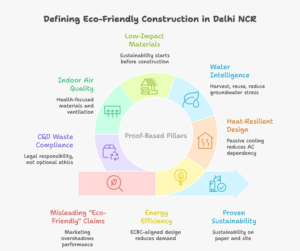
Sustainability fails without execution discipline.
A credible eco-friendly construction company in Delhi NCR maintains:
Transparency protects both the client and the asset.
A persistent myth is that eco-friendly construction is prohibitively expensive.
In reality, sustainability often increases targeted upfront costs while significantly reducing:
When evaluated over 20–30 years, lifecycle economics consistently favour efficient buildings—particularly in high-stress climates like Delhi NCR.
This is why institutional investors globally now evaluate assets based on operational performance, not just construction cost.
When assessing an eco-friendly construction company in Delhi NCR, ask:
Clear answers indicate genuine sustainability.
True sustainability is designed, not appended.
1. What defines an eco-friendly construction company in Delhi NCR in 2026?
An eco-friendly construction company in Delhi NCR is defined by measurable performance, not marketing language. In 2026, this includes energy-efficient design aligned with India’s Energy Conservation Building Code (ECBC), climate-responsive architecture for heat resilience, responsible water management, low-impact material selection, indoor air quality safeguards, and compliant construction waste handling.
The Bureau of Energy Efficiency (BEE) clearly outlines how ECBC-compliant buildings can reduce energy consumption by 25–50%, depending on performance level.
2. Is eco-friendly construction legally regulated in Delhi NCR or still voluntary?
While not all residential buildings are mandatorily required to follow ECBC, sustainability is increasingly guided by regulatory frameworks. Energy efficiency, water management, and construction waste handling are already governed by national and state-level rules.
For example, the Construction & Demolition Waste Management Rules, 2016 apply across India and legally mandate responsible debris handling—making compliance non-negotiable for any eco-friendly construction company in Delhi NCR.
3. How does an eco-friendly construction company in Delhi NCR reduce energy costs long-term?
Energy cost reduction comes primarily from passive design and envelope efficiency, not from renewable add-ons alone. An eco-friendly construction company in Delhi NCR reduces energy demand through insulation, efficient glazing, shading strategies, optimised orientation, and lighting efficiency—before installing systems like solar.
According to BEE, ECBC-compliant buildings achieve substantial reductions in operational energy consumption over their lifecycle.
4. Is sustainable construction suitable for luxury homes and high-end properties?
Yes. In fact, luxury homes often benefit the most from sustainable construction because they typically have higher energy loads, larger built-up areas, and longer ownership horizons.
An eco-friendly construction company in Delhi NCR integrates sustainability invisibly—through thermal comfort, quiet interiors, stable indoor temperatures, and lower long-term operating costs—without compromising aesthetics or design freedom.
Global frameworks such as the World Green Building Council highlight how sustainability enhances long-term asset value rather than limiting luxury.
5. How does eco-friendly construction address Delhi NCR’s extreme heat conditions?
Delhi NCR is experiencing increasingly intense heatwaves, recognised as a major risk by the National Disaster Management Authority (NDMA). An eco-friendly construction company in Delhi NCR addresses this through passive cooling strategies such as insulated roofs, reflective surfaces, controlled glazing, cross-ventilation, and shaded outdoor spaces.
These measures reduce dependence on air-conditioning and protect occupants during power stress or peak summer periods.
6. What role does water management play in eco-friendly construction?
Water sustainability is central to eco-friendly construction in Delhi NCR due to declining groundwater levels. An eco-friendly construction company in Delhi NCR plans water use holistically—through rainwater harvesting, low-flow fixtures, reuse systems, and landscaping strategies suited to local conditions.
The Central Groundwater Board (CGWB) regularly highlights the urgency of groundwater conservation in NCR districts.
7. How can homeowners verify sustainability claims made by a construction company?
Verification requires documentation, not verbal assurances. A genuine eco-friendly construction company in Delhi NCR can share drawings, material specifications, energy calculations, waste disposal records, and test reports.
India’s Bureau of Indian Standards (BIS) provides benchmarks for material and construction quality that support transparent verification.
8. Does eco-friendly construction improve resale value or investment performance?
While resale value depends on market conditions, sustainable buildings generally perform better over time due to lower operating costs, improved comfort, and regulatory readiness.
For long-term investors and NRIs, an eco-friendly construction company in Delhi NCR helps protect capital by reducing obsolescence risk as efficiency and environmental compliance become market expectations rather than differentiators.
Institutional research increasingly links building performance with asset longevity.
9. How important is indoor air quality in eco-friendly homes?
Indoor air quality is a critical but often overlooked aspect of sustainability. An eco-friendly construction company in Delhi NCR prioritises low-VOC materials, dust control during construction, moisture management, and proper ventilation.
The World Health Organization (WHO) identifies indoor air pollution as a significant health risk, particularly for senior residents and children.
10. Is eco-friendly construction more expensive than traditional construction?
Eco-friendly construction may involve targeted upfront costs, but it often reduces lifetime expenses related to energy, water, repairs, and premature material failure.
When evaluated over a 20–30 year period, buildings delivered by an eco-friendly construction company in Delhi NCR frequently show better lifecycle economics—especially in climates with high cooling demand like Delhi NCR.
This lifecycle approach is increasingly used by institutional investors and policymakers when assessing infrastructure value.
Eco-friendly construction in Delhi NCR has reached a critical inflection point. What was once viewed as a niche preference or a value-added feature is now increasingly understood as a core determinant of long-term asset performance.
The region’s realities are unambiguous. Rising heat intensity, prolonged air-quality stress, tightening energy norms, and increasing pressure on water resources are not temporary disruptions—they are structural shifts. Buildings constructed without regard for these forces face higher operating costs, accelerated wear, declining comfort, and growing regulatory exposure over time.
In this environment, the role of an eco-friendly construction company in Delhi NCR extends far beyond delivering a building. It is about anticipating risk, preserving capital, and future-proofing habitation.
Energy-inefficient structures are already showing their vulnerabilities through excessive cooling demand and volatile utility expenses. Poorly detailed buildings suffer from moisture ingress, thermal discomfort, and premature material failure. Homes that ignore indoor air quality compromise occupant health—an issue that grows more significant as ownership horizons lengthen.
Conversely, buildings designed with climate intelligence, resource efficiency, and execution discipline demonstrate a different trajectory. They consume less energy, manage water responsibly, age more gracefully, and remain comfortable across seasons. Over decades, these qualities translate into lower lifecycle costs and higher resilience, regardless of market cycles.
This shift is also being reinforced at the institutional level. Government frameworks such as the Energy Conservation Building Code (ECBC), national water and waste regulations, and global sustainability benchmarks increasingly shape how buildings are approved, financed, and evaluated. As these frameworks mature, assets that fail to align with them risk functional and financial obsolescence.
For homeowners, NRIs, and long-term investors, the implication is clear: sustainability is no longer a matter of preference—it is a matter of due diligence.
Choosing an eco-friendly construction company in Delhi NCR, therefore, requires moving beyond surface claims and focusing on proof. Documentation, design intent, material logic, site discipline, and post-occupancy performance matter far more than labels or awards. Builders who operate transparently and align with measurable standards offer something increasingly rare in real estate: predictability.
As Delhi NCR continues to urbanise and adapt to climate and regulatory pressures, the buildings that endure will not be the ones that were built fastest or cheapest, but those that were built thoughtfully.
Some construction teams, including Hindpride, position their work around compliance-led design, lifecycle thinking, and long-term performance rather than cosmetic sustainability. In the years ahead, this approach is likely to separate buildings that merely exist from those that retain value, comfort, and relevance over time.