low-carbon builder in Delhi NCR construction landscape is transforming faster than ever. Between the National Green Tribunal’s (NGT) environmental rulings, CPCB’s stricter emissions mandates, and rising client awareness, the next decade will belong to the low-carbon builder in Delhi-NCR — those who can combine compliance with innovation.
A low-carbon builder doesn’t just use green buzzwords. They actively reduce embodied and operational carbon through smarter materials, cleaner processes, and verified technologies — all backed by government frameworks and measurable
Low-Carbon Builder in Delhi-NCR
This blog dives deep into the materials, codes, and technologies that actually reduce carbon, backed by authoritative sources from India’s environmental and construction agencies Low-Carbon Builder in Delhi-NCR.
According to the Central Pollution Control Board (CPCB) and the Bureau of Energy Efficiency (BEE), India’s building sector contributes nearly 23–25% of the nation’s total CO₂ emissions Low-Carbon Builder in Delhi-NCR.
Over 60% of these emissions come from three materials alone — cement, steel, and bricks .
By 2030, India aims to reduce its carbon intensity by 45%, aligned with the Ministry of Environment, Forest and Climate Change (MoEFCC)’s Long-Term Low-Emission Development Strategy (LT-LEDS).
For builders in Delhi-NCR, this means the shift is no longer optional — it’s strategic. Those who adapt first will benefit from policy incentives, faster approvals, and investor preference.
What Changed
In 2025, India’s Ministry of Steel introduced an official “Green Steel Classification Framework” — a rating system that defines steel based on CO₂ emitted per tonne produced.
Green Steel Tier | CO₂ Emissions (tCO₂/t) | Star Rating |
≤1.6 | 5-Star (Best) | |
1.6–2.2 | 4-Star (Preferred) | |
>2.2 | Not Green-Classified |
By FY 2027–28, all government and large infrastructure projects are expected to mandate green-classified steel.
For a low-carbon builder in Delhi-NCR, this means:
What is LC3?
LC3 (Limestone Calcined Clay Cement) is a next-generation binder developed by IIT-Delhi and EPFL Switzerland, now endorsed by the National Council for Cement and Building Materials (NCB) and MoEFCC.
It replaces up to 50% of clinker with calcined clay + limestone, cutting CO₂ emissions by 35–40%.
The Delhi-NCR Connection
The Noida International Airport project is India’s first large-scale infrastructure using LC3.
It proves that the technology works at scale — reducing embodied carbon and cost simultaneouslyLow-Carbon Builder in Delhi-NCR .
Cost & Performance
LC3 = perfect for foundations, walls, slabs, and mortar.
Developed by IIT-Indore, geopolymer concrete (GPC) replaces traditional OPC cement with fly ash and slag activated by alkali binders.
It results in:
As a low-carbon builder in Delhi-NCR, using GPC can reduce embodied carbon by up to 500 kg CO₂/m³ in concrete-intensive projects Low-Carbon Builder in Delhi-NCR.
AAC (Autoclaved Aerated Concrete) Blocks
AAC blocks are lightweight, thermally efficient, and reduce dead load by ~40%.
They contain fly ash, converting waste into usable masonry.
Made using Class F fly ash (a thermal-plant by-product) — no topsoil destruction, low embodied energy.
Adopted under the MoEFCC Fly Ash Notification (2022) mandating fly-ash utilization near power plants Low-Carbon Builder in Delhi-NCR.
Perfect for farmhouses and sustainable developments — these cut embodied carbon by 70–80% compared to fired bricks .
Hindpride Tip: Mix AAC + CSEB combinations for low-rise farmhouses — thermal comfort + carbon neutrality.
India’s new Construction & Demolition Waste Management Rules (2025) introduce:
Recycling 1 tonne of C&D waste saves ~250 kg CO₂ and 1.5 m³ landfill space Low-Carbon Builder in Delhi-NCR.
Delhi-NCR now has certified recycling plants at:
Solar-Ready Design
BEE’s Energy Conservation Building Code (ECBC 2023) mandates roof readiness for solar PV in new constructions above 100 kW load.
Integrate tilt, wiring & inverter space during design.
As per IGBC Green Homes V3, passive cooling can reduce HVAC load by 20–30% using:
Rainwater harvesting is mandatory under DPCC Circular No. DPCC/2023/22, with ₹50,000 penalties for non-compliance Low-Carbon Builder in Delhi-NCR.
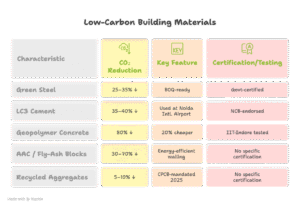
Material | CO₂ Reduction | Approx. Cost Impact | Source |
Green Steel (4-5 Star) | 25–35% ↓ | +5–8% | |
LC3 Cement | 35–40% ↓ | −5–7% | NCB India |
GPC (Geopolymer Concrete) | 80% ↓ | −20% | |
AAC Blocks | 30% ↓ | Neutral | |
Fly-Ash Bricks | 45% ↓ | −10% | |
CSEB Blocks | 70–80% ↓ | −15% |
Conclusion: Even with slightly higher green steel premiums, LC3 and AAC offset costs, making an overall carbon reduction of 45–55% feasible at cost parity.
Steel:
Supply and erection of Green Steel (≥ 4 Star) per Ministry of Steel classification, with mill EPD and batch traceability.
Cement:
Use LC3 Cement (Limestone Calcined Clay) conforming to NCB standards; clinker substitution ≥ 40%.
Concrete:
Where feasible, replace ≥ 30% OPC with fly-ash or GGBS; for precast, specify Geopolymer Concrete Mix M60 (as per IIT Indore protocols).
Masonry:
AAC blocks density 550 kg/m³, thermal conductivity ≤ 0.24 W/mK; alternative CSEB blocks (IS 1725:1982).
C&D Waste:
Contractor to ensure min 20% recycled aggregates for non-structural elements; report to CPCB C&D portal Low-Carbon Builder in Delhi-NCR .
Being a low-carbon builder in Delhi-NCR is no longer just about environmental ethics — it’s about market leadership.
By adopting LC3, GPC, AAC, and green steel, Hindpride can position itself as the region’s benchmark in sustainable construction — combining compliance, cost efficiency, and credibility.
✅ Use LC3 instead of OPC — up to 40% less CO₂
✅ Green steel (≥ 4 Star) mandatory by 2027–28
✅ Geopolymer concrete = 80% CO₂ cut
✅ AAC & fly-ash over clay bricks = instant energy & cost savings
✅ Register all projects on CPCB C&D portal
✅ Solar, rainwater, passive design — legally required, financially smart
In 2025, carbon reduction is not a side initiative — it’s a core construction KPI.
Every builder will soon be measured not just by speed or cost, but by how little carbon they leave behind.
As a low-carbon builder in Delhi-NCR, Hindpride is leading this change — creating spaces that breathe cleaner, last longer, and cost less to maintain.
If you’re planning a farmhouse, villa, or commercial space and want to future-proof your investment:
👉 Book a free “Low-Carbon Builder in Delhi-NCR” with Hindpride today.
Let’s build smarter, cleaner, and for generations to come.