Buildings are no longer just walls and roofs. They are climate actors. In India, where urbanisation is rising at a rate we haven’t seen before, each new home, each new office block, each new structure is a choice — a choice between burdening our planet and our children, or healing it. That is why carbon-neutral construction in India 2025 isn’t just an industry niche — it’s the frontline of our climate future.
According to a policy-paper by Royal Institution of Chartered Surveyors (RICS), the Indian built environment — homes, commercial buildings, infrastructure — is responsible for about a quarter to a third of India’s total greenhouse gas emissions.With India aiming for net-zero by 2070, the buildings we erect today literally shape the air our children breathe tomorrow.
In this blog we’ll explore:
Let’s begin with a fact: the building and construction sector is not just a passive follower in climate change—it is a driving force. According to multiple sources, the sector accounts for around 30-32 % of India’s greenhouse gas emissions.
In the words of a recent ET Edge article:
“India’s buildings and real estate sectors account for a substantial 32 % of India’s greenhouse-gas emissions.”
That means that every design decision, every material choice, every corridor and window in a building adds up to real emissions that will last for decades. An estimated large share of future urban infrastructure is still unbuilt—according to the World Economic Forum nearly 70% of urban infrastructure in India that will exist in 2047 is yet to be built.
So when we talk about carbon-neutral construction in India 2025, we are talking about a pivot point: what we build now will govern the emissions of the next 50-100 years. It’s not just about design—it’s legacy.
Further, a detailed study by KPMG shows that the “embodied carbon” — i.e., emissions locked into manufacturing materials, transport, construction — is massive in infrastructure work in India, posing a huge risk to remaining carbon budget.
What this means: for India to truly live the promise of carbon-neutral construction in India 2025, we must target not just energy use when the building operates, but the carbon embedded in walls, roofs, floors, steel, cement—even before the first occupant steps in.
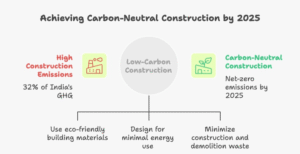
If the old model was “build cheaply, operate inefficiently, replace often”, the new model is “design once, decarbonise now, future-proof forever”. These are the three major code-shifts to anchor your understanding.
ECBC 2017 (Commercial Buildings) – The Original Energy Baseline
The Energy Conservation Building Code (ECBC 2017), released by Bureau of Energy Efficiency (BEE), targets operational energy performance in commercial buildings—lighting, HVAC, insulation, glazing. It mandates minimum performance levels and localisation in states that adopt it.
According to official sources, ECBC-compliant buildings can reduce energy use by 30-50%.
Eco Niwas Samhita (ENS) 2024 – Residential Gets the Net Zero Push
For homes and apartments, the ENS 2024 edition (by BEE) sets energy-efficiency requirements for the building envelope, appliances and lighting, solar readiness, and helps push the residential sector into the low-carbon zone. Homes built under these standards are much more likely to qualify as part of carbon-neutral construction in India 2025 journeys.
ECSBC – The Next-Gen Sustainability Code
The emerging Energy Conservation and Sustainable Building Code integrates passive design, sustainable cooling, low-carbon materials, and net-zero ready design. This is the “future baseline” for 2025 and beyond. With it, the construction sector is being asked to not only reduce emissions but anticipate them.
The Indian Green Building Council (IGBC) Net Zero Carbon Certification brings together embodied carbon, operational carbon and renewable energy generation on site. Builders who adopt it are making a strong statement: they are delivering on carbon-neutral construction in India 2025, not just promising it.
In these frameworks, every time you see “net-zero”, “carbon-neutral”, “low embodied carbon”, you are looking at a move away from business as usual. For your home, that means better materials, smarter design, and higher value.
Here comes the exciting part: because thanks to material innovation, carbon-neutral construction in India 2025 is no longer theoretical—it is actionable and measurable. Builders and manufacturers are now using materials that reduce emissions by 30-40% (or more) compared to traditional options.
LC3 Green Cement: Up to 40 % Less CO₂
Take, for example, Limestone Calcined Clay Cement (LC3). Developed through international collaboration, LC3 uses low-grade limestone and calcined clay instead of pure limestone and emits up to 40% less CO₂ than ordinary Portland cement. According to media coverage, one major infrastructure project has already deployed it in India.
So when a builder says “we’re carbon-neutral”, check if LC3 or equivalent is in their BoQ.
Green Steel Classification in India
Steel is another big lever. India’s Ministry of Steel has announced classification thresholds for “green steel” — steel with emissions below 2.2 tCO₂ per tonne qualifies.
In a 2025 home or commercial building, if the structural steel is “green rated”, that’s a sign the builder is serious about carbon-neutral construction in India 2025.
AAC Blocks, Recycled Aggregates & Low-Carbon Bricks
A report from Alliance for an Energy Efficient Economy (AEEE) highlights that switching masonry and blocks to AAC (Autoclaved Aerated Concrete) or recycled aggregates significantly lowers embodied carbon.
Fly-ash bricks also save on coal-fired kiln emissions and fertile soil loss.
Logistics & On-Site Carbon Savings
Often overlooked: transporting heavy materials long distances, on-site waste, cutting trees, makes a big difference. Low-carbon builders now factor in materials sourcing radius, on-site prefabrication, and waste-lite logistics. According to World Resources Institute (WRI) India, prefabrication can reduce embodied carbon by up to 15.6%.
Proving the change is real, not just aspirational.
In 2025, Noida International Airport became India’s first major infrastructure project to adopt LC3 cement at scale, signalling the era of carbon-light construction.
City Programmes Driving Net-Zero Construction
An article in the World Economic Forum states that India’s new and existing buildings account for nearly 37% of emissions in the urban built-environment context and highlights the urgent need for climate-conscious construction.
These examples show that carbon-neutral construction in India 2025 is happening—not sometime later, but now.
Close your eyes for a moment: imagine waking up in a farmhouse where the roof is designed to catch the breeze, the walls are made from low-carbon blocks that keep the morning chill out, and the materials used didn’t cost the earth—not the one you live on, and not the one your children will inherit.
When you choose carbon-neutral construction in India 2025, you are not just buying a structure. You are buying peace of mind.
In the vast sea of builders, one name stands out when it comes to carbon-neutral construction in India 2025: Hindpride. Here’s how we are delivering on the promise:
Zero-Tree-Cut Farmhouse Policy
Our commitment: preserve the natural landscape, retain and integrate trees, ensure a minimal-disturbance build. Because true sustainability isn’t just materials—it’s respect for the land.
Solar-Ready Homes with Rooftop Integration
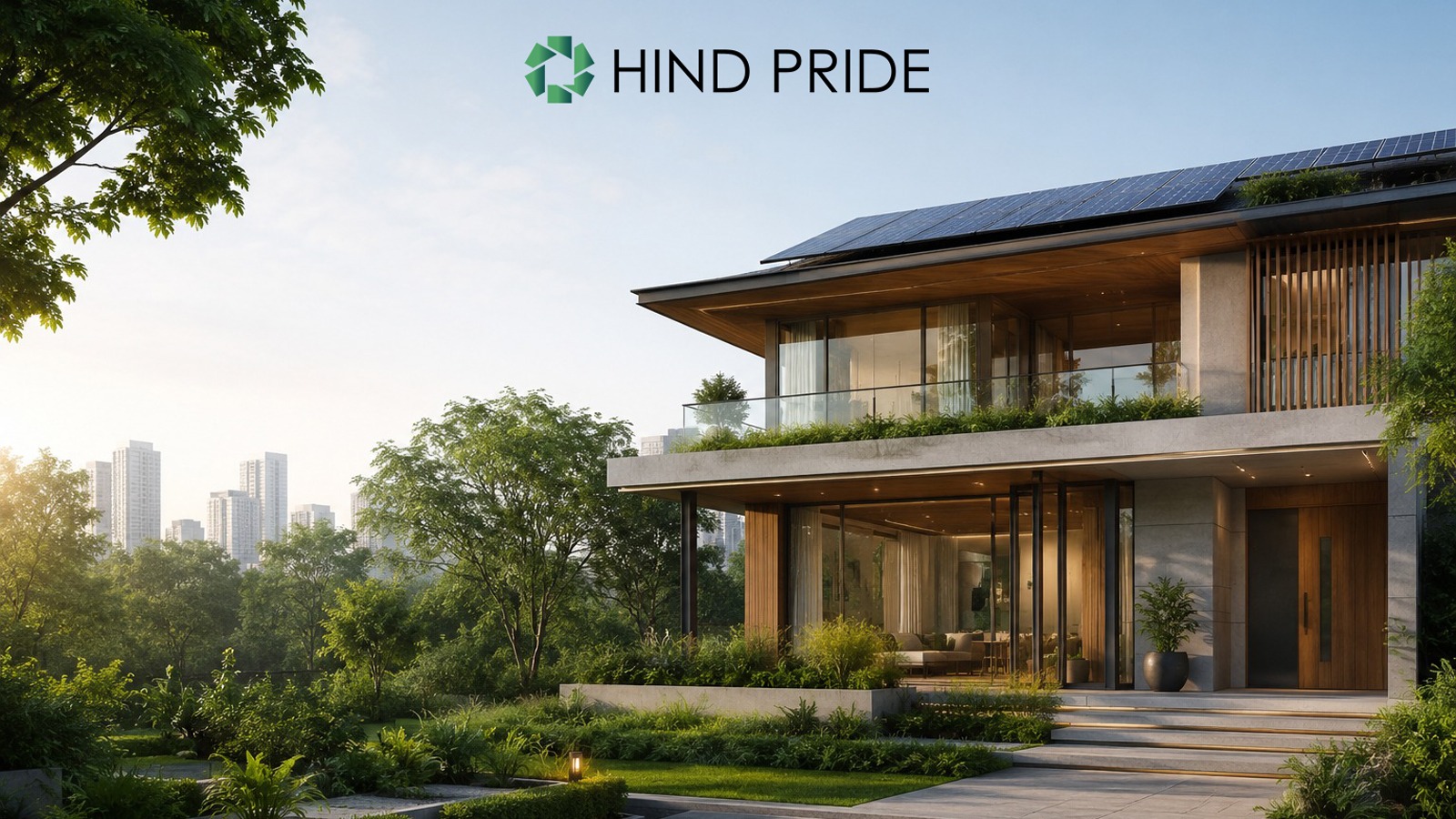
Every home is designed with a solar-ready roof, aligned to the guidelines of Ministry of New & Renewable Energy (MNRE). That means your home is future-proof, ready for grid parity and future carbon credits.
Low-Carbon Materials from the Ground Up
We deploy LC3 cement, AAC blocks, recycled steel, and source materials within a tight radius to reduce transport emissions. In other words: drafting the future of carbon-neutral construction in India 2025 into every specification.
Waste-Lite Modular Process
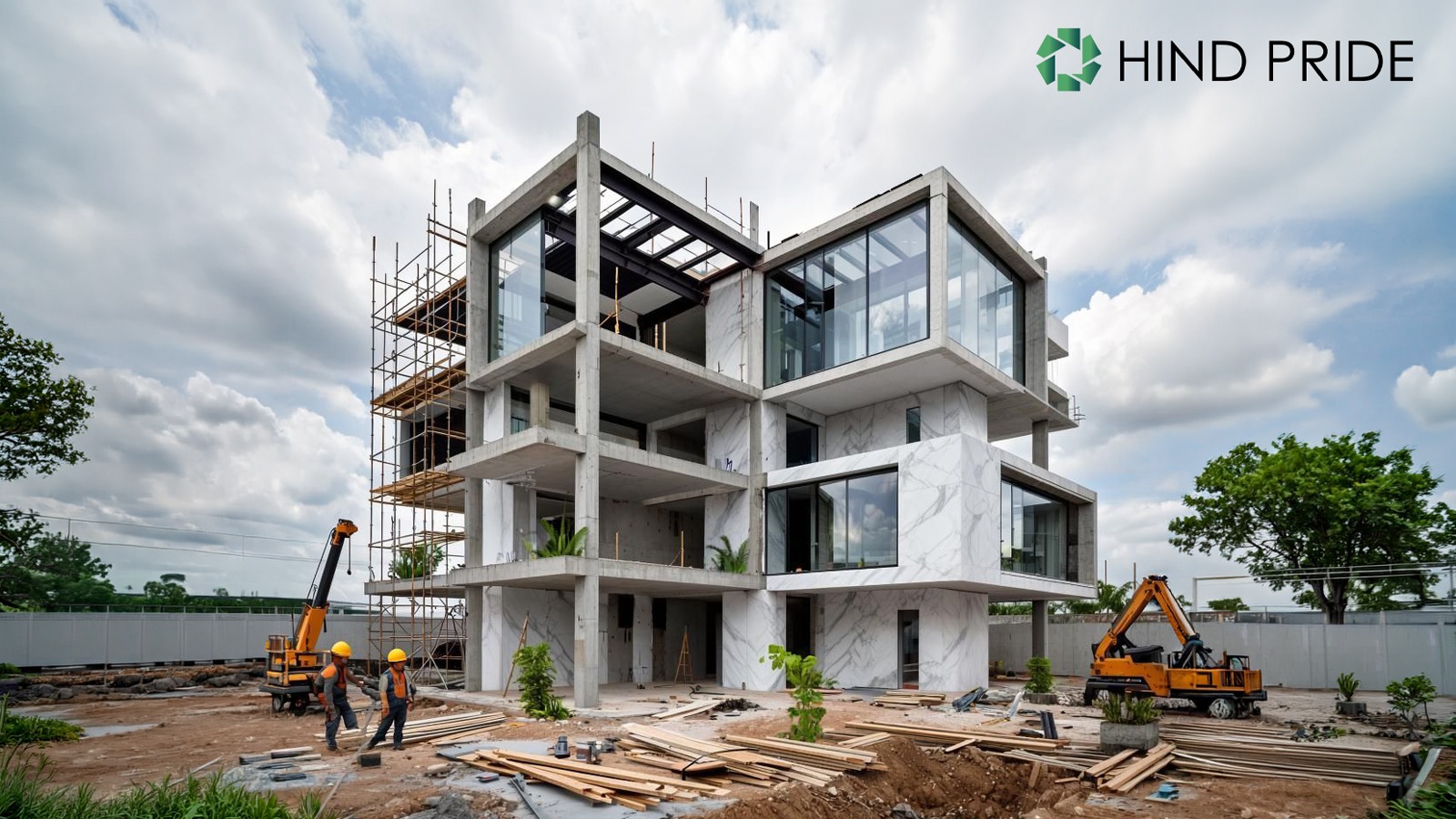
Our modular construction model minimises on-site waste, speeds up construction, and reduces embodied carbon by design. Prefabrication, smart logistics, and material-efficiency.
With this approach, Hindpride isn’t just promising—they’re delivering.
2025 Checklist: How to Ensure Your Next Home is Truly Carbon-Neutral
Don’t be swayed by buzzwords. Here’s a buyer’s checklist for you to ask your builder, architect or contractor:
If the answer is “yes” to most of these, you’re well on the path to true carbon-neutral construction in India 2025.
1. What exactly does “carbon-neutral construction in India 2025” mean?
Carbon-neutral construction in India 2025 refers to creating buildings whose total carbon emissions — from materials, transport, construction, and operation — are reduced as much as possible, and the remaining unavoidable emissions are offset through renewable energy, carbon credits, or regenerative design.
With India’s commitment to Net Zero by 2070 MoEFCC: the construction industry is being pushed to use low-carbon materials like LC3 cement, green steel, AAC blocks, passive design, energy-efficient codes like ECBC, ENS 2024, and ECSBC, making carbon-neutral construction not just an option but a national direction.
2. Why is carbon-neutral construction so important for India right now?
India’s construction and real estate sectors are responsible for 30–32% of total national GHG emissions (Source: RICS COP28 Policy Paper). As India rapidly urbanizes, 70% of the infrastructure required for 2047 is still not built (World Economic Forum). If we don’t shift now, India’s emissions will lock in for decades.
Moving toward carbon-neutral construction in India 2025 helps protect air quality, reduce energy bills, build climate-resilient homes, and future-proof properties against stricter 2030–2040 building laws.
3. How can builders cut up to 40% carbon emissions using materials?
The most powerful way to reduce emissions is through smart materials:
LC3 cement: Uses calcined clay + low-grade limestone. Cuts 40% CO₂ vs OPC. (TOI Link: https://timesofindia.indiatimes.com)
Green steel: India labels steel “green” if emissions are <2.2 tCO₂/ton (Reuters).
AAC blocks: Reduce embodied carbon and improve thermal performance.
Recycled aggregates: Cut quarrying emissions & landfill waste.
Such materials are central to carbon-neutral construction in India 2025, as they reduce embodied carbon right at the foundation stage.
4. Are carbon-neutral homes more expensive to build in India?
Surprisingly, not always.
While some low-carbon materials like green steel may cost slightly more, LC3 cement, AAC blocks, fly-ash bricks, and passive design strategies often reduce material and energy costs.
Plus, ENS-compliant homes use 30–50% less electricity, lowering lifetime utility bills significantly. Long-term, carbon-neutral homes deliver better resale value as buyers increasingly prefer sustainable, future-ready properties.
5. What government codes support carbon-neutral construction in India?
India has introduced several powerful national codes:
ECBC 2017 (Commercial) – reduces energy consumption by 30–50%
Eco Niwas Samhita 2024 (Residential) – mandates energy-efficient design
ECSBC (Energy Conservation Sustainable Building Code) – new sustainability norms
IGBC Net Zero Carbon Rating – national voluntary standard
These codes directly support carbon-neutral construction in India 2025 and are increasingly being adopted by states and city planning authorities.
6. How can homeowners verify if a proposed home is truly carbon-neutral?
Ask your builder for these documents:
Material LCA for cement, steel, blocks
BoQ listing LC3, AAC, recycled aggregates, or green steel
ENS/ECBC compliance certificate
Solar-ready roof design
Passive ventilation & daylight design maps
Waste-management & sourcing plan
If builders cannot provide this, the project is not aligned with true carbon-neutral construction in India 2025.
7. What role does rooftop solar play in carbon-neutral buildings?
A huge one.
MNRE’s national rooftop solar initiative aims to saturate government and residential buildings with solar installations (https://mnre.gov.in).
A 5–8 kW rooftop solar system on a medium-sized home can offset 80–100% of its annual electricity consumption.
Solar-ready roofs are now a mandatory feature in many green building certifications and a pillar of carbon-neutral construction strategies.
8. Can carbon-neutral construction work for farmhouses and luxury homes?
Absolutely — in fact, farmhouses and luxury villas are ideal candidates.
They offer:
Larger south-facing roof areas for solar
Better orientation flexibility for passive cooling
Space for rainwater harvesting, climate-friendly landscaping
Scope for LC3, AAC, bamboo composites, and regenerative earthworks
Most premium buyers now demand climate-safe, low-energy homes, making carbon-neutral construction in India 2025 perfect for eco-farmhouses and high-value villa plots.
9. Do carbon-neutral homes have a higher resale value?
Yes.
A study by multiple global green-building councils confirms certified green homes sell 8–12% higher and much faster.
In India, as regulations tighten, homes built through carbon-neutral construction in India 2025 will stand out as:
Lower operating cost
Better insulated
Long-term compliant
Healthier indoor air quality
Sustainable, desirable lifestyle
These factors significantly increase buyer demand and resale premium.
10. How is Hindpride implementing carbon-neutral construction in real projects?
Hindpride follows a strict sustainability framework:
Zero-tree-cut construction policies
LC3, AAC, recycled steel, and low-carbon concrete mixes
Solar-ready roofs designed per MNRE norms
Passive-cooling layouts (orientation, shade, airflow)
Modular, waste-lite construction workflows
Soil-first land development to avoid ecosystem disruption
This ensures every Hindpride project aligns with carbon-neutral construction in India 2025 — not through slogans, but through science, materials, engineering, and values.
Conclusion — The Home That Gives More Than It Takes
In a world where every decision counts, choosing a home built on the principle of carbon-neutral construction in India 2025 is not merely smart—it is essential.
You are not just investing in walls and windows; you are investing in climate resilience, healthier living, and generational value. Houses built today with high emissions will carry hidden costs for decades. But houses built with care, foresight and low-carbon materials will carry value—monetary, emotional and environmental.
If you sense that moment—when your home can breathe with the land, grow with your family, and still quietly help heal the planet—then you are looking at more than property. You are looking at legacy.
Ready to take the step? Let’s build your future together with precision, purpose and planet in mind. Book a free consultation today, download our BoQ template and let’s set the blueprint for a home that gives more than it takes.