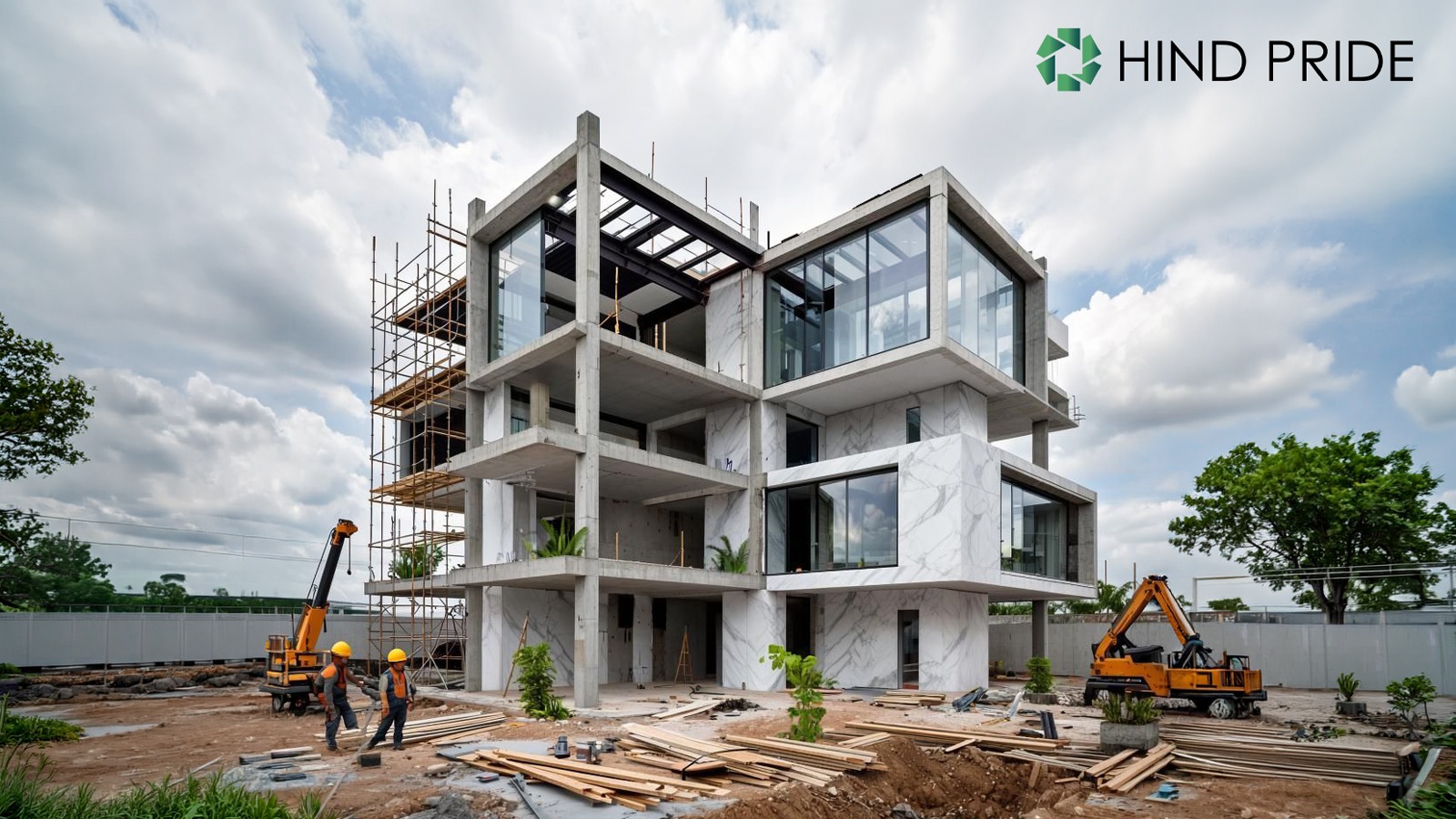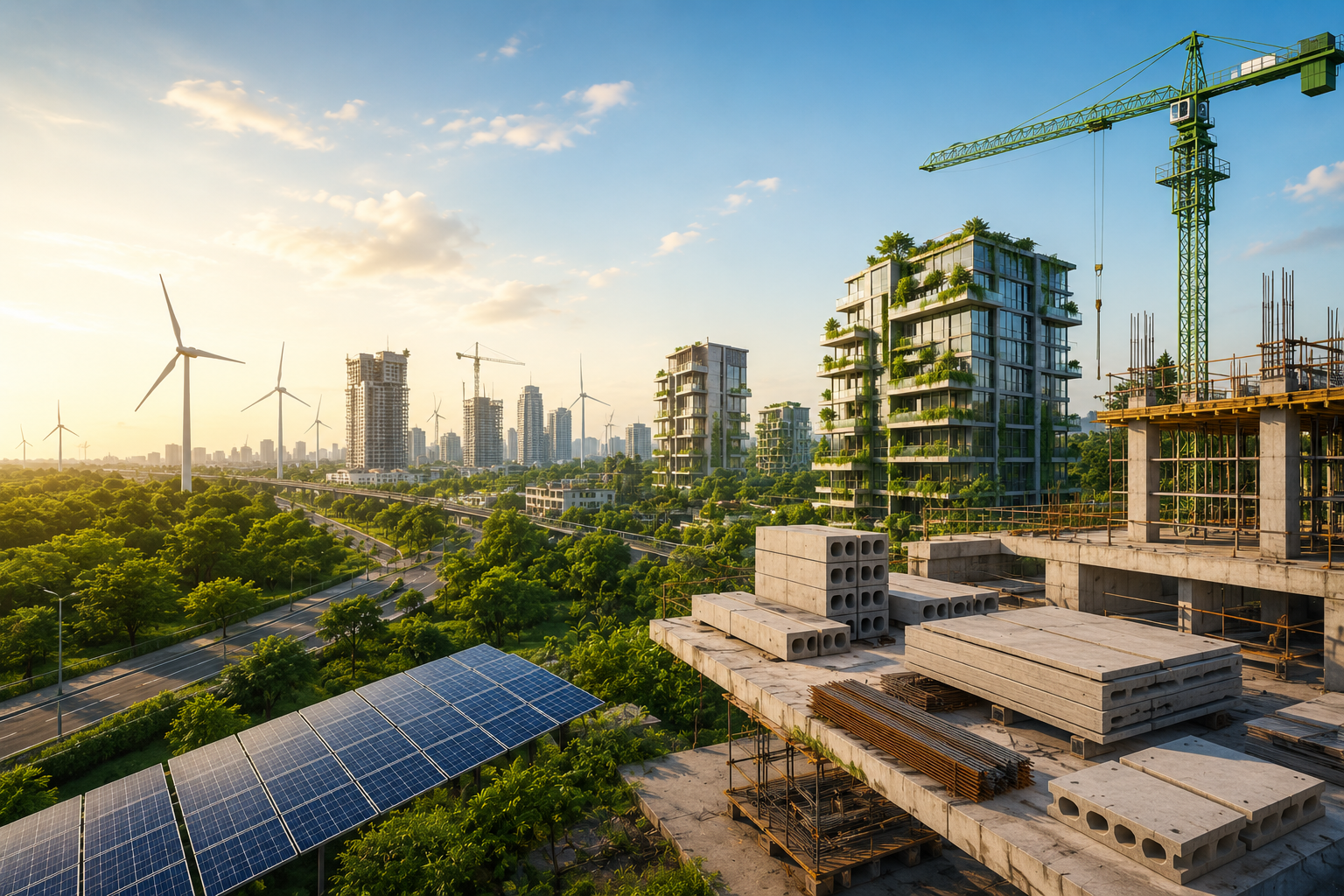
India is entering one of the most transformative infrastructure phases in its history. Rapid urbanization, expanding industrial corridors, smart city development, renewable energy adoption, and increasing environmental concerns are collectively reshaping how the country approaches infrastructure and real estate development. In this transition, sustainable construction in India is no longer viewed as a niche concept limited to environmental discussions. It is becoming a strategic necessity for long-term economic growth, energy efficiency, and future-ready infrastructure planning.
Over the last decade, India has witnessed a significant shift toward eco-friendly buildings, renewable energy integration, green commercial spaces, and sustainable urban planning. Investors, policymakers, developers, corporations, and institutional stakeholders are increasingly prioritizing projects that align with long-term environmental and operational efficiency goals.
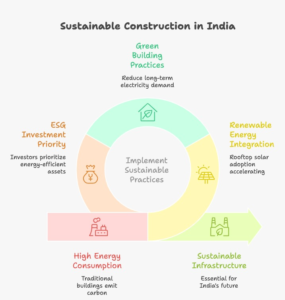
This shift is not driven by trends alone. Rising energy costs, increasing pressure on natural resources, climate-related challenges, ESG-focused investments, and government-backed renewable energy initiatives are accelerating the adoption of sustainable infrastructure across India.
Today, sustainable construction in India represents more than environmentally conscious building practices. It reflects a broader transformation toward smarter infrastructure, resource-efficient development, lower operational costs, improved asset longevity, and resilient economic growth.
According to the International Energy Agency (IEA), India is expected to witness one of the largest increases in energy demand globally over the coming decades. Simultaneously, the government is aggressively promoting renewable energy expansion and green infrastructure development through initiatives supported by the Ministry of New and Renewable Energy (MNRE) and NITI Aayog.
As infrastructure demand continues to rise, the importance of sustainable construction in India is becoming increasingly critical for investors, HNIs, NRIs, businessmen, bureaucrats, and decision-makers seeking long-term value creation and resilient asset positioning.
India’s urban landscape is expanding at an unprecedented pace. New residential projects, industrial hubs, commercial developments, logistics parks, and infrastructure corridors are emerging across multiple states. While this growth creates economic opportunities, it also places enormous pressure on energy consumption, water resources, and environmental sustainability.
Traditional construction methods are resource-intensive and contribute significantly to carbon emissions. Cement production, steel manufacturing, excessive water consumption, and inefficient energy use collectively increase the environmental impact of infrastructure development.
According to global sustainability studies from the World Green Building Council, the building and construction sector contributes a major share of global carbon emissions. This reality is driving countries like India to adopt greener infrastructure strategies.
The importance of sustainable construction in India is growing because it addresses several interconnected challenges:
Sustainable infrastructure focuses on minimizing environmental impact while maximizing long-term performance and economic efficiency. Green buildings are designed to reduce energy consumption, improve thermal efficiency, optimize water usage, and enhance occupant well-being.
For investors and developers, this shift is becoming increasingly relevant because sustainability is no longer only an environmental concern. It is now closely connected to operational costs, future regulations, ESG compliance, and long-term asset valuation.
The Indian construction sector is gradually transitioning from conventional development models toward eco-conscious infrastructure planning. Developers and infrastructure companies are increasingly incorporating sustainable practices into residential, commercial, and industrial projects.
This evolution is visible in:
Organizations such as the Indian Green Building Council (IGBC) and GRIHA Council India have played an important role in promoting sustainable construction standards and green building certifications across India.
Eco-friendly construction is gaining momentum because it provides measurable long-term benefits, including:
The demand for eco-friendly homes and green commercial spaces is also increasing among affluent buyers, corporates, and institutional investors who prioritize sustainability, wellness, and long-term operational efficiency.
In metropolitan regions and emerging infrastructure zones, sustainable developments are increasingly viewed as future-ready assets that align with evolving urban and environmental expectations.
Government support has become one of the strongest drivers behind the growth of sustainable construction in India. Over the last several years, multiple national initiatives have encouraged renewable energy adoption, smart urban planning, energy-efficient buildings, and green infrastructure development.
Programs such as the Smart Cities Mission are designed to promote urban modernization through sustainable planning, integrated infrastructure, and technology-driven governance.
Similarly, housing and infrastructure policies increasingly emphasize:
India’s renewable energy expansion strategy is also closely connected to sustainable infrastructure growth. The government has committed to increasing renewable energy capacity significantly over the coming years, creating opportunities for solar-powered buildings and eco-friendly developments.
These initiatives are influencing both public and private sector infrastructure decisions.
One of the most important aspects of sustainable construction in India is the rapid expansion of solar energy adoption. Rising electricity costs and increasing awareness around renewable energy are encouraging residential, commercial, and industrial sectors to integrate solar infrastructure into modern developments.
Solar energy supports sustainable construction by:
India’s rooftop solar market has grown rapidly due to policy support, subsidies, and improving affordability.
The government’s PM Surya Ghar Yojana has become a major initiative encouraging rooftop solar adoption across residential households. The scheme supports solar installations through direct subsidies and aims to accelerate renewable energy integration nationwide.
The initiative includes:
The MNRE Rooftop Solar Portal provides additional guidance regarding solar adoption and subsidy mechanisms.
For infrastructure developers and property owners, solar integration is increasingly becoming a strategic advantage because it improves operational efficiency while aligning with sustainability goals.
Commercial buildings, industrial parks, logistics facilities, and residential developments are increasingly incorporating rooftop solar systems as part of long-term infrastructure planning.
Building materials play a crucial role in determining the environmental impact of construction projects. Conventional construction materials often require high energy consumption during manufacturing and contribute significantly to carbon emissions.
As sustainable construction in India continues to evolve, there is growing emphasis on eco-friendly and resource-efficient building materials.
Some of the widely adopted sustainable materials include:
These materials help reduce:
Eco-friendly materials also contribute to:
According to insights from the Bureau of Energy Efficiency India, energy-efficient infrastructure and sustainable material usage are becoming increasingly important for future-ready construction ecosystems.
Sustainable materials are not only environmentally beneficial but also economically strategic because they improve lifecycle performance and reduce long-term operational costs.
The growing demand for efficient, scalable, and durable infrastructure has accelerated the adoption of PCC panels and precast construction systems across India.
PCC panels are increasingly used in:
Their growing relevance in sustainable construction in India is linked to several practical and environmental advantages.
Traditional construction methods often involve:
PCC panels help address many of these challenges through factory-manufactured precision systems that improve efficiency and reduce on-site disruptions.
Durability is one of the key pillars of sustainable infrastructure. Buildings and infrastructure systems designed for longer operational life naturally reduce repair frequency, reconstruction needs, and material consumption over time.
PCC panels provide:
In regions facing climatic variations, heavy rainfall, heat exposure, or infrastructure stress, durable construction systems become increasingly valuable for long-term sustainability planning.
For investors and developers, durability directly impacts:
India’s expanding infrastructure demand requires faster and more efficient project execution. Construction delays can significantly increase operational costs and capital deployment timelines.
PCC panels support:
Because these systems are manufactured off-site and assembled efficiently, they help reduce:
This approach is increasingly valuable in:
As India continues expanding infrastructure capacity, faster construction technologies are expected to play an important role in improving scalability and project execution efficiency.
PCC panels also contribute to sustainability objectives in several ways.
They support:
Water conservation is becoming particularly important in urban India, where water stress continues to increase across multiple regions.
Precast and modular construction systems reduce the extensive on-site water usage commonly associated with traditional construction practices.
Additionally, better thermal insulation capabilities can help reduce cooling loads in buildings, which contributes to lower electricity consumption and improved energy efficiency.
This aligns closely with the broader goals of sustainable construction in India, where infrastructure is expected to balance economic growth with environmental responsibility.
One of the biggest misconceptions around sustainable infrastructure is that it is only environmentally beneficial. In reality, sustainable construction increasingly offers strong long-term economic advantages as well.
Eco-friendly infrastructure can help reduce:
For commercial and industrial projects, operational efficiency directly affects profitability and long-term asset performance.
Green-certified and energy-efficient buildings are also becoming increasingly attractive for:
Global financial institutions such as the International Finance Corporation (IFC) and the World Bank continue emphasizing the importance of sustainable infrastructure for future economic resilience.
As ESG investing gains momentum globally, sustainable assets are increasingly viewed as lower-risk and future-aligned investments.
A major trend emerging across India is the growing preference for eco-conscious infrastructure among affluent investors, NRIs, institutional stakeholders, and business leaders.
This shift is influenced by multiple factors:
Sustainable developments are increasingly perceived as strategic long-term assets rather than short-term trends.
For HNIs and institutional investors, infrastructure quality and future viability are becoming critical investment considerations. Eco-friendly projects aligned with renewable energy and sustainable urban planning frameworks often provide stronger long-term positioning.
Similarly, policymakers and bureaucrats are recognizing the importance of sustainable urbanization for managing future population growth and infrastructure demand.
This broader shift is accelerating the adoption of sustainable construction in India across multiple sectors.
Several important trends are currently shaping the future of sustainable infrastructure across India.
1. Growth of Green-Certified Buildings
Green-certified projects are increasing across:
Certifications from organizations like IGBC and GRIHA are becoming increasingly relevant in modern infrastructure planning.
2. Expansion of Rooftop Solar Infrastructure
Solar adoption continues to expand across residential and commercial sectors due to:
This trend is expected to continue as India strengthens its renewable energy capacity.
3. Rising Demand for Precast and Modular Construction
Industrial expansion and warehousing growth are increasing the demand for:
These systems support scalability, speed, and sustainability.
4. Smart Sustainable Urban Development
Modern urban planning increasingly emphasizes:
India’s future cities are expected to integrate sustainability into infrastructure planning at a much larger scale.
Despite strong growth potential, sustainable construction in India still faces certain challenges.
These include:
However, the long-term opportunities remain significant.
India’s growing infrastructure demand, renewable energy expansion, and policy support create strong foundations for continued sustainable infrastructure growth.
As technology adoption improves and awareness increases, sustainable construction practices are expected to become increasingly mainstream.
The future of infrastructure development in India is becoming closely linked with sustainability, renewable energy integration, and climate-conscious urban planning.
Over the coming decades, sustainable construction in India is expected to play a central role in:
The shift toward eco-friendly infrastructure is no longer driven only by environmental priorities. It is increasingly connected to economic resilience, operational efficiency, investor confidence, and long-term infrastructure sustainability.
For investors, policymakers, infrastructure developers, and institutional stakeholders, sustainable infrastructure represents an important strategic direction aligned with India’s future growth trajectory.
1. What is sustainable construction in India and why is it becoming important?
Sustainable construction in India refers to the development of buildings and infrastructure using environmentally responsible methods, energy-efficient systems, renewable energy integration, and eco-friendly building materials. The goal is to reduce environmental impact while improving long-term operational efficiency and infrastructure durability.
The importance of sustainable construction in India is increasing because the country is facing:
Green infrastructure helps reduce electricity consumption, improve energy efficiency, lower maintenance costs, and support long-term environmental sustainability. It also aligns with India’s renewable energy and smart infrastructure goals.
2. How does sustainable construction in India help reduce environmental impact?
Sustainable construction in India reduces environmental impact by minimizing resource consumption, lowering carbon emissions, and improving energy efficiency across buildings and infrastructure projects.
Eco-friendly construction practices help:
Green buildings often incorporate:
These measures collectively help reduce the long-term environmental footprint of infrastructure development.
3. What are the major government initiatives supporting sustainable construction in India?
The Indian government has launched multiple initiatives to support sustainable construction in India, renewable energy adoption, and green infrastructure development.
Major initiatives include:
These programs encourage:
Government policies are helping accelerate the transition toward eco-friendly infrastructure across residential, industrial, and commercial sectors.
4. What is the PM Surya Ghar scheme and how does it support solar adoption?
The PM Surya Ghar Yojana is a Government of India initiative designed to encourage rooftop solar installations across residential households.
The scheme supports renewable energy adoption by offering:
Under the scheme, eligible households can receive subsidies for installing solar systems, helping reduce upfront investment costs and encouraging long-term renewable energy usage.
The initiative is playing a significant role in strengthening sustainable infrastructure and renewable energy integration in India.
5. What are the benefits of eco-friendly homes and green commercial buildings?
Eco-friendly homes and green commercial buildings provide both environmental and economic advantages. As sustainable construction in India grows, green buildings are increasingly valued for their operational efficiency and long-term sustainability.
Major benefits include:
Green commercial spaces are also becoming attractive for corporates and institutional investors because they align with ESG goals and sustainability-focused business strategies.
6. What are PCC panels and why are they important in sustainable construction in India?
PCC panels are precast concrete construction systems increasingly used in modern infrastructure and sustainable development projects.
In sustainable construction in India, PCC panels are important because they support:
These systems are commonly used in:
PCC panels also help reduce project timelines and improve long-term infrastructure performance.
7. How do PCC panels support cost-efficient and faster construction?
PCC panels support faster and more cost-efficient construction because they are factory-manufactured and assembled on-site with greater precision.
Advantages include:
In large-scale infrastructure and industrial projects, faster execution improves operational efficiency and reduces delays associated with conventional construction methods.
This makes PCC panels increasingly relevant in the future of sustainable infrastructure development in India.
8. Why are investors and HNIs focusing on sustainable infrastructure in India?
HNIs, NRIs, institutional investors, and business leaders are increasingly focusing on sustainable construction in India because eco-friendly infrastructure is becoming associated with long-term resilience and future-ready asset positioning.
Sustainable infrastructure offers:
As global ESG investment trends continue to grow, sustainable real estate and green infrastructure are increasingly viewed as strategic long-term investment opportunities.
9. What role do sustainable building materials play in eco-friendly construction?
Sustainable building materials are critical to reducing the environmental impact of infrastructure development.
Materials such as:
help reduce:
In sustainable construction in India, these materials also improve energy efficiency, structural performance, and long-term durability.
The growing adoption of eco-friendly materials reflects the increasing demand for climate-conscious infrastructure solutions.
10. What is the future of sustainable construction in India?
The future of sustainable construction in India is expected to be driven by:
India’s growing focus on renewable energy, ESG investment strategies, and sustainable urbanization is likely to accelerate demand for eco-friendly infrastructure over the coming decades.
Future-ready infrastructure will increasingly prioritize:
As infrastructure demand expands, sustainable construction is expected to play a central role in shaping India’s economic and urban development future.
India’s infrastructure landscape is undergoing a major transformation, and sustainable construction in India is emerging at the center of this evolution. Rising urbanization, renewable energy adoption, environmental pressures, and long-term infrastructure demands are collectively accelerating the transition toward eco-friendly and resource-efficient development models.
Government initiatives promoting solar energy, green infrastructure, and renewable energy adoption are further strengthening this transition. Simultaneously, sustainable building materials, energy-efficient systems, and modern construction technologies such as PCC panels are helping improve durability, efficiency, and long-term operational performance.
The growing interest from HNIs, NRIs, institutional investors, corporates, policymakers, and sustainability-focused organizations reflects a broader recognition that future-ready infrastructure must balance environmental responsibility with long-term economic resilience.
As India continues expanding its urban and industrial infrastructure, sustainable construction is expected to become increasingly important for creating efficient, resilient, and future-oriented development ecosystems that align with both economic growth and environmental sustainability.