India is standing at the intersection of extraordinary economic growth and unprecedented environmental transformation.
Over the past decade, the country has emerged as one of the world’s fastest-growing major economies, attracting global investment, accelerating infrastructure development, and witnessing a massive expansion of urban wealth creation. From technology and manufacturing to luxury consumption and premium real estate, India’s growth story is increasingly becoming central to the global economic narrative.
According to the International Monetary Fund, India is projected to remain among the fastest-growing large economies globally, while the World Bank continues to identify India as one of the most significant long-term growth markets for global investors.
Yet beneath this remarkable economic rise lies another reality — one that is increasingly shaping how people live, work, invest, and define quality of life.
Indian cities are becoming hotter, denser, more energy-intensive, and environmentally stressed. Rising temperatures, worsening air pollution, increasing electricity consumption, water scarcity, and urban congestion are no longer isolated concerns. They are becoming structural challenges influencing everything from public health and productivity to real estate demand and long-term asset resilience.
As India urbanizes at an unprecedented scale, the definition of luxury itself is evolving.
For affluent homebuyers, HNIs, NRIs, entrepreneurs, policymakers, and institutional investors, premium real estate is no longer only about location, scale, or aesthetics. Increasingly, the conversation is shifting toward sustainability, climate resilience, wellness, energy efficiency, and future-ready living ecosystems.
This is where Sustainable Luxury Homes in India are emerging not merely as an architectural trend, but as a strategic response to the environmental and urban realities of the coming decades.
The future of Indian luxury real estate may increasingly belong to developments that successfully combine environmental intelligence, operational efficiency, wellness-oriented design, and long-term sustainability.
India’s economic rise is fundamentally transforming the country’s urban and investment landscape.
The country recently became the world’s fifth-largest economy and is widely expected to become the third-largest economy within the next decade. Rapid growth in infrastructure, digital connectivity, manufacturing, renewable energy, and financial services has accelerated wealth creation across multiple sectors.
Global corporations, including Apple, Google, and Microsoft, continue expanding their presence in India, reflecting growing confidence in the country’s long-term economic trajectory.
Simultaneously, India is witnessing:
According to the Knight Frank Wealth Report, India continues to witness significant growth in ultra-high-net-worth individuals, creating long-term demand for premium and luxury real estate.
However, this economic growth is occurring alongside one of the largest urbanization transitions in modern history.
India’s cities are expanding at a remarkable pace.
The United Nations Human Settlements Programme (UN-Habitat) estimates that hundreds of millions of Indians will move into urban areas over the coming decades. Urban centers are becoming engines of economic productivity, innovation, and consumption.
But rapid urbanization also creates significant pressure on:
Cities including Delhi, Mumbai, Bengaluru, and Hyderabad are increasingly experiencing the side effects of dense urban growth.
High-rise clusters, reduced green cover, traffic congestion, and concrete-heavy urban planning are contributing to environmental stress and declining comfort levels.
This urban pressure is fundamentally changing what affluent buyers seek from premium housing.
Increasingly, wealthier homebuyers are prioritizing:
As a result, Sustainable Luxury Homes in India are gaining increasing relevance among investors seeking long-term value and future-ready living.
Climate change is no longer a distant environmental concern. It is directly influencing everyday urban living across India.
According to the Intergovernmental Panel on Climate Change (IPCC), South Asia remains one of the regions most vulnerable to climate-related heat stress.
India has witnessed:
In several Indian cities, temperatures now regularly exceed historical seasonal averages.
The India Meteorological Department has repeatedly highlighted increasing heatwave frequency across multiple regions of India.
For urban residents, rising temperatures are affecting:
The urban heat island effect has intensified the situation further.
Concrete surfaces, dense construction, limited tree cover, and glass-dominated architecture trap heat within cities, causing metropolitan areas to remain significantly warmer than surrounding rural regions.
This shift is changing how people evaluate housing quality.
Today, affluent buyers increasingly value homes that can provide:
This evolving demand is one of the reasons Sustainable Luxury Homes in India are becoming increasingly important in the premium housing market.
One of the most important transformations shaping India’s future is the rapid increase in cooling demand.
As temperatures rise and urban lifestyles evolve, adoption of air conditioners across India is accelerating.
According to the International Energy Agency (IEA), India is expected to experience one of the world’s largest increases in air-conditioning demand over the coming decades.
This has major implications for:
During peak summer months, electricity demand in India regularly reaches record highs. The Ministry of Power, Government of India has repeatedly reported rising peak power demand driven significantly by cooling requirements.
Modern urban housing in many Indian cities has become heavily dependent on artificial cooling systems due to:
This creates a concerning cycle:
Higher temperatures lead to increased AC usage, which increases electricity consumption and carbon emissions, further contributing to urban heat stress.
From an investment perspective, this creates long-term operational risks for inefficient buildings.
Future buyers and investors are increasingly expected to prioritize homes that reduce dependence on excessive energy consumption.
This is precisely where Sustainable Luxury Homes in India offer a meaningful long-term advantage.
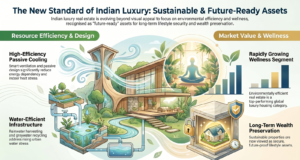
Historically, luxury real estate was often associated with scale, visual aesthetics, and premium locations.
Today, the definition of luxury is changing globally.
Increasingly, affluent buyers value:
Globally, green and wellness-oriented real estate sectors are witnessing significant growth.
According to the Global Wellness Institute, wellness real estate has become one of the fastest-growing segments within the luxury property market.
This trend is influencing Indian luxury housing as well.
Modern Sustainable Luxury Homes in India increasingly incorporate:
These features not only improve environmental performance but also enhance everyday comfort and long-term operational efficiency.
For investors, energy-efficient homes may offer:
As climate realities intensify, sustainability is increasingly moving from optional to essential.
Air pollution has become one of the most serious quality-of-life concerns in urban India.
Cities such as Delhi frequently rank among the world’s most polluted urban regions.
According to the World Health Organization (WHO) and IQAir Global Air Quality Reports, air quality continues to pose serious health challenges across several Indian metropolitan regions.
Pollution impacts:
As awareness grows, premium homebuyers increasingly seek living environments that support healthier lifestyles.
This has accelerated interest in:
Sustainable Luxury Homes in India are increasingly being designed to improve:
For many affluent buyers, environmental wellness is becoming a critical component of luxury living.
India’s water challenges are becoming increasingly serious.
Several urban centers have already experienced severe water shortages in recent years. According to the NITI Aayog Composite Water Management Index, multiple Indian cities remain vulnerable to groundwater depletion and water stress.
Water security is emerging as a major factor influencing future urban development.
Modern Sustainable Luxury Homes in India increasingly incorporate:
These systems help reduce long-term dependency on strained urban water networks while improving environmental resilience.
For long-term investors, resource-efficient developments may become increasingly valuable as environmental regulations and infrastructure pressures evolve.
The pandemic accelerated a global reassessment of housing priorities.
People increasingly began valuing:
This trend has continued even after economic normalization.
Globally, premium buyers are increasingly shifting toward:
India is witnessing similar trends.
Regions with:
are increasingly attracting affluent investors and second-home buyers.
This evolution is contributing to growing demand for Sustainable Luxury Homes in India that combine environmental intelligence with premium living experiences.
For high-net-worth individuals and long-term investors, real estate has historically served as both a lifestyle asset and a wealth preservation strategy.
However, climate change and environmental stress are reshaping the criteria that may define future asset performance.
Buildings that are energy inefficient, environmentally vulnerable, or operationally expensive may face increasing long-term disadvantages.
In contrast, Sustainable Luxury Homes in India may offer several strategic advantages:
Globally, ESG-focused investment frameworks are increasingly influencing institutional capital allocation.
According to Deloitte Sustainability Insights and JLL Global Sustainability Research, sustainability considerations are becoming increasingly important in real estate valuation and investment decisions.
As environmental regulations evolve and climate awareness grows, sustainability-oriented housing may increasingly command stronger long-term demand.
India is actively investing in sustainability and green infrastructure initiatives.
Government-led programs including the Smart Cities Mission aim to improve urban efficiency, sustainability, and infrastructure modernization.
Similarly, organizations such as the Bureau of Energy Efficiency and the Indian Green Building Council are promoting energy-efficient and environmentally responsible construction practices.
India’s renewable energy ambitions are also expanding rapidly.
The country has become one of the world’s largest renewable energy markets, with increasing emphasis on:
These developments are creating a supportive ecosystem for Sustainable Luxury Homes in India and future-ready real estate development.
The next generation of luxury real estate in India is increasingly being shaped by a different philosophy.
Luxury is no longer defined solely by:
Instead, modern affluent buyers increasingly associate luxury with:
This transformation reflects a broader global shift toward conscious living and responsible wealth stewardship.
Increasingly, premium buyers seek homes that enhance both:
This is why Sustainable Luxury Homes in India are becoming central to the future of premium housing.
India’s urban and environmental trajectory suggests that climate-conscious development will become increasingly important over the next two decades.
Several long-term trends are converging simultaneously:
As these forces intensify, future housing demand is expected to increasingly favor:
For investors, this is not simply a lifestyle trend.
It is a structural transformation.
Sustainable Luxury Homes in India represent the intersection of:
1. Why are Sustainable Luxury Homes in India becoming increasingly important?
Sustainable Luxury Homes in India are becoming increasingly important because rising temperatures, pollution, urban congestion, and growing energy consumption are reshaping urban living conditions. Modern affluent buyers now prioritize energy efficiency, wellness, climate resilience, and long-term sustainability alongside luxury and location.
2. How do Sustainable Luxury Homes in India help reduce energy consumption?
Sustainable Luxury Homes in India often incorporate passive cooling systems, thermal insulation, natural ventilation, solar energy integration, and smart energy management technologies. These features help reduce dependence on excessive air conditioning and lower long-term electricity consumption.
3. Are Sustainable Luxury Homes in India a good long-term investment?
Many investors increasingly view Sustainable Luxury Homes in India as future-ready assets because they align with evolving environmental regulations, wellness trends, and energy efficiency standards. Climate-conscious developments may also benefit from stronger long-term demand and operational resilience.
4. How does climate change affect the future of Indian real estate?
Climate change is influencing rising temperatures, water stress, flooding risks, and energy demand across Indian cities. As a result, future real estate demand may increasingly shift toward climate-resilient, environmentally efficient, and wellness-oriented housing ecosystems.
5. What features define Sustainable Luxury Homes in India?
Sustainable Luxury Homes in India typically include:
6. Why are HNIs and NRIs increasingly interested in Sustainable Luxury Homes in India?
HNIs and NRIs are increasingly attracted to Sustainable Luxury Homes in India because they combine premium living with environmental responsibility, wellness, long-term operational efficiency, and future-ready asset positioning. Many affluent buyers now seek homes that support both lifestyle enhancement and sustainable wealth preservation.
7. How do Sustainable Luxury Homes in India improve indoor wellness and comfort?
These homes are designed to improve air circulation, natural lighting, thermal comfort, and acoustic quality. Many sustainable developments also integrate biophilic design principles that strengthen the connection between indoor living and nature.
8. What role does water conservation play in Sustainable Luxury Homes in India?
Water conservation is becoming a critical part of Sustainable Luxury Homes in India due to growing urban water stress. Features like rainwater harvesting, greywater recycling, efficient irrigation systems, and water-efficient landscaping help improve long-term resource resilience.
9. How is the Indian government supporting sustainable housing and green infrastructure?
The Indian government is supporting sustainable development through initiatives such as the Smart Cities Mission, renewable energy expansion, energy efficiency programs, and green building promotion frameworks.
10. Why could Sustainable Luxury Homes in India become a necessity rather than a choice in the future?
As rising temperatures, pollution, urban density, and resource pressures continue to increase, Sustainable Luxury Homes in India may become essential for ensuring long-term comfort, energy efficiency, environmental resilience, and healthier living conditions. Future luxury living is expected to prioritize sustainability alongside sophistication.
India’s economic rise is creating immense opportunities across infrastructure, business, technology, and real estate.
But the country’s future will also be shaped by how effectively it responds to rising temperatures, urban stress, environmental degradation, and resource pressures.
The conversation around premium housing is therefore evolving rapidly.
Today, luxury increasingly means:
As cities become hotter and more resource-intensive, Sustainable Luxury Homes in India are emerging not merely as aspirational assets, but as practical, future-oriented solutions for modern living.
For HNIs, NRIs, policymakers, investors, entrepreneurs, and environmentally conscious homebuyers, the future of real estate may increasingly belong to developments that successfully balance luxury with sustainability, environmental intelligence, and long-term resilience.
Because in the coming decades, the most valuable homes may not simply be the most expensive ones — but the ones most prepared for the future.